The best heavy-duty floor jacks for trucks in 2026 span 3-ton to 22-ton capacities, matching axle loads from light pickups to commercial buses. You’ll find the 22 Ton Air Hydraulic Floor Jack delivers 47-inch maximum height with a 4.5-inch ram stroke, while the VEVOR 3 Ton Low Profile offers a 3.35-inch minimum clearance and dual parallel pump for seven-stroke full extension. Mid-range options like the 5 Ton Heavy Duty model provide 11,000-pound capacity with dual-piston systems and industrial welded steel construction. The guide ahead breaks down specifications, safety systems, and selection criteria to guarantee proper capacity margins and lifting range for your truck.
Quick Tips
- Heavy-duty truck jacks range from 3-ton (6,600 lb) for light trucks to 22-ton (44,000 lb) for heavy commercial vehicles.
- Dual-piston hydraulic systems reach full height in 5–7 strokes, significantly faster than single-piston models for efficient lifting.
- Low-profile designs (3.35–7.1 inch minimum height) access tight clearances under lowered or heavily loaded truck frames.
- Built-in safety valves prevent overloading; always use jack stands immediately after lifting—never exceed rated capacity.
- Extension adapters (10mm–100mm) and chrome-plated rams provide versatile height adjustments and corrosion resistance for demanding use.
| 22 Ton Air Hydraulic Floor Jack | 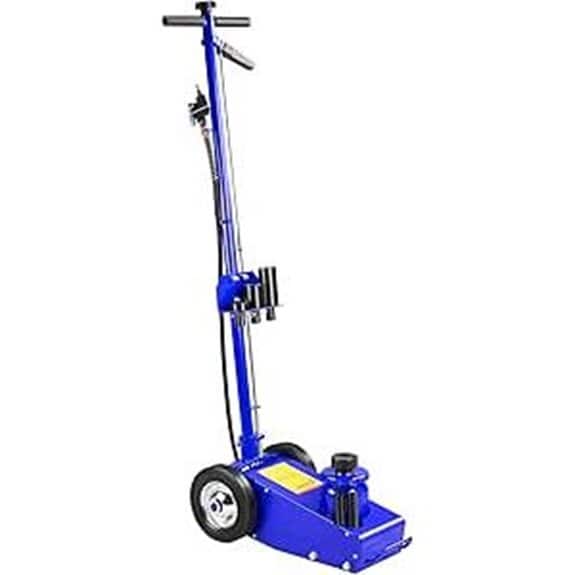 |
Best Overall | Load Capacity: 22 tons | Maximum Lift Height: 47 inches | Minimum Height: 9 inches | VIEW LATEST PRICE | Read Our Analysis |
| 5 Ton Heavy Duty Hydraulic Floor Jack | 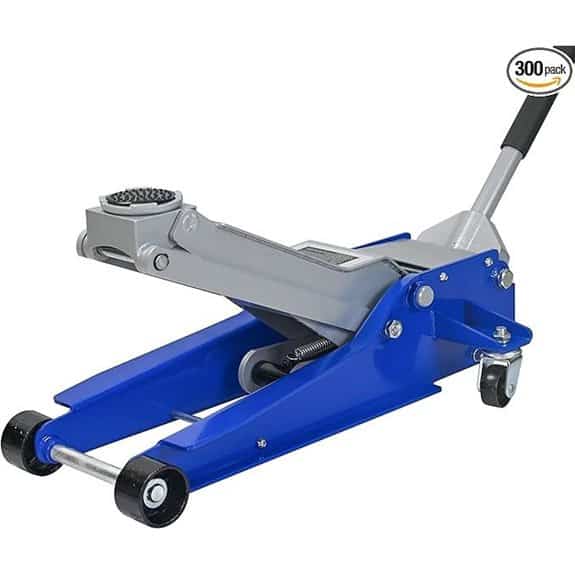 |
Best Value | Load Capacity: 5 tons (11,000 lbs) | Maximum Lift Height: 21.6 inches | Minimum Height: 3.5 inches | VIEW LATEST PRICE | Read Our Analysis |
| XtremepowerUS 22 Ton Hydraulic Floor Jack with Wheels | 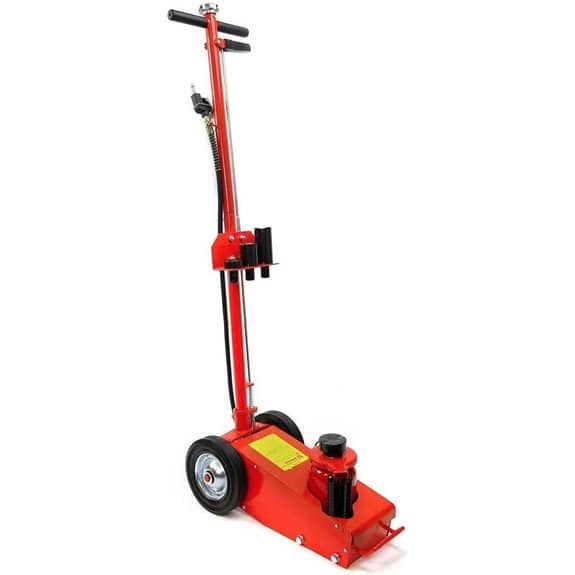 |
Heavy-Duty Pick | Load Capacity: 22 tons | Maximum Lift Height: Not specified | Minimum Height: Not specified | VIEW LATEST PRICE | Read Our Analysis |
| Hydraulic Forklift Jack 5 Ton Capacity Black | 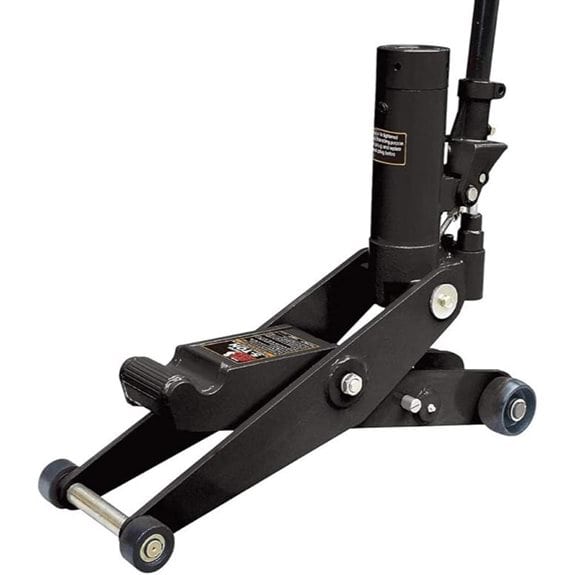 |
Most Versatile | Load Capacity: 5 tons (10,000 lbs) | Maximum Lift Height: 28.74 inches (dual-mode) | Minimum Height: 2.76 inches | VIEW LATEST PRICE | Read Our Analysis |
| 3 Ton Heavy Duty Hydraulic Floor Jack | 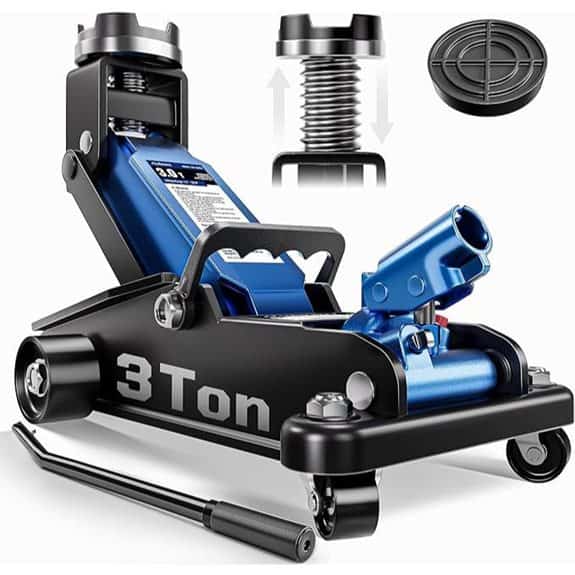 |
Budget-Friendly Option | Load Capacity: 3 tons (6,600 lbs) | Maximum Lift Height: 20.9 inches | Minimum Height: 7.1 inches | VIEW LATEST PRICE | Read Our Analysis |
| VEVOR 3 Ton Low Profile Racing Floor Jack | 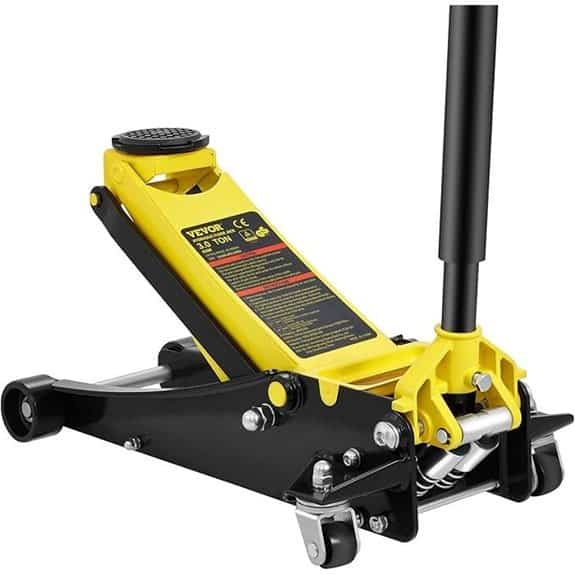 |
Most Popular | Load Capacity: 3 tons (6,600 lbs) | Maximum Lift Height: 19.69 inches | Minimum Height: 3.35 inches | VIEW LATEST PRICE | Read Our Analysis |
| 5-Ton Low Profile Hydraulic Floor Jack | 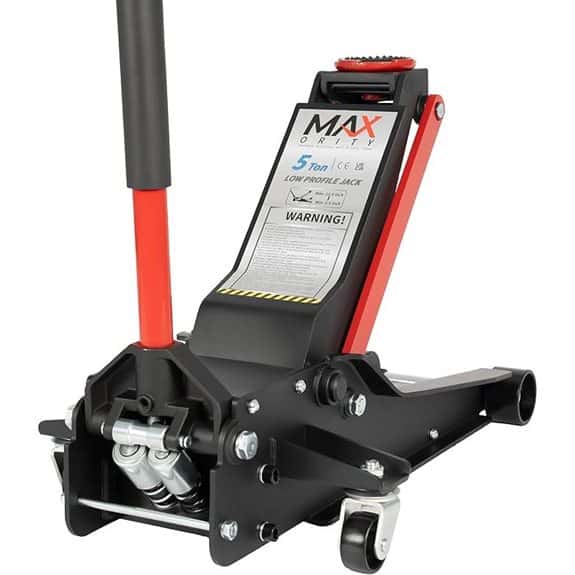 |
Professional Grade | Load Capacity: 5 tons (11,000 lbs) | Maximum Lift Height: 22 inches | Minimum Height: Low profile (specific height not stated) | VIEW LATEST PRICE | Read Our Analysis |
More Details on Our Top Picks
-
22 Ton Air Hydraulic Floor Jack
When you’re working with heavy-duty trucks, trailers, or buses in a professional shop environment, the 22 Ton Air Hydraulic Floor Jack from MOTOOS offers the lifting capacity and reach you’ll need for serious repair work. This Roadstar-manufactured unit lifts loads up to 22 tons with a maximum height of 47 inches, providing exceptional clearance for undercarriage access. The minimum saddle height starts at 9 inches, and the jack features a one-pull operation that activates its self-retracting ram with a 4-1/2 inch stroke. At 64.6 pounds, it’s equipped with 8-inch hard rubber tires for shop mobility and a 47-inch handle with integrated air controls. The adjustable handle locks between 90 and 180 degrees for operator comfort.
- Load Capacity:22 tons
- Maximum Lift Height:47 inches
- Minimum Height:9 inches
- Item Weight:64.6 pounds
- Construction Material:Steel with hard rubber tires
- Safety Features:Handle lock lever, adjustable angle 90–180°
- Additional Feature:Air-controlled lengthened handle
- Additional Feature:Self-retracting ram operation
- Additional Feature:Four saddle extension adapters
-
5 Ton Heavy Duty Hydraulic Floor Jack
The 5-ton hydraulic floor jack delivers 11,000 pounds of lifting capacity, making it the best choice for professional mechanics and serious DIY enthusiasts who regularly service heavy-duty pickups, commercial vehicles, and full-size SUVs. Its dual piston hydraulic system raises the saddle faster with each pump stroke, reducing time spent positioning vehicles. The extended lift range spans 3.5 to 21.6 inches, accommodating both low-profile sedans and tall trucks. Industrial-grade welded steel construction provides durability, while the wide base resists twisting under maximum loads. A built-in safety valve prevents overloading, and CE certification confirms compliance with international safety standards. This jack’s low-profile design accesses tight clearances efficiently.
- Load Capacity:5 tons (11,000 lbs)
- Maximum Lift Height:21.6 inches
- Minimum Height:3.5 inches
- Item Weight:Not specified
- Construction Material:Industrial-grade welded steel
- Safety Features:CE certified, built-in safety valve
- Additional Feature:Dual piston hydraulic system
- Additional Feature:CE certified
- Additional Feature:Wide base for stability
-
XtremepowerUS 22 Ton Hydraulic Floor Jack with Wheels
Professional mechanics and truck owners dealing with heavy-duty vehicles will find the XtremepowerUS 22 Ton Hydraulic Floor Jack stands out as a complete lifting solution that combines air-powered hydraulics with exceptional mobility. This commercial-grade jack features a chrome-plated ram and one-pull self-retracting system that simplifies operation through a single handle with lock lever. The 46-inch handle adjusts between 90 and 180 degrees, incorporating air controls for pneumatic assistance. Two 8-inch hard rubber tires provide shock absorption and skid resistance while rolling the 83-pound unit across shop floors. You’ll receive four extension adapters (10mm, 25mm, 60mm, 100mm) crafted from 45# heavy-duty steel, allowing precise height adjustments for various truck configurations and axle positions.
- Load Capacity:22 tons
- Maximum Lift Height:Not specified
- Minimum Height:Not specified
- Item Weight:83 pounds
- Construction Material:Commercial-grade heavy-duty steel
- Safety Features:Handle lock lever, adjustable angle 90–180°
- Additional Feature:Chrome-plated ram piston
- Additional Feature:Y-style polyurethane seal
- Additional Feature:Sprayed paint rust protection
-
Hydraulic Forklift Jack 5 Ton Capacity Black
HPDMC’s dual-position forklift jack delivers 5-ton lifting capacity through two distinct operating modes, making it the best choice for shops and technicians who service both heavy-duty forklifts and standard vehicles. In scissor lift mode, you’ll lift 4 tons from 2.76 to 17.32 inches—ideal for standard vehicle maintenance. Switch to post lift mode for the full 5-ton capacity, extending your reach from 16.53 to 28.74 inches to accommodate taller forklift chassis. The heavy-duty steel construction weighs 101 pounds and rolls on steel casters for positioning. You can use it on forklifts, trucks, SUVs, and tractors under 10,000 pounds for tire changes, brake service, and oil changes, though you must immediately support loads with jack stands.
- Load Capacity:5 tons (10,000 lbs)
- Maximum Lift Height:28.74 inches (dual-mode)
- Minimum Height:2.76 inches
- Item Weight:101 pounds
- Construction Material:Heavy-duty steel
- Safety Features:Lifting device only warning, requires jack stands
- Additional Feature:Dual-mode lifting system
- Additional Feature:Scissor and post modes
- Additional Feature:Forklift-specific design
-
3 Ton Heavy Duty Hydraulic Floor Jack
Heavy-duty truck owners who need reliable lifting power without breaking the bank will find the AUTOWN 3 Ton Floor Jack (Model JAC-203BL) strikes an ideal balance between performance and value. This blue hydraulic jack hoists up to 6,600 pounds, with a lifting range spanning 7.1 to 20.9 inches. Its quick-lift hydraulic system reduces the pumping required to reach working height, while the precision release valve guarantees controlled lowering. Constructed from carbon steel and weighing 36.4 pounds, it features smooth-rolling casters for easy positioning and a reinforced rubber saddle that protects your vehicle’s frame from scratches. The quick-connect two-piece handle assembles instantly and stores compactly, though you’ll want to verify clearance compatibility with low-profile sedans before purchase.
- Load Capacity:3 tons (6,600 lbs)
- Maximum Lift Height:20.9 inches
- Minimum Height:7.1 inches
- Item Weight:36.4 pounds
- Construction Material:Robust carbon steel
- Safety Features:Precision hydraulic release valve, reinforced rubber saddle
- Additional Feature:Quick-connect two-piece handle
- Additional Feature:Reinforced rubber saddle
- Additional Feature:Low-profile higher-clearance design
-
VEVOR 3 Ton Low Profile Racing Floor Jack
Lifting massive trucks and SUVs demands equipment that won't buckle under pressure, and the Majority 5-Ton Low Profile Hydraulic Floor Jack delivers exactly that capability with its 11,000-pound capacity. You'll appreciate the dual-piston hydraulic system, which reduces the number of pumps needed to reach the maximum 22-inch lifting height. The low-profile design slides easily beneath vehicles with minimal ground clearance, while the extra-long handle provides leverage that minimizes physical strain during operation. Heavy-duty steel construction guarantees longevity in professional environments, and the rubber-padded saddle protects your vehicle's undercarriage from scratches and damage. A built-in safety valve prevents dangerous overloading situations, making this 100-pound jack a reliable choice for heavy automotive work.
- Load Capacity:5 tons (11,000 lbs)
- Maximum Lift Height:22 inches
- Minimum Height:Low profile (specific height not stated)
- Item Weight:100 pounds
- Construction Material:Heavy-duty high-strength steel
- Safety Features:Built-in safety valve, anti-slip rubber saddle
- Additional Feature:Extra-long ergonomic handle
- Additional Feature:Anti-slip rubber padding
- Additional Feature:Quick-lift dual-piston pump
Factors to Consider When Choosing Heavy-Duty Floor Jacks for Trucks
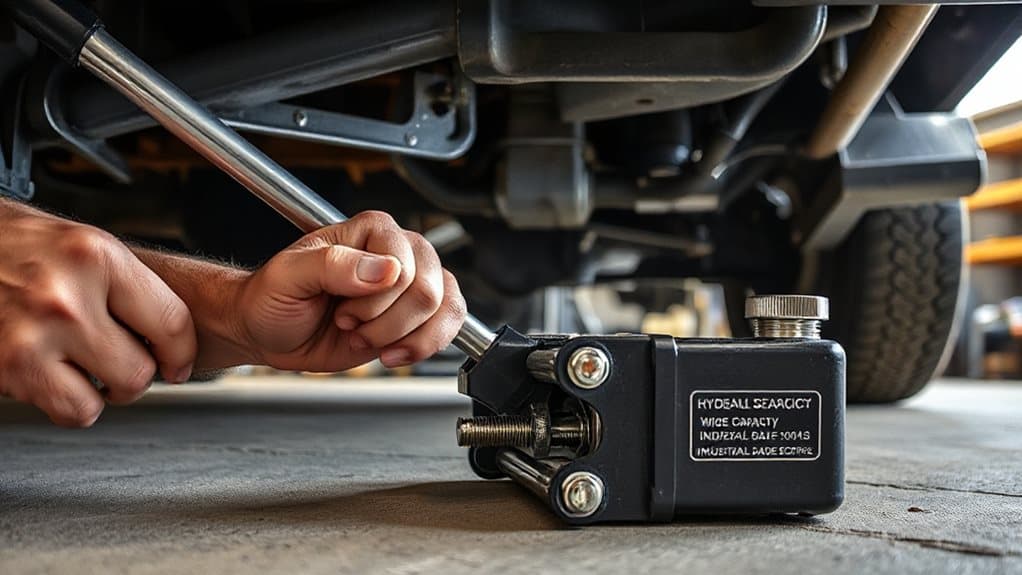
When you're selecting a heavy-duty floor jack for your truck, you'll need to evaluate several critical specifications to guarantee safe and effective operation. The jack's weight capacity must exceed your vehicle's gross weight, while the lifting height range should accommodate both your truck's ground clearance and the elevation needed for maintenance tasks. Additionally, you should examine the construction material quality, determine whether a dual piston system is necessary for your applications, and assess if a low profile design is required to fit beneath your truck's frame.
Weight Capacity Requirements
Selecting a floor jack with inadequate weight capacity ranks among the most dangerous mistakes truck owners make, since the consequences range from equipment failure to catastrophic vehicle drops and severe injury. You'll need to match the jack's rated capacity to your truck's gross vehicle weight (GVW), focusing specifically on the heaviest axle load. A 5-ton jack handles 11,000 pounds, while a 22-ton model supports 44,000 pounds. Apply a safety margin by choosing capacity 25–50% higher than your expected lift weight, accounting for uneven loading and fluctuating forces. Consider lifting height alongside capacity, as some high-capacity jacks feature limited stroke. Verify the duty rating—professional-grade construction withstands repeated heavy loads. Never exceed the nominal capacity, and confirm the rating matches your intended lift mode.
Lifting Height Range
Beyond raw lifting power, the vertical travel range of your floor jack determines whether you'll actually reach your truck's frame rails and achieve adequate working clearance beneath the chassis. Start by measuring your truck's lowest lift point: heavy-duty jacks typically feature minimum saddle heights between 3–9 inches, so confirm clearance before purchasing. Next, verify the maximum lifting height—commonly 17–47 inches—ensures you'll reach the frame under load and provides room for jack stands. The stroke, or ram travel distance, matters too; larger strokes reduce your need for adapter extensions. Speaking of adapters, check which saddle extensions come included, since they add critical inches to match different frame geometries. Match your jack's range to your specific service tasks, whether tire changes or underbody repairs.
Construction Material Quality
A floor jack's lifting range means little if the unit bends, cracks, or leaks after a few months of shop use. Look for heavy-gauge, industrial-grade steel construction—thicker stamped or welded frames deliver superior torsional rigidity and resist bending under truck-weight loads. Check that rams and pistons feature chrome plating or hardened steel with quality seals, such as polyurethane or nitrile with backup rings, to prevent leaks and guarantee smooth operation over time. Prefer welded chassis and reinforced lifting arms with gussets or boxed sections instead of thin, stamped components. Inspect wheel and axle materials; steel axles paired with large-diameter, durable wheels distribute weight effectively on uneven floors. Finally, verify corrosion protection through powder coating or rust-resistant plating, since surface corrosion accelerates fatigue and compromises structural integrity.
Dual Piston System
Heavy-duty truck jacks equipped with dual-piston hydraulic systems dramatically reduce the time and effort required to lift multi-ton loads to working height. This design uses two pistons working in sequence: the first delivers rapid initial lift, while the second handles higher loads through the remaining travel range. You'll reach maximum height in just 5–7 full handle strokes, compared to single-piston models requiring markedly more pumping. The dual-stage arrangement provides both low minimum profile for clearance-challenged vehicles and tall maximum lift for larger trucks. However, these systems demand quality seals and valves to prevent internal leakage between hydraulic stages. Look for models with calibrated controlled-release valves for predictable descent and built-in overload protection to prevent overpressurization during heavy-load operations.
Low Profile Design
While dual-piston systems accelerate the lifting process, they won't help if your jack can't slide beneath the truck in the first place. Low-profile jacks feature minimum saddle heights under 4 inches—often around 3 to 3.5 inches—allowing clearance beneath lowered trucks and trailers. Measure your vehicle's lowest lift point first, then select a jack with a minimum height below that dimension. Despite their compact profile, these jacks must still reach maximum heights of 17 to 47 inches for truck service needs. Look for welded steel frames and reinforced saddles that maintain rated capacity without sacrificing strength. Long handles, dual-piston pumps, and low-profile wheels enable easier positioning and faster stroke from a very low starting point, ensuring both access and performance.
Wheel Size and Mobility
Maneuvering a 100-pound floor jack across your workspace becomes exponentially easier when it's equipped with the right wheels. Look for diameters between 6 and 8 inches, which roll smoothly over cracks, cables, and gravel while requiring less effort than smaller alternatives. Hard rubber or polyurethane tires outperform thin metal wheels by resisting deformation under heavy loads and absorbing shocks during transport. A wider wheelbase with dual casters or large rear swivel wheels enhances lateral stability and improves steering control when you're positioning the jack beneath a lifted truck. Low-profile models typically feature smaller, flatter wheels that sacrifice some mobility for improved access in tight clearances. Finally, check whether wheels are fixed or swivel-mounted, and verify that locking pins or brakes are included to prevent unwanted movement during positioning and initial lift.
Safety Valve Features
Once you've positioned your jack beneath the truck using those carefully chosen wheels, the internal safety valve becomes your last line of defense against dangerous overload conditions. This built-in mechanism prevents the jack from exceeding its rated capacity, protecting both the hydraulic system and your safety by stopping catastrophic failure. Look for valves calibrated to engage just above maximum load—typically within a small percentage—so they trip before overpressurization damages components. The valve should feature corrosion-resistant materials and proper sealing to maintain reliability in humid garage environments. Regular inspection and functional testing remain essential, since debris, wear, or contaminated hydraulic fluid can compromise the valve's protective capabilities. Select jacks offering easy access to safety valve components or clear manufacturer guidance for replacement and service, ensuring you can maintain long-term safety compliance throughout the jack's operational life.
Handle Length and Ergonomics
Pumping up a three-ton truck demands more than raw strength—it requires mechanical advantage through proper handle design. Look for handles between 40 and 52 inches long, which reduce the force and pump count needed for heavy lifts. An ergonomic, padded grip with a 40–50 mm diameter minimizes hand fatigue during extended use and improves control when positioning the jack. Adjustable or folding handles that lock between 90° and 180° provide better access in cramped spaces beneath trucks while simplifying storage. Integrated air controls or quick-release features speed operation when lifting high-capacity loads. Make sure the handle mounts securely with sturdy locking mechanisms and corrosion-resistant finishes—wobble or failure under side loads compromises both safety and durability. Proper ergonomics convert exhausting manual work into manageable mechanical tasks.
Frequently Asked Questions
How Often Should I Inspect My Heavy-Duty Floor Jack for Safety?
You should inspect your heavy-duty floor jack before each use, checking for hydraulic leaks, damaged parts, and proper operation. Additionally, perform a thorough maintenance inspection every six months to verify it's safe and functioning correctly.
Can Floor Jacks Be Used on Uneven or Sloped Surfaces Safely?
No, you shouldn't use floor jacks on uneven or sloped surfaces. They'll become unstable and create serious safety hazards. Always position your jack on level, solid ground to prevent the vehicle from shifting or falling unexpectedly.
What's the Average Lifespan of a Heavy-Duty Hydraulic Floor Jack?
You'll get 5-10 years from a quality heavy-duty hydraulic floor jack with proper maintenance. If you're using it frequently in professional settings, expect closer to 5 years. Regular fluid changes and care extend longevity considerably.
Do I Need Jack Stands When Using a Floor Jack on Trucks?
Yes, you absolutely need jack stands when working under your truck. Floor jacks can fail or leak hydraulic fluid, causing the vehicle to drop. Never rely solely on a floor jack for safety—always use jack stands.
How Do I Properly Maintain and Store My Floor Jack Long-Term?
You'll need to regularly lubricate moving parts, check hydraulic fluid levels, and store it in a dry location. Always release pressure when not in use, keep it clean, and periodically inspect seals for leaks or damage.
Wrapping Up
You've now reviewed seven heavy-duty floor jacks designed for truck lifting, ranging from 3-ton to 22-ton capacities. Each option offers distinct features—whether it's air hydraulic power, low-profile design, or wheeled portability. Before purchasing, you'll need to assess your truck's weight, clearance requirements, and lifting frequency. Match the jack's capacity to your specific needs, ensuring it exceeds your vehicle's weight by at least 20%. This precaution guarantees safe, effective lifting for maintenance and repairs.