
To adjust your Edelbrock electric choke, you’ll first loosen the cap’s retaining screws and rotate it until the choke valve closes just barely, then align the tick mark with the leanest notch on the housing as your baseline. If your engine stumbles when cold, you’ve got a too-lean condition—enrichen it by restricting the choke plate opening in small 1/32″ increments by bending the choke rod. Test your adjustments with a cold start, watching for smooth idle and gradual choke opening as the thermostatic coil heats up. The sections below break down each component and fine-tuning step in greater detail.
Quick Tips
- Verify plunger moves freely, ground wire is secure, and choke wire voltage source functions before making adjustments.
- Loosen retaining screws, rotate cap until choke barely closes, then align tick mark with leanest notch baseline.
- Engine stumbling when cold indicates too-lean; bend choke rod in 1/32″ increments to restrict plate opening.
- Test cold start for ready ignition and stable idle, observing gradual choke plate opening during warm-up.
- Choke should progressively open over several minutes to near full-open at operating temperature without hesitation.
Understanding Your Electric Choke System Components

Before you can properly adjust your Edelbrock electric choke, you’ll need to understand the five main components that work together to control your engine’s air-fuel mixture during cold starts.
The main body houses everything and mounts to your carburetor.
Inside, you’ll find the thermostatic coil, which expands with heat to open the choke plate through connecting linkage rods, while the adjustable cap controls timing and houses electrical terminals. Additionally, understanding spray paint drips can help you make precise adjustments without compromising other engine components.
Pre-Adjustment Inspection and Setup Requirements
Before you begin any choke adjustment procedure, you’ll need to confirm that the plunger system is securely mounted to the carburetor housing without any loose fasteners or misalignment that could compromise its operation.
The plunger, which extends and retracts based on heating coil temperature, must move freely within its cylinder bore—any binding or restriction will prevent proper choke valve control throughout the engine’s warm-up cycle. Additionally, it’s crucial to ensure that any neutral safety switch related wiring is intact and functioning to avoid starting issues.
Additionally, inspect the ground wire connection, ensuring it maintains firm contact with a clean metal surface on the carburetor body or engine block, because inadequate grounding creates electrical resistance that reduces heating efficiency and 延长s choke engagement time beyond normal parameters. Verify that your choke wire voltage source is functioning correctly, as electrical supply issues can prevent the heating element from reaching the temperature needed to open the choke valve properly.
Verify Plunger System Security
Following the initial installation of your Edelbrock electric choke, verifying the plunger system’s security becomes the critical first inspection step that prevents erratic choke operation and guarantees consistent engine starting performance.
Inspect the plunger assembly for excessive play by gently moving it laterally; any looseness indicates mounting screws require tightening. Confirm the plunger moves smoothly up and down without binding, and verify its dimple engages properly in the corresponding positioning hole. This electric choke conversion includes all necessary parts designed specifically for Edelbrock Performer carburetors #1404, #1405, #1407, and #1412.
Check Ground Wire Tension
After confirming the plunger assembly operates without binding or excessive play, your attention must shift to the electrical grounding system that powers the choke’s heating element.
Inspect the black ground wire for damage, fraying, or corrosion, ensuring the eyelet end sits securely under the choke cap retainer screw and the clip terminal attaches firmly to the negative spade on the choke housing without excessive slack or tension.
Setting the Choke Cap Position

Once you’ve located the choke cap on your Edelbrock carburetor, you’ll need to loosen the retaining screws or ring that secure it to the choke housing. This allows the cap to rotate freely.
Turn it until the choke valve opens completely, then rotate back slightly so it’s just barely closed. Align the tick mark with the leanest notch on the housing as your baseline starting position. Regular maintenance, including cleaning fuel injectors, ensures optimal engine performance and can prevent potential issues with your carburetor system.
Adjusting for Lean and Rich Fuel Mixture
With the choke cap properly positioned, you’ll need to fine-tune how the choke opens during cold starts to achieve the right fuel mixture. If your engine stumbles or dies when cold, it’s likely running too lean—the choke is opening too quickly. Adjust the choke rod by bending it in 1/32″ increments: restricting choke plate opening enriches the mixture, while opening it more creates a leaner condition. This adjustment is crucial for achieving optimal fuel delivery and ensuring smooth engine operation during cold starts.
Cold Start Operation and Fast Idle Configuration
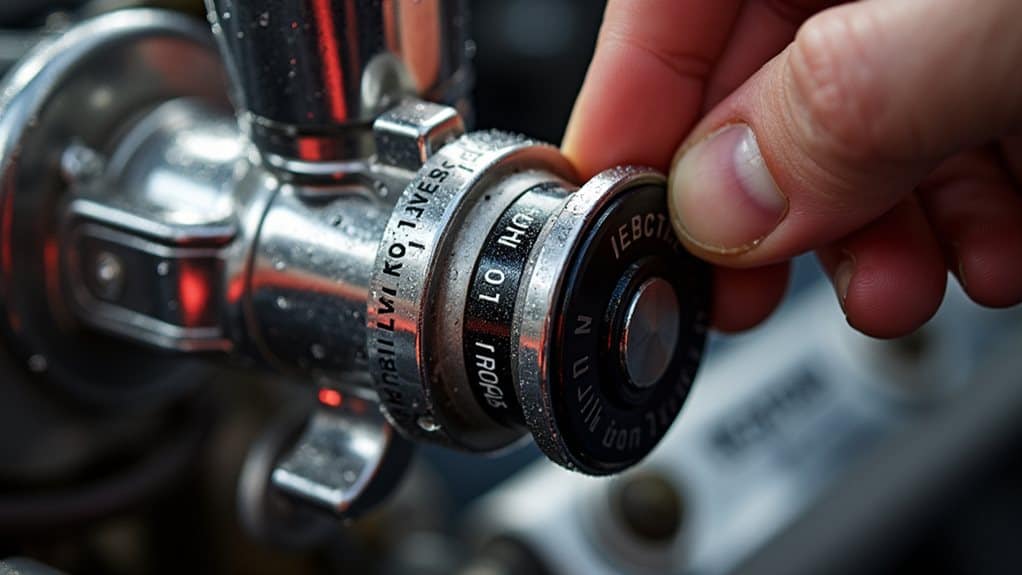
Understanding how your Edelbrock electric choke operates during cold starts will help you diagnose problems and maintain smooth engine performance.
The choke plate closes fully before startup, then opens approximately 1/8 inch immediately after ignition to prevent over-choking. As the electric heating element warms the choke coil, the plate gradually opens.
Meanwhile, the fast idle mechanism holds your throttle slightly open, raising idle speed until the engine reaches operating temperature.
Testing and Verifying Proper Choke Function
Testing your Edelbrock electric choke requires systematic observation of three critical performance phases: cold start behavior, warm-up progression, and throttle response during operation.
You’ll need to monitor how the choke plate positions itself when the engine is completely cold, track its gradual opening as the heating element activates, and verify that the carburetor delivers smooth acceleration without hesitation or stumbling.
This verification process confirms whether your choke adjustment settings are properly calibrated or if additional fine-tuning is necessary to achieve peak engine performance.
Cold Start Performance Check
After completing the initial installation and adjustment of your Edelbrock electric choke, you’ll need to verify that the system operates correctly under actual cold-start conditions.
Allow your engine to cool completely, then attempt starting with minimal throttle input. Your vehicle should start readily and maintain stable idle. Below 20 degrees Fahrenheit provides ideal testing conditions, confirming proper choke engagement and fuel-to-air ratio calibration.
Warm-Up Operation Monitoring
Once your engine starts successfully in cold conditions, the next step involves watching how the electric choke behaves during the warm-up phase.
Observe the choke lever gradually moving as the bi-metallic spring heats and expands.
The choke plate should progressively open over several minutes, reaching nearly full-open position when the engine warms.
Consistent timing across multiple starts indicates reliable function, while delayed or rapid opening suggests adjustment problems.
Throttle Response Verification
With the engine now warming properly, you’ll need to verify that the choke system delivers smooth throttle response throughout the entire warm-up cycle. Lightly blip the throttle and observe for hesitation or stumbling.
The engine should accelerate cleanly without stuttering. If you notice rough shifts, the choke may be opening too quickly or slowly, requiring coil adjustment to match your engine’s warm-up characteristics.
Wrapping Up
You’ve now learned the critical steps for adjusting your Edelbrock electric choke, from inspecting components to fine-tuning the cap position and verifying cold-start performance. Remember, proper adjustment guarantees your carburetor delivers the right fuel mixture during warm-up, preventing rough idling and stalling. If you’re still experiencing issues after following these procedures, you’ll need to check for vacuum leaks or electrical problems. Regular maintenance keeps your choke system functioning reliably throughout changing weather conditions.


