
You’ll find three main types of fiberglass dune buggy bodies: sand rails with minimal panels weighing 800–1,500 pounds for desert flotation, trail buggies featuring reinforced shells and enhanced suspension mounts to handle rocky terrain, and beach buggies offering enclosed hand-laid fiberglass with UV-resistant gel coats for coastal use. The iconic Meyers Manx pioneered monocoque construction by mounting fiberglass bodies onto shortened VW Beetle chassis, while variants like the Deserter models introduced mid-engine configurations for improved weight distribution. Each design matches specific terrain demands, and understanding their structural differences will help you select the best body for your intended environment.
Quick Tips
- Sand rail bodies feature minimal panels and tubular frames weighing 800-1,500 pounds, designed for desert flotation and high-speed stability.
- Trail buggy bodies use reinforced fiberglass shells with enclosed panels and enhanced suspension mounts for rocky terrain and brush protection.
- Beach buggy bodies employ hand-laid fiberglass with UV-resistant gel coat, offering retro styling for coastal cruising and dune performance.
- Meyers Manx introduced monocoque fiberglass construction with steel reinforcement, mounted on shortened Volkswagen Beetle chassis for affordable off-roading.
- Modern fiberglass shells use advanced composites and CNC-machined molds, providing lighter weight, superior UV resistance, and improved dimensional accuracy.
Sand Rail Bodies: Built for Speed and Minimal Weight
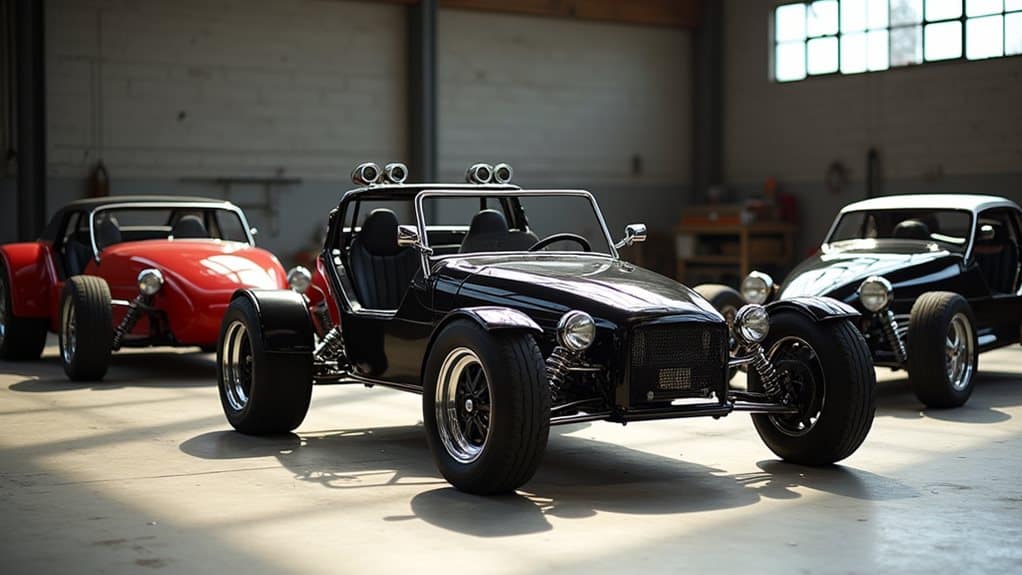
Sand rail bodies strip away everything that doesn’t contribute to pure performance, creating vehicles that prioritize speed and agility over comfort or protection.
You’ll find minimal body panels, windows, and fenders compared to traditional dune buggies.
This lightweight construction, tipping the scales between 800 to 1,500 pounds, allows your vehicle to float across sand surfaces without sinking, while the tubular space frame with integrated roll cage provides essential structural integrity. Many enthusiasts appreciate this design as it mirrors the dependability and maintenance of classic vehicles like OBS trucks.
Wheelbase options for sandrails range from 90″ to 115″, with longer wheelbases increasing stability at high speeds.
Trail Buggy Bodies: Engineered for Rugged Terrain
Trail buggy bodies differ markedly from sand rails because you’ll need far more protection and durability when negotiating rocky trails, dense brush, and unpredictable terrain.
These fiberglass shells feature reinforced construction with integrated strengthening tubes running front to back under each side, and they’re designed with enclosed body panels that shield both you and critical mechanical components from debris impacts. Proper grounding is essential for engine performance as it prevents electrical failures during intense off-road conditions.
The chassis beneath incorporates enhanced suspension mounting points for longer-travel shocks and independent suspension systems, while the body itself often includes a built-in roll cage structure—all working together to handle the severe stresses of off-road trail riding. Modern designs may utilize 0.7mm polycarbonate construction split into multiple sections to achieve complex shapes while maintaining durability.
Reinforced Construction and Protection
When you’re building a dune buggy for off-road trails, the fiberglass body needs far more than basic construction—it requires strategic reinforcement to withstand the punishment of rocks, roots, and rough terrain.
Manufacturers layer thicker gel-coated surfaces with high-strength resins and chopped strand mat in high-impact zones like bumpers and rocker panels. Internal fiberglass ribs increase rigidity, while pre-drilled mounting points accommodate aftermarket protection accessories and reinforced roll cage integration points.
Enhanced Suspension System Design
Off-road enthusiasts quickly find that a fiberglass dune buggy body’s performance depends heavily on the suspension system engineered beneath it.
Trail buggies require minimum 4″ up and down travel to absorb terrain impacts effectively.
Double A-arm independent suspension geometries allow wheels to move independently over obstacles, maintaining traction.
Gas-charged shocks with bypass designs manage heat dissipation better than oil-based alternatives, while air bump stops control compression without harsh impacts.
Enclosed Body Panel Features
Protection distinguishes enclosed trail buggy bodies from their minimalist sand rail counterparts, as these reinforced fiberglass shells shield occupants from the unrelenting barrage of rocks, branches, and debris encountered during off-road excursions.
You’ll find gel-coated panels providing weather resistance while maintaining lightweight agility. The removable panel mounting system allows quick replacement after damage, and the enclosed design reduces dust infiltration while maintaining comfortable cabin temperatures during extended trail routing.
Beach Buggy Bodies: Coastal Cruising in Style
Beach buggy bodies capture the essence of coastal freedom, blending lightweight fiberglass construction with retro styling that recalls the golden age of surf culture.
You’ll find hand-laid 7.5 oz fiberglass shells featuring satin gel coat finishes that resist UV damage and salt spray.
Classic models like the Nostalgia emphasize 1960s lines, while four-seater variants accommodate group outings.
Integrated strengthening tubes provide structural integrity for dune terrain. Additionally, the use of lightweight fiberglass construction enhances performance and durability, making these buggies ideal for rugged beach environments.
The Meyers Manx: Pioneer of Fiberglass Dune Buggies
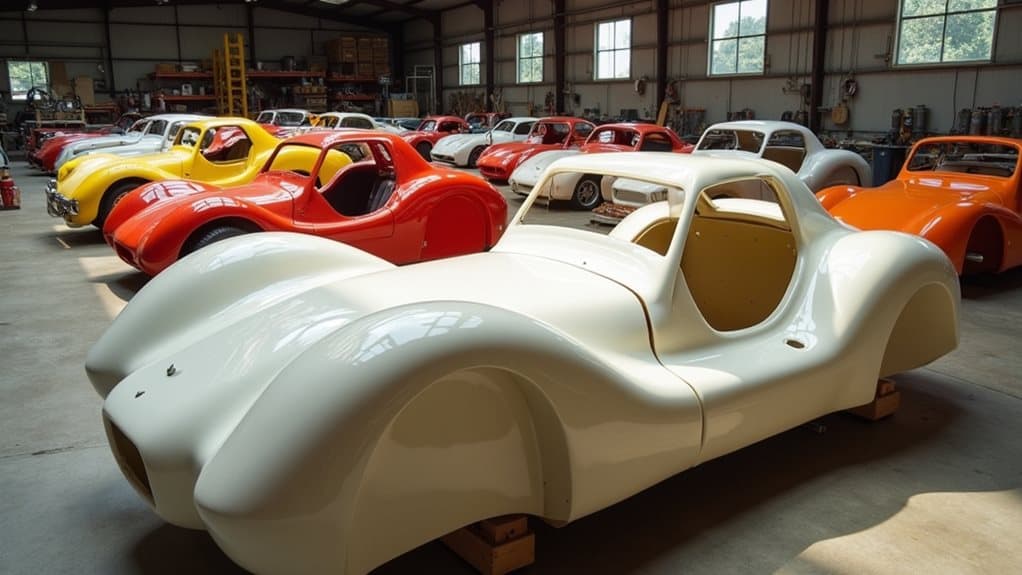
Bruce Meyers revolutionized off-road vehicle construction between 1963 and 1964 by developing a monocoque fiberglass body with embedded steel reinforcement, which created a lightweight yet durable structure for dune buggy applications. You’ll find that this innovative approach contrasted sharply with traditional metal fabrication methods, as the fiberglass construction reduced weight while maintaining the structural integrity needed for harsh off-road conditions. The key to the Meyers Manx’s success lay in bolting this advanced fiberglass body directly onto a shortened Volkswagen Beetle chassis, which provided readily available mechanical components, affordability, and proven reliability for enthusiasts seeking to build their own off-road machines. Additionally, the use of engine hoists to assist in assembly showcases the importance of proper lifting equipment in constructing these modified vehicles.
Revolutionary Fiberglass Construction Methods
When the automotive world met fiberglass technology in the early 1960s, an engineer named Bruce Meyers recognized an opportunity that would revolution recreational vehicle design forever.
He applied boat-building techniques to create a lightweight fiberglass body shell that mounted directly onto a Volkswagen Beetle chassis. This innovative approach combined a monocoque fiberglass structure with embedded steel reinforcements, achieving exceptional strength while maintaining minimal weight.
Volkswagen Beetle Platform Integration
By adapting the Volkswagen Beetle’s proven mechanical platform, the Meyers Manx converted an economy car into a capable off-road machine through ingenious engineering integration.
You’d shorten the Beetle chassis by approximately 14 inches, then mount the fiberglass body over the rear-engine, rear-wheel-drive layout.
The kit retained VW’s flat-four engine, trailing-arm suspension, transmission, and pedal assemblies while eliminating original steel bodywork, creating an affordable recreation vehicle.
Deserter Models: Versatile Designs From S1 to GT
Dearborn Automotive’s Deserter line evolved through three distinct configurations, each designed to address different performance priorities and builder preferences.
The S1 model employed a shortened Volkswagen Beetle chassis with traditional rear-engine placement, producing 802 units.
In 1969, the GT variant introduced an 84-inch wheelbase for improved stability, reaching 410 units through 1972.
The innovative GS configuration featured mid-engine mounting with tubular steel construction, achieving nearly 50/50 weight distribution across approximately 138 examples.
Custom Fiberglass Body Shells: Modern Manufacturing Techniques

Although fiberglass technology has existed since the 1940s, modern manufacturing techniques have revolutionized how custom dune buggy body shells are produced, combining traditional hand lay-up methods with advanced materials and precision tooling.
You’ll find manufacturers now use CNC-machined molds, chopper guns for efficient resin application, and advanced composite resins like epoxy or urethane. These innovations deliver stronger, lighter shells with superior UV resistance and dimensional accuracy compared to earlier production methods.
Choosing the Right Fiberglass Body for Your Build
When you’re ready to select a fiberglass body for your dune buggy project, you’ll need to match the body style to your intended use, terrain, and budget.
Sand rail bodies excel in desert environments, while trail buggies handle rocky terrain better.
Standard fiberglass shells cost $3,000 to $4,500, with custom finishes adding $500 to $1,000.
Verify your chosen body fits your chassis wheelbase before purchasing.
Wrapping Up
You’ve now examined the major fiberglass dune buggy body types, from lightweight sand rails to versatile Deserter models. Each design serves specific purposes, whether you’re racing across dunes, steering rocky trails, or cruising beaches. When selecting your body, consider your intended terrain, weight requirements, and structural needs. Modern manufacturing techniques have made these shells more accessible and durable than ever. Match your choice to your driving style, and you’ll build a buggy that performs exactly as intended.


