
Disconnecting the battery erases the ECU’s volatile memory—temporary fuel‑trim values, short‑term sensor data, and stored fault snapshots—while all non‑volatile data such as calibration maps, mileage, security settings, and aftermarket tunes stay intact. You need to leave the battery disconnected for at least 15 minutes, preferably 30 minutes, to fully discharge capacitors and clear those temporary logs. After reconnection the ECU relearns idle speed and fuel trims during normal driving, and the check‑engine light will stay off if the relearn succeeds. Continue for and you’ll discover the exact timing and steps for different vehicle makes.
Quick Tips
- Disconnecting the battery clears only volatile ECU data (temporary trims, short‑term driving info, freeze‑frame, and pending DTCs).
- Non‑volatile memory—permanent DTCs, mileage, clock, security settings, and stored calibrations—remains unchanged.
- A full power‑down requires at least 15 minutes (often 30 minutes to an hour) to discharge capacitors and ensure all modules lose power.
- After reconnection, the ECU must relearn idle speed, fuel trims, and ignition timing; normal driving for 10 minutes–1 hour typically completes this.
- Persistent codes and calibration data cannot be reset by battery removal alone; they require a scan tool or reprogramming to modify.
Does a Battery Disconnect Fully Reset the ECU? – Quick Answer
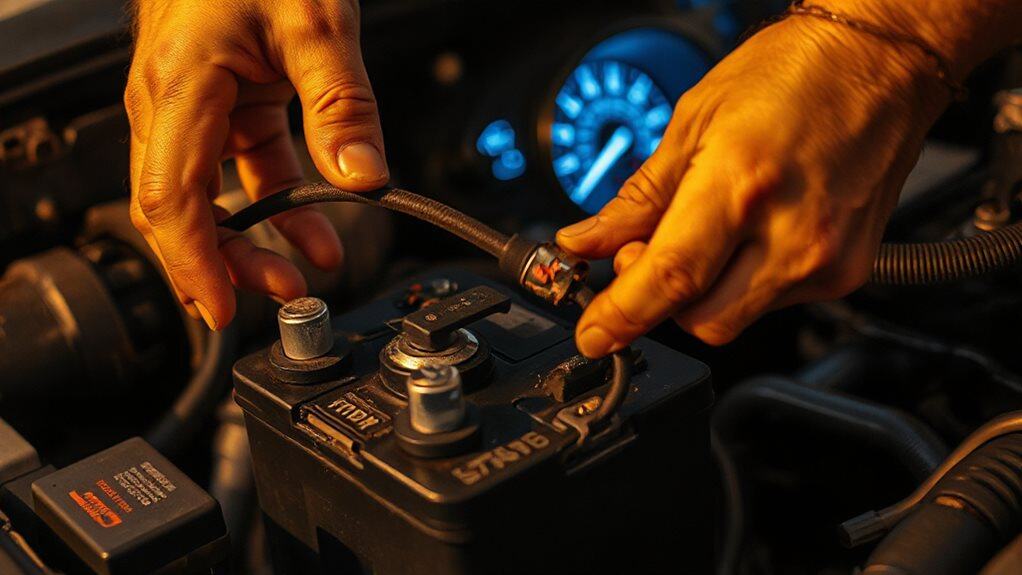
Does a battery disconnect fully reset the ECU? Not completely. You’ll erase volatile memory—temporary fuel trims, idle settings, and trouble codes—so the engine must relearn those values. However, non‑volatile maps, flash programming, and custom tuning stay intact. A 20‑minute disconnect fully drains residual power, but even a 5‑minute gap often clears the short‑term data you need. The ECU also sensor inputs to continuously adjust performance. To be safe, plan for a brief relearning period and check fuel economy after reconnecting to confirm normal operation.
Which Parts of the ECU’s Memory Get Cleared During a Hard Reset?
What actually disappears when you perform a hard reset on the ECU is any data that lives in volatile memory—those sections that need constant power to stay intact. You lose adaptive fuel trims, short‑term driving habit data, temporary diagnostic trouble codes, and freeze‑frame information.
Capacitor‑held data drains in minutes, while non‑volatile calibrations, permanent DTCs, mileage, clock, and security settings remain untouched. Designers also account for vehicle structural rigidity when placing ECU modules to protect them in collisions and reduce the risk of damage that could corrupt memory.
How Long Should You Leave the Battery Disconnected for a Full Battery‑Disconnect Reset?

You’ll want to keep the battery disconnected for at least 15 minutes to let the ECU’s capacitors fully discharge, which clears most minor glitches.
If you’re dealing with persistent electronic problems or a more complex vehicle, extending the cut‑off to 30 minutes or even an hour can guarantee every control module loses power and resets completely.
Remember that some makes—like Honda or Toyota—often need the longer interval, while German brands such as BMW and Mercedes usually reset with the shorter time.
Optimal Disconnection Time
Typically, you’ll need to leave the battery disconnected for at least fifteen minutes to guarantee that the residual charge stored in the ECU’s capacitors fully drains. Fifteen minutes clears basic memory, but thirty minutes ensures all sensors and modules lose power, reducing error‑code persistence. For stubborn faults, extending to one hour guarantees complete discharge, though most drivers find thirty minutes sufficient for a thorough reset.
Impact of Vehicle Model
How long you need to keep the battery disconnected depends heavily on the vehicle’s make and model, because each platform houses a different number of electronic control units (ECUs) and auxiliary modules that store residual charge. Modern cars often need 30 minutes, using headlights or bridging to drain capacitors; older models may reset after 15 minutes. BMWs typically require both post isolation and a 30‑second connector short to fully discharge.
What Happens to Stored Trouble Codes After Battery Removal?
When you disconnect the battery, most stored trouble codes—those that the ECU has logged but not yet classified as permanent—are erased because the loss of power de-energizes the memory chips that hold them.
Stored DTCs clear, pending codes disappear, and only permanent codes persist.
After reconnection, the ECU may re‑log codes if the original fault remains, so a scan tool often verifies the clean state.
Regular maintenance, such as replacing a clogged cabin air filter, can prevent faults that might trigger HVAC-related codes.
How Does the ECU Relearn Fuel Trims and Idle Settings After Reconnection?

After the battery’s reconnected and the engine starts, the ECU immediately begins to relearn the idle speed and fuel‑trim values that were cleared when power was lost. You let the engine idle for five to fifteen minutes without accessories, then drive normally for ten minutes to an hour. During this time the ECU gathers sensor data, adjusts ignition timing, and fine‑tunes fuel injection until the check‑engine light stays off.
Which Reset Method Works Best for Different Vehicle Makes?
Which reset method works best depends on the make and model of your vehicle, because manufacturers design their electronic control units (ECUs) with different access points and safety protocols.
For most modern cars, an OBD2 scanner gives precise control, while Ford and GM owners often prefer fuse removal to preserve settings.
Battery disconnect works universally but erases readiness monitors; gas‑pedal and key‑cycling tricks suit older or simpler systems.
Rocking while driving can indicate suspension or tire issues such as worn shocks, unbalanced tires, or damaged components — check worn shocks as a possible cause.
Why Does Aftermarket Tuning Stay Intact After a Battery Disconnect?
Why does an aftermarket tune survive a battery disconnect?
Because the tune is written to non‑volatile flash memory, not the volatile RAM that loses short‑term data. Flash retains custom mappings and firmware changes even when power is cut.
Volatile RAM resets, erasing fuel trims and learned adaptations, but the permanent code remains intact, so performance returns after the ECU relearns. Heavy-duty vehicles and trucks may need jacks rated for much greater capacity, so consider the vehicle’s weight and lifting capacity when selecting tools.
Safety Steps for a Clean ECU Battery‑Disconnect Reset
How do you guarantee a clean ECU battery‑disconnect reset without damaging components or losing critical data? Park the car, turn off all accessories, and remove the key. Loosen the negative terminal first, pull it away, and isolate it with a rag. Wait 15‑30 minutes to drain residual power. Reconnect positive, then negative, tightening securely. Finally, turn the ignition on without starting, idle five minutes, and verify all systems are normal. Dispose of any used solvent-soaked rags properly and consult hazardous waste guidelines to prevent fire or environmental harm.
Common Misconceptions: When a Hard Reset Won’t Solve the Issue

You might think a hard reset clears every problem, but persistent mechanical faults often remain because the ECU only erases volatile memory, not the underlying hardware issues. Fault‑code memory retention means error codes can survive the power loss, so the system still knows something is wrong even after the battery is reconnected. Calibration data that extends beyond temporary settings—such as long‑term fuel trim adaptations—won’t be rebuilt automatically, leaving the engine running sub‑optimally until the ECU relearns those parameters.
Persistent Mechanical Faults
So, when you disconnect the battery hoping to erase a mechanical fault, the problem often survives the hard reset because many control modules retain their memory or require specific re‑initialization steps.
The Body Control Module may keep error settings, power windows and memory seats stay disabled until reprogrammed, and an unregistered new battery triggers warning codes.
Alternator faults or parasitic drains also persist, ignoring the reset.
Fault‑Code Memory Retention
When you pull the battery plug hoping to wipe a fault code, the ECU’s volatile memory does clear, but the stored trouble code often re‑appears because the underlying problem hasn’t been fixed. The ECU retains the code in non‑volatile memory, so after a short disconnect it will re‑register the fault once the sensor detects the same condition. A full 15‑minute power‑down clears both volatile and non‑volatile logs, but if the issue persists, the code will re‑populate during the relearning phase, overriding the temporary reset.
Calibration Beyond Volatile Data
Why does a hard‑reset battery disconnect often fail to fix calibration problems?
Because the ECU stores critical maps in non‑volatile memory, so APR stage 2+ tuning, factory or custom mappings, and flash‑based engine parameters survive the power loss.
Relearning throttle, idle, and fuel trim still requires driving cycles, and sensor lock‑in errors stay unchanged.
Only a reprogramming tool can modify that persistent calibration data.
Wrapping Up
A battery disconnect can clear volatile memory, erasing learned fuel trims, idle settings, and temporary fault codes, but it leaves non‑volatile memory—such as permanent fault logs and aftermarket tuning parameters—intact. The ECU will re‑learn optimal values after a few drive cycles, provided the battery remains disconnected long enough (typically 10–15 minutes). Follow safety steps, and you’ll avoid unnecessary diagnostics and ensure the reset works as intended.


