
You can silence a Toyota seat‑belt alarm with the trip‑reset button, a push‑button start, or an OBD‑II app, but only on certain models like newer Tacomas and Tundras. Hold the reset button for ten seconds while the ignition is on, then buckle the belt when the B‑Off prompt appears; the chime stops but the dash light stays lit. An OBD‑II scanner or Carista can also disable the warning, though it may affect warranty and safety compliance. If you keep exploring, you’ll find detailed steps and precautions.
Quick Tips
- Toyota’s push‑button start does not include a built‑in option to permanently disable the seat‑belt chime; it can only be muted temporarily via the trip‑reset button sequence.
- OBD2 adapters (e.g., Carista) can disable the chime by turning off driver and passenger belt alerts, but the dashboard light remains lit and the change may be logged as a non‑factory modification.
- Disabling the alarm via software or hardware can void warranty coverage for related safety systems and may expose the owner to liability in an accident.
- Legal restrictions vary by jurisdiction; while no federal law bans disabling the chime, state regulations may penalize non‑compliance with seat‑belt reminders.
- For models lacking a native disable option (most late‑model sedans and 4Runners), only aftermarket or OBD‑based methods exist, and they carry safety and regulatory risks.
Quick Answer: How to Turn Off the Toyota Seat‑Belt Alarm
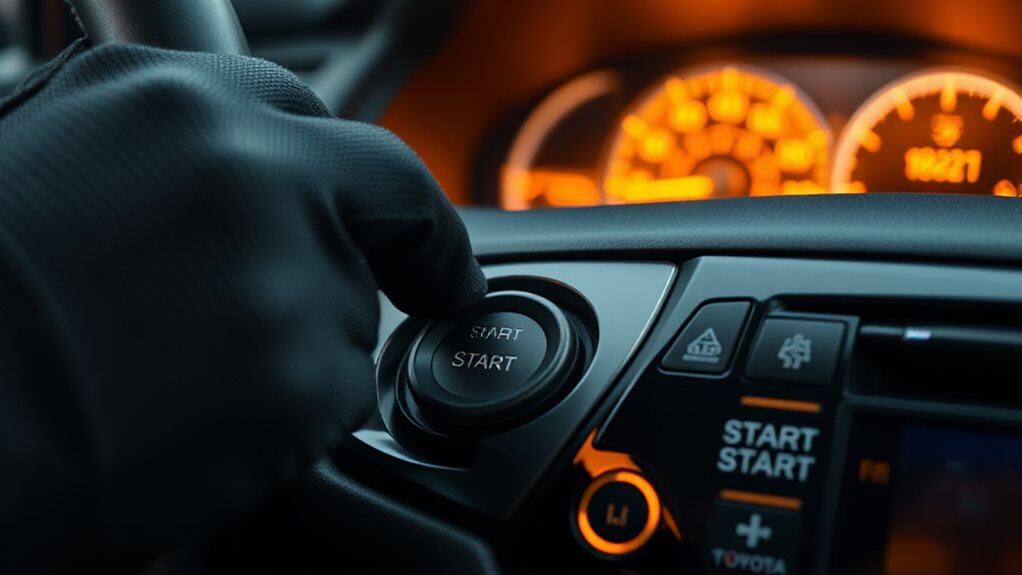
How can you silence the seat‑belt chime in a Toyota without disabling the safety light? Plug an OBD2 adapter into the port, ignition on, wider side up. Open Carista, go to Customize → Links & Warnings, and toggle driver, front‑passenger, and rear‑seat warnings off. The chime stops after 20 km/h, but the dashboard indicator stays lit. Remove the adapter to finish.
Disable the Alarm Using the Trip Reset Button (Method 1)
If you have a Toyota with a trip‑reset button, you can silence the seat‑belt chime without touching the wiring or using external tools.
Turn the ignition on, set the display to ODO, then turn it off without fastening the belt.
Turn it on again, hold the reset button ten seconds, fasten the belt, and select B‑Off when B‑On/B‑Off appears.
Release the button; the audible chime is disabled.
For cleaning nearby components, use a gentle dish soap solution to avoid damaging plastic parts while removing grease.
Toggle B‑On / B‑Off After the Button Procedure (Method 2)

After you’ve silenced the chime with the trip‑reset button, you can switch between the B‑On and B‑Off modes without any wiring or tools.
Hold the trip‑reset button for ten to twenty seconds while the ignition is on, then buckle the belt; the dashboard will show B‑On or B‑Off.
Release the button, press it again to toggle, and confirm the change by starting the engine.
Be aware that persistent safety warnings may indicate a fault, such as low transmission fluid or an electrical issue that can trigger safety/limp mode, requiring professional inspection.
Re‑Enable the Seat‑Belt Alarm If Needed?
Can you restore the seat‑belt alarm when you need it again? Reverse the menu steps you used to disable it, hold the button in the same sequence, and keep the ignition in accessory mode if required. Verify audio by driving past 20 km/h and checking the dashboard light. Use the app or OBD2 adapter for selective re‑enabling, testing each seat position afterward. Carista can disable the chime quickly within minutes. Consider pairing re‑enabling with pH‑neutral detergents when cleaning interior trim to avoid damaging upholstery treatments.
Use an OBD Scanner to Turn Off the Alarm (Method 3)
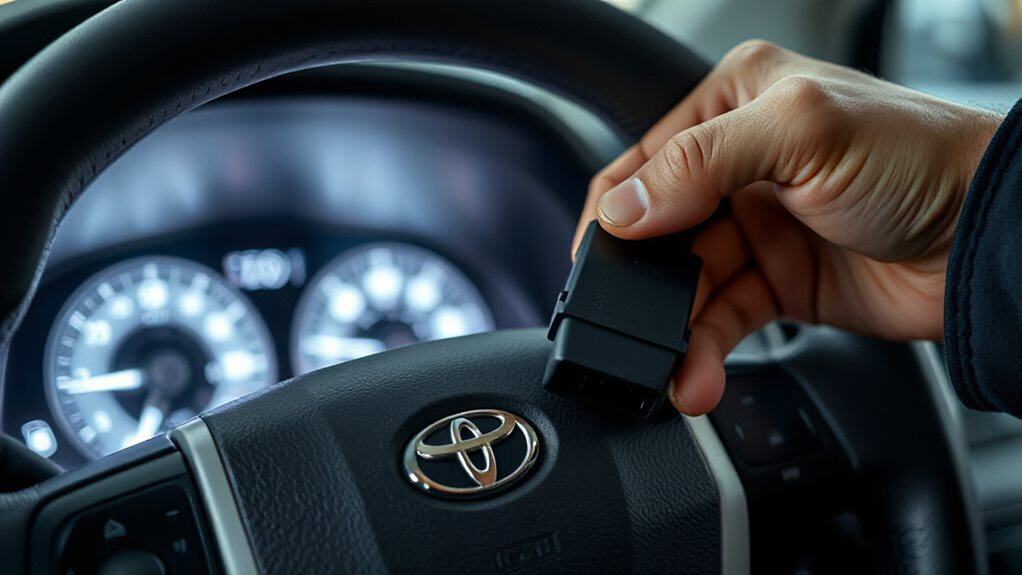
Typically, you’ll start by plugging an ELM327‑compatible OBD scanner into the vehicle’s diagnostic port, which is usually tucked beneath the hood release panel. Pair it via Bluetooth, keep ignition on, and launch the scan tool software. Navigate to the customization menu, toggle driver and passenger seat‑belt buzzers to “off,” then verify silence on a test drive while the dashboard light stays illuminated. Some security fasteners on certain vehicle panels may require special tools or careful removal, so take precautions and consult professional help if needed.
Troubleshoot Common Button‑Procedure Failures
Ever wonder why the push‑start button sometimes seems dead even though the key fob is nearby? Check the fob battery first; a weak cell stops the signal, so replace it and test lock/unlock functions. Clean grime from the button, inspect contacts for wear, and ensure the brake pedal is fully depressed. Finally, verify vehicle‑battery voltage and wiring integrity to rule out electrical interruptions. Regular inspection of related components can prevent failures, so routinely check the gas cap and locking mechanism for signs of wear or damage.
Which Toyota Models Support the Button Method?

While the previous section covered why a push‑start button might appear dead, the next step is to identify which Toyota models actually allow the seat‑belt buzzer to be disabled using the button method.
Only second‑generation Tacoma and current Tundra trucks support the trip‑reset button sequence in accessory mode.
Late‑model sedans and 4Runners lack this native option, requiring OBD tools instead.
Many local jurisdictions only permit one junk car on private property and require proper storage or concealment.
OBD‑Scanner Compatibility Across Toyota Vehicles
You’ll find that each Toyota model has a specific OBD‑Scanner compatibility matrix, so you must check the year, make, and trim before selecting a tool. Some scanners need a software update to read newer protocols like EOBD or hybrid‑specific codes, and those updates are often released by the manufacturer to keep pace with evolving diagnostics. Additionally, regional regulatory constraints—such as emissions testing standards in the US versus Europe—can limit which diagnostic functions are legally accessible on a given vehicle.
Model Compatibility Overview
Which Toyota models can you reliably service with a single OBD‑scanner? You’ll cover OBD1 pre‑1996 and OBD2 post‑1996 Toyotas using any Innova‑branded scanner, and hybrids with BlueDriver, Autel MaxiCOM MK808, or Foxwell NT809BT for electric‑motor and battery codes. Kista Evo, TCH Stream, and Launch X431 Elite add bi‑directional controls, ECU coding, and component testing across most Toyota, Lexus, and Scion lineups.
Software Update Requirements
Model compatibility sets the stage for the next step: ensuring your OBD‑scanner’s software can communicate with every Toyota you intend to service. You must verify that the scanner supports SAE J1850, ISO 9141‑2, ISO 14230‑4, and ISO 15765‑4 CAN protocols, as Toyota models vary by year. Updates should include Toyota’s proprietary extensions for hybrid battery, airbag, and stop‑start parameters, guaranteeing full diagnostic access.
Regional Regulatory Constraints
Where do regional regulations fit into your OBD‑scanner selection for Toyota vehicles? In the U.S., every Toyota sold after 1996 follows OBD‑II, so any standard scanner works, and California adds stricter emissions monitoring. Europe requires EOBD compliance—petrol from 2002, diesel from 2007—so your scanner must support that variant. Asia and Australia use similar OBD‑II timelines, but hybrids need hybrid‑specific tools. Choose a scanner that matches the regional protocol and model year.
Safety Implications of Disabling the Seat‑Belt Alarm
When you disable the seat‑belt alarm, you increase crash risk because the reminder that prompts occupants to buckle up no longer functions, and studies show unbelted passengers suffer far higher injury rates.
This alteration also exposes you to legal liability; many jurisdictions consider tampering with mandatory safety equipment a violation, which can lead to fines, penalties, and reduced crash‑safety ratings.
Furthermore, removing the alarm undermines a culture of safety, making it easier for drivers and passengers to ignore proper restraint practices.
Legalcreasedcreased Crash Risk
Why does disabling the seat‑belt alarm raise crash risk? You remove a cue that keeps occupants restrained, and NHTSA data shows unbelted passengers face 30‑50 times higher serious injury risk. Alarms sync with airbags and pretensioners; without them, deployment timing degrades, increasing ejection odds and mortality by up to 60 %. Studies link alarm removal to a 10‑20 % rise in non‑compliance, amplifying overall crash severity.
Legal Liability Exposure
Can you imagine the legal fallout when a seat‑belt alarm is disabled? You risk civil liability because insurers can argue contributory negligence, and courts may view the disabled warning as evidence you ignored safety reminders. State citations for non‑use can lower damage awards, while manufacturers and dealers could be sued if the modification links to injuries. No federal law bans disabling, but liability exposure remains significant.
Reduced Safety Culture
What happens to a community’s safety mindset when seat‑belt alarms are disabled? You’ll notice a gradual desensitization; people stop hearing reminders, so they buckle less often. This lowers overall belt usage, raises fatality risk by up to 60%, and weakens child‑safety warnings. The habit spreads, eroding cultural emphasis on restraint, and ultimately inflates crash injury rates across the population.
Will Disabling the Alarm Affect Your Warranty?
Does the seat‑belt alarm disable jeopardize your Toyota warranty? If you use a diagnostic tool such as the Xtool D8 or an OBD2‑compatible app like Carista to alter the factory‑programmed warning settings, the change is recorded as a modification of the vehicle’s original configuration. Toyota doesn’t explicitly forbid these changes, but any recorded alteration can be cited as a non‑factory modification, potentially voiding warranty coverage for related components if a claim arises.
Frequently Asked Questions About the Toyota Seat‑Belt Alarm
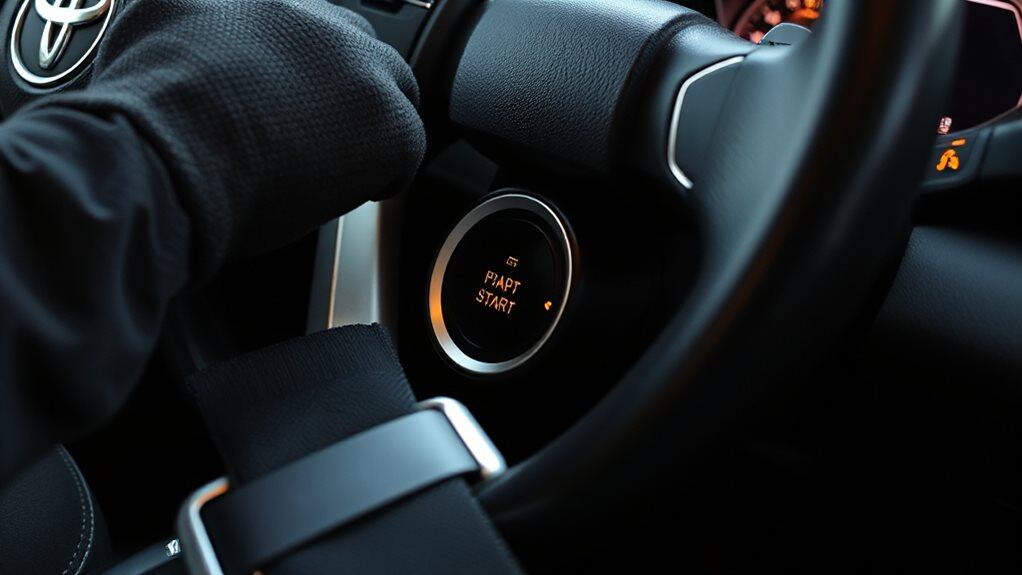
After reviewing how warranty coverage can be impacted by modifying the seat‑belt alarm, you’ll likely have a handful of practical questions about the system itself. The alarm uses buckle switches, occupant sensors, and a meter ECU to trigger a 6‑second buzzer and flashing dash light when the driver’s belt is unbuckled. Visual alerts persist for at least 60 seconds, and rear‑seat reminders count door cycles versus buckle events. Different Toyota models and destination markets vary in buzzer presence and passenger‑seat warnings.
Summary of All Methods and When to Use Each
How each method works and when you should choose it depends on the urgency of the issue, the tools you have on hand, and whether you need a permanent or temporary fix.
Use the ignition sequence for a quick, non‑tool reset;
battery disconnect for stubborn malfunctions;
belt manipulation for on‑the‑fly, temporary relief;
OBD software (Carista) for customizable, speed‑sensitive disabling;
and specialized silencer/fuse tools only when you accept higher risk and want a lasting solution.
Wrapping Up
You now have three viable ways to silence a Toyota seat‑belt alarm: the trip‑reset button, the B‑On/B‑Off toggle, and an OBD scanner. Each method works for specific models and situations, but all require careful follow‑through to avoid unintended effects. Remember that disabling the alarm can reduce safety, may affect warranty coverage, and should be re‑enabled when the vehicle is used by others. Choose the approach that matches your technical comfort level and vehicle configuration.


