
You’ll notice the 2500 is longer, wider, taller and heavier, so it carries a higher payload (≈3,700 lb vs. 2,260 lb) and a reinforced frame with five-leaf-spring suspension for load stability. Its 14‑bolt rear axle and larger brakes support a towing capacity up to 22,500 lb, whereas the 1500’s lighter coil-spring setup, smaller axle and 10‑bolt hub give a smoother, car-like ride and better fuel economy—about 23/29 mpg diesel versus 6 mpg under load for the 2500. The 1500 is ideal for everyday driving and lighter trailers; the 2500 excels with heavy trailers and demanding haul-away work. If you keep going, you’ll uncover deeper details on engine choices, cost of ownership, and comfort features.
Quick Tips
- 2500 has a reinforced, larger frame and five leaf‑spring rear suspension, giving it 1,500 lb more payload capacity than the 1500.
- 2500’s rear axle uses a 14‑bolt semi‑floating design with a 10.5‑inch ring gear, while the 1500 uses a lighter 10‑bolt, 6‑lug setup.
- Diesel 2500 delivers up to 470 hp and 975 lb‑ft torque, supporting 22,500 lb GC towing, versus the 1500’s ~13,300 lb limit and lower torque.
- Fuel economy drops more sharply on the 2500 under load (≈6 mpg when hauling) compared to the 1500’s diesel (≈23/29 mpg unloaded, ≈27 mpg under steady load).
- Ride quality differs: the 1500 offers a smoother, car‑like feel with lighter coil springs, while the 2500’s heavier leaf‑spring setup feels firmer and prioritizes durability.
Quick Comparison: Suburban 1500 vs. 2500
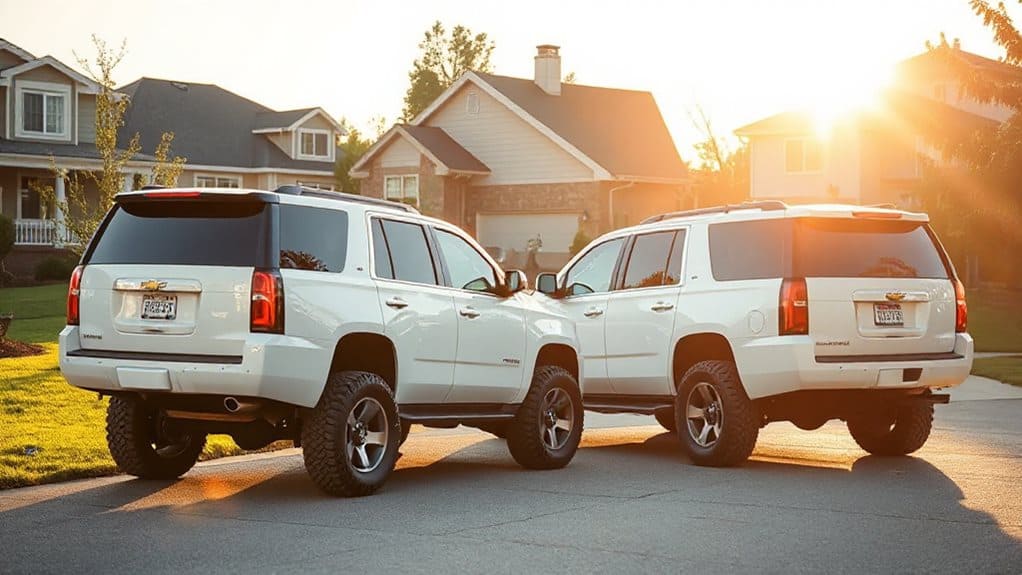
Ever wonder how the Suburban 1500 and 2500 stack up right off the line? The 2500 HD is longer, wider, taller, and heavier, classified as a three‑quarter‑ton versus the 1500’s half‑ton. Its suspension uses five leaf springs and stronger components, giving better towing stability but a stiffer ride.
The 2500’s 14‑bolt semi‑floating rear axle and full‑floating design outmatch the 1500’s 10‑bolt axle for durability. Brakes and payload follow suit, with the 2500 handling higher GVW and a 3,689‑lb payload, while the 1500 caps at 2,260 lb. Reinforced frame enhances load stability. For long-term outdoor or heavy-duty use, consider installing wiring in rigid conduit to protect electrical systems from environmental damage.
Which Engine Is Right for Daily Driving or Heavy Towing?
You’ll find the 5.3 L V8 in the 1500 gives you better fuel economy and a lighter ride for everyday commuting, while the 6.0 L V8 in the 2500 provides the heavy‑duty torque needed for sustained towing of large trailers.
The 1500’s standard 3.23 axle ratio balances acceleration with efficiency, so it handles occasional loads up to about 8,300 lb without sacrificing mileage.
In contrast, the 2500’s reinforced chassis, larger brakes, and higher‑output engines keep the vehicle stable and powerful when you’re pulling 6,000 lb or more on steep grades.
Regular maintenance like cleaning the camera lens and checking wiring can prevent problems with backup system guidelines, especially after repairs or updates that may require camera calibration.
Daily Driving Efficiency
How does engine choice affect your daily driving efficiency and occasional towing needs? The 1500’s 3.0L Duramax diesel reaches up to 28 MPG highway, making it the most fuel‑efficient option for commuting. Its 2.7L TurboMax I4 also balances economy with light towing. In contrast, 2500 gas V8s prioritize durability over MPG, while 2500 diesel adds power but costs more and consumes more fuel. Choose the 1500 for everyday mileage and modest haulage.
Heavy‑Duty Torque
What torque you need for daily driving versus heavy towing hinges on engine design and output curves. The 1500’s smaller displacement delivers modest low‑rpm torque, ideal for city traffic and light loads.
The 2500’s larger V8 provides higher peak torque at lower RPMs, supporting heavy trailers and steep grades.
Choose the 1500 for everyday comfort; pick the 2500 when you regularly tow substantial weight.
Fuel Economy vs. Power
When considering fuel economy against power, the key is to match the engine’s characteristics to your primary use—daily commuting or heavy towing.
A 1500 diesel delivers 23 / 29 mpg and 310 hp, ideal for routine trips and light trailers.
A 2500 6.6 L diesel offers 470 hp and 975 lb‑ft torque but drops to 6 mpg when hauling, suiting demanding loads.
Choose based on mileage needs versus hauling capacity.
Towing Capacity – 13,300 lb vs. 22,500 lb – What That Means for You
You’ll notice that the 1500’s real‑world towing limit hovers around 7,800–8,500 lb, while the 2500 can handle up to 22,500 lb when equipped with the proper engine and gear ratio.
Choosing a higher‑displacement V8 or the 8.1L option dramatically raises the maximum trailer weight you can pull without sacrificing acceleration or hill‑climbing ability.
Keep in mind that the Gross Combined Weight Rating (GCWR) and brake system capacity must also be matched to your load to stay within safe operating parameters.
Persistent smoke with a gasoline smell from the exhaust can indicate unburned fuel entering the system, so stop driving and have the fuel system checked promptly for issues like stuck-open injectors.
Real‑World Towing Limits
How much you can actually haul with a Silverado hinges on the interplay between its curb weight, Gross Combination Weight Rating (GCWR), and the trailer’s own mass. The 1500’s 13,300 lb limit assumes a light chassis, so adding passengers or cargo quickly cuts usable trailer weight. The 2500 HD’s 22,500 lb rating benefits from a rigid frame, stronger brakes, and higher axle ratios, allowing heavier loads while maintaining stability and brake life.
Engine Choice Impact
What does the engine you pick mean for the 13,300‑lb versus 22,500‑lb towing limits?
The 1500’s lighter‑duty V6 or V8 delivers up to 13,300 lb, suitable for small trailers and weekend projects.
The 2500’s 6.6 L Duramax diesel or larger V8, 22,500 lb, thanks to higher torque, reinforced chassis, bigger brakes, and upgraded coolers.
Choose based on payload, terrain, and duty cycle.
Payload Limits & Bed Volume: Picking the Right Cargo Space
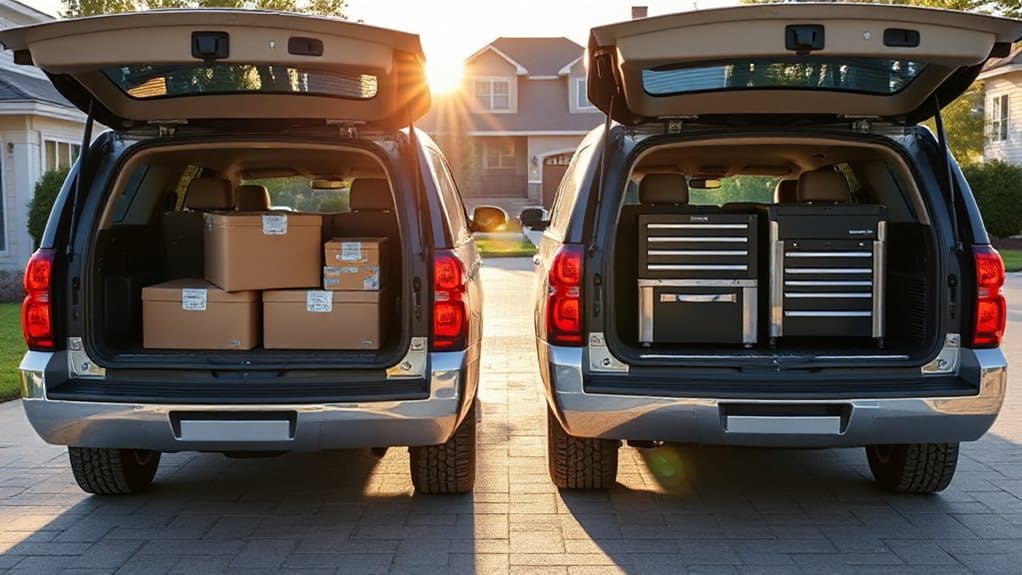
When evaluating the Suburban 1500 and 2500, the key distinction lies in how much weight each can safely carry and how that weight interacts with the bed’s usable volume.
The 1500 limits payload to about 1,834 lb, while the 2500 handles 3,400‑3,900 lb thanks to a higher GVWR of 8,600 lb. Bed size stays similar, but the 2500’s stronger chassis lets you load denser cargo without sacrificing volume. Tri-wing screws are a tamper-resistant fastener commonly used in electronics to deter easy repairs.
Suburban 1500 Vs 2500: Axle & Suspension Design – Stability & Ride Quality
So, why does the Suburban 2500 feel more planted on the road than the 1500? You’ll notice the 2500’s 14‑bolt semi‑floating rear axle with an 8‑lug wheel hub and larger 10.5‑inch ring gear, compared to the 1500’s 10‑bolt axle, 6‑lug hub, and 9.5‑inch gear. The 2500 also uses five leaf springs versus three on the 1500, giving it greater load‑capacity stability and reduced sag, while the 1500’s lighter springs favor a smoother ride when unloaded. Regular monitoring of cooling and drivetrain temperatures can prevent issues that affect performance and ride quality, such as overheating or component failure, so check your coolant temperature.
Suburban 1500 Vs 2500: Frame Strength & Brakes – Safety Under Load
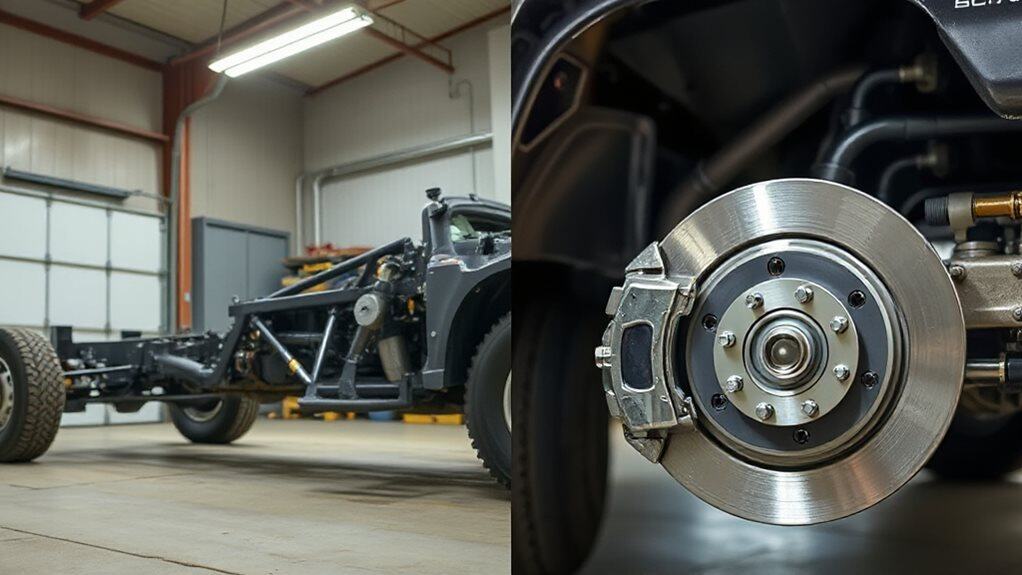
The 2500’s sturdier frame and upgraded brake system build on the axle and suspension advantages you just saw, delivering safety that scales with load.
Its 215 × 90 × 4.5 mm rails, 60 kpsi steel, and extra cross‑members resist flex when you tow heavy trailers.
Bigger “big brakes,” 8‑lug wheels, and reinforced brake lines stop the vehicle more reliably under stress.
Regular inspections of axle, wheel bearing, and suspension components help catch drivetrain issues like CV joint damage early.
Fuel Economy & Diesel Benefits: Long‑Distance Hauling Savings
You’ll notice that a diesel‑powered Suburban can push its highway MPG up by several points compared to the gasoline models, because diesel engines convert more of the fuel’s energy into motion.
This efficiency translates into lower fuel costs per mile on long‑haul trips, especially when you maintain steady speeds on the highway where the diesel’s higher torque reduces the need for frequent downshifts.
Consequently, the diesel option can save you a significant amount of money over the life of the vehicle when you regularly tow heavy loads across state lines.
Diesel Efficiency Gains
How does diesel’s higher energy density translate into real‑world savings on long hauls? You’ll see roughly 20 % better fuel economy than a gasoline counterpart when towing heavy loads, because diesel’s thicker fuel burns slower and maintains power at low RPMs. This means fewer fuel stops, lower operating costs, and longer distances between refueling, which directly cuts expenses on cross‑country trips.
Highway MPG Advantage
Why does highway MPG matter for long‑distance hauling? You’ll notice the 1500 averages 19‑21 MPG unloaded, while the 2500 hovers around 17‑21 MPG, dropping sharply when towing. Transmission design matters: the 1500’s 4L60E yields 2‑4 MPG more than the 2500’s 4L80E. Speed also impacts fuel use; 55 MPP gives 20.6 MPG, 70 MPP falls to 17.7 MPG. These variations directly affect operating costs on extended trips.
Long‑Haul Cost Savings
What makes a diesel‑powered Suburban a smarter choice for long‑haul trucking is its superior fuel‑economy profile under sustained load. You’ll see 27‑28 mpg in real‑world highway tests, beating the EPA rating by up to 2 mpg. Diesel torque stays high while towing, so the 2500’s mileage only drops to about 8 mpg, far better than gasoline’s larger decline, saving fuel costs over long distances.
Suburban 1500 Vs 2500: Comfort, Tech & Ride Smoothness – Which Feels Like a Car?
Ever wondered which Chevrolet Suburban feels more like a car? The 1500’s lighter coil‑spring suspension delivers a smoother, car‑like ride and quieter cabin, while its Super Cruise and IntelliBeam tech add convenience. Premium trims feature leather, heated seats, and dual‑zone climate control.
In contrast, the 2500’s rugged multi‑leaf springs feel firmer and bouncy, prioritizing durability over comfort, and it includes advanced trailering cameras.
How the Suburban Handles 5,000 lb Tows – Road Manners & Stability
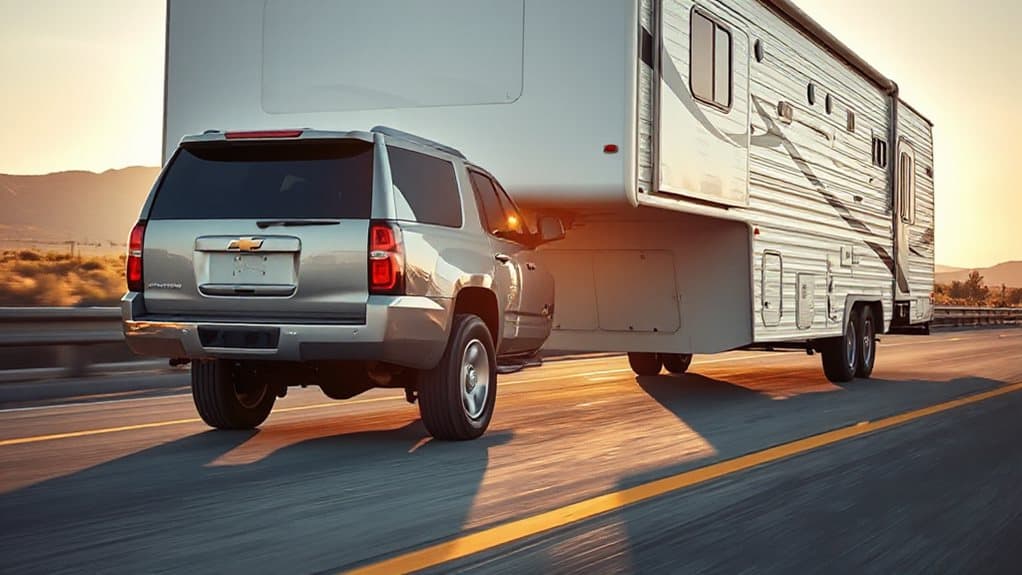
How a Suburban behaves when you attach a 5,000‑lb trailer depends largely on chassis rigidity, brake performance, cooling capacity, power delivery, and overall stability handling.
The 2500’s stiffer frame reduces flex, letting you stay steady on hills.
Bigger brakes and an exhaust brake keep stopping distances short, while larger coolers prevent overheating.
Torque‑rich engines maintain speed without downshifting, and Z71 4WD with 4.10 gears curbs sway, delivering composed road manners.
Suburban 1500 Vs 2500: Total Cost of Ownership – Price, Maintenance & Resale
Where does the total cost of ownership split between the Suburban 1500 and the 2500? You’ll spend roughly $1,234 versus $1,146 annually on maintenance, translating to $7,888 and $9,281 over five years respectively. Ten‑year projections hover around $10,061 for both, exceeding the SUV average by $1,895.
Major repairs—AC compressor, radiator, control arm—cost $150‑$2,566, while resale values differ modestly due to these expense patterns.
Which Suburban Should You Buy? Decision Checklist for Your Needs
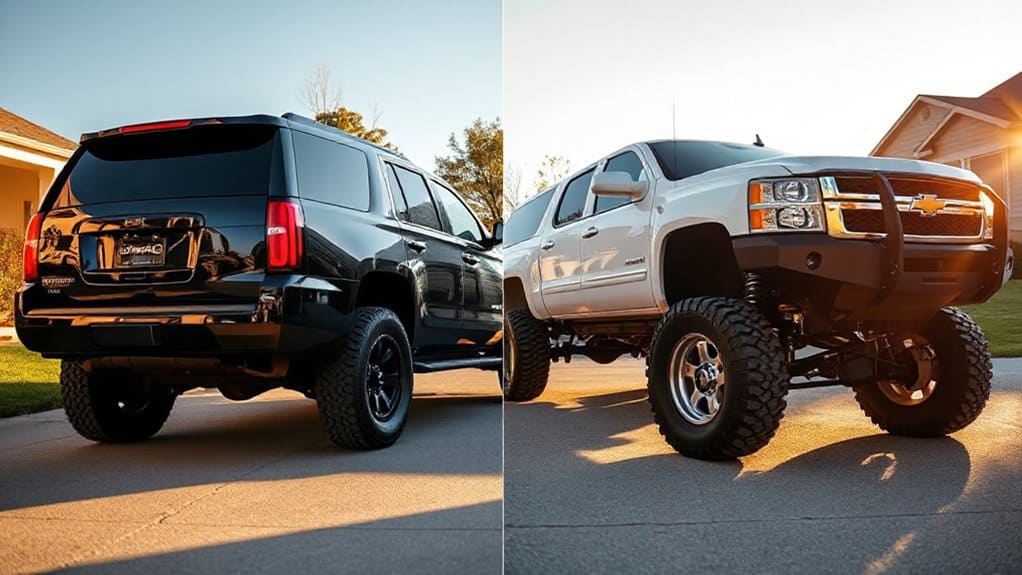
Which Suburban fits your needs depends on how you prioritize towing, payload, and durability. If you regularly haul near 3,000 lb or tow over 18,000 lb, choose the 2500 for its class‑5 hitch, full‑floating rear axle, and reinforced frame. For everyday driving with lighter loads, the 1500’s smaller payload, semi‑floating axle, and lower‑weight engine suffice. Compare towing capacity, chassis strength, and suspension to match your typical workload.
Wrapping Up
Choose the Suburban 1500 if you prioritize lower purchase price, better fuel economy, and everyday driving comfort, while still handling moderate towing up to 13,300 lb. Opt for the 2500 when you need maximum payload, 22,500 lb towing capacity, and reinforced axle and suspension for heavy‑duty work. Compare your typical cargo volume, expected tow weight, and long‑term cost of ownership. Match those requirements to the model’s specifications, and you’ll select the version that best fits your practical needs.


