
Installing aftermarket headers won’t automatically void your entire factory warranty, thanks to the Magnuson-Moss Warranty Act, which requires manufacturers to prove the modification directly caused a specific failure. However, you’ll face increased scrutiny on exhaust-related and engine-related claims, and catless headers violate emissions regulations, creating stronger grounds for denial. Unrelated systems like air conditioning and transmission typically remain covered. Thorough documentation of your modification and proper maintenance records serve as your primary defense against wrongful denials, and understanding how dealers approach these claims helps you protect your remaining coverage throughout the warranty period.
Quick Tips
- Headers do not automatically void your entire factory warranty under federal Magnuson-Moss Warranty Act protections.
- Manufacturers must prove headers directly caused a specific failure before denying warranty coverage on that component.
- Exhaust and engine claims face increased scrutiny, but unrelated systems like transmission and electrical typically remain covered.
- Catless headers violate emissions laws and explicitly void warranty; catted CARB-compliant headers reduce denial risk.
- Dealers bear burden of proof for causation, but ECU tuning combined with headers increases detection and denial likelihood.
Understanding the Magnuson-Moss Warranty Act and Your Legal Protections
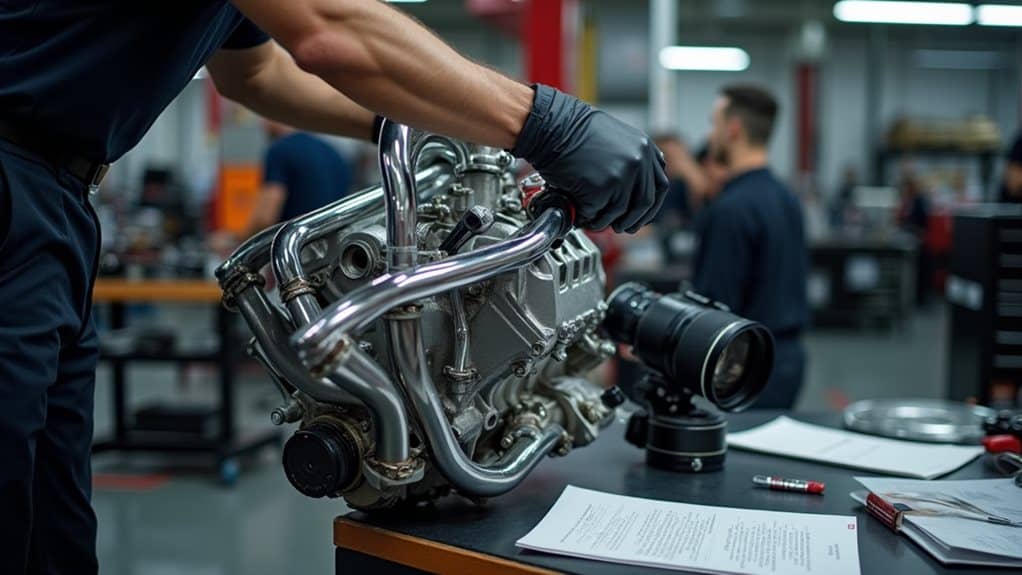
When you modify your vehicle with aftermarket parts like headers, you might wonder whether the manufacturer can deny warranty claims on your entire car.
The Magnuson-Moss Warranty Act, federal legislation from 1975, protects your rights as a consumer. This law prohibits manufacturers from voiding your warranty simply because you’ve installed non-branded components. The burden of proof rests with the manufacturer or dealer to demonstrate that your aftermarket part or service actually caused the specific failure before they can deny warranty coverage. Understanding these protections helps you make informed modification decisions, as ensuring the integrity of the EVAP system is crucial for maintaining vehicle performance.
How Headers Actually Affect Your Factory Warranty Coverage
Although installing headers on your vehicle won’t automatically void your entire factory warranty, the modification does create specific vulnerabilities in your coverage that you need to understand.
Manufacturers segregate warranty protection, meaning unrelated systems like electronics and body components typically remain covered. However, you’ll face increased scrutiny on exhaust and engine-related claims. Dealers may deny coverage if they prove your headers directly caused the specific failure. Additionally, issues such as alternator problems can arise from modifications that affect engine performance.
Before making any modifications, you should check with your dealer or manufacturer to understand how headers might impact your warranty terms and potential coverage impacts.
The Difference Between Full Warranty Void and Partial Denial
Installing headers won’t automatically void your entire vehicle warranty, but it can trigger a partial denial on specific components if your dealer proves the modification caused a failure.
You’ll retain full warranty coverage on unaffected systems—your air conditioning, electrical components, and transmission remain protected even if the manufacturer denies a claim on your exhaust manifold or catalytic converter.
The Magnuson-Moss Warranty Act requires your dealer to establish direct causation between your headers and any damaged part before denying coverage, which means they can’t reject warranty claims on unrelated systems simply because you’ve added aftermarket parts. Additionally, understanding your rights during this process can help you navigate warranty claims effectively.
What Full Void Means
Understanding the difference between a full warranty void and a partial coverage denial matters substantially when you’re dealing with modified vehicles.
A full void eliminates all protections and guarantees provided by your warranty agreement. Conversely, partial denial restricts coverage to specific components while retaining warranty protection on the remainder of your product. Specific defect causation determines which applies to your claim.
Partial Denial Explained
When your warranty claim receives a partial denial, you’re facing a selective coverage decision rather than complete warranty cancellation. The manufacturer approves coverage for certain components while denying others.
You’ll receive documented communication explaining which parts qualify for coverage and which don’t. For instance, if headers damage your exhaust manifold, coverage might apply to unaffected engine components while excluding exhaust-related repairs.
Magnuson-Moss Legal Protections
The Magnuson-Moss Warranty Act provides federal protection against manufacturers who attempt blanket warranty denials based solely on aftermarket modifications like headers.
Under this law, the burden falls on the warrantor to prove your headers directly caused the specific defect. They can’t void your entire warranty without documentation showing a causal link between the modification and failure, protecting your remaining coverage.
Catted Vs Catless Headers: Does It Matter for Warranty Claims?
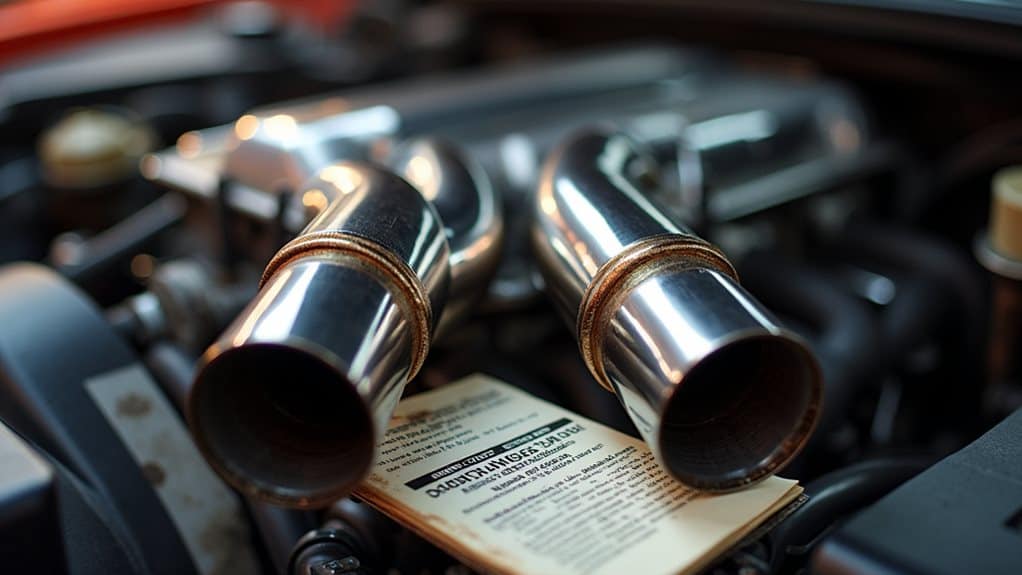
Choosing between catted and catless headers markedly impacts your warranty protection, with catless options presenting far greater risks of claim denials.
Catless headers violate emissions regulations and trigger check engine lights, alerting dealerships to modifications. Manufacturers explicitly void warranties when emissions equipment is tampered with.
Conversely, catted headers with CARB-compliant catalytic converters maintain emissions standards, greatly reducing warranty denial likelihood while providing comparable performance gains. Understanding common heated seat malfunctions can help in assessing modifications that might affect warranty coverage.
Why Dealerships Often Target Exhaust Components for Warranty Exclusions
Dealerships zero in on exhaust components as prime targets for warranty exclusions because these modifications are immediately visible during routine service inspections.
They exploit categorical distinctions between integrated engine components and downstream modifications, creating convenient denial points.
Federal law requires them to prove direct causation, yet they often shift burden through documentation demands and maintenance scrutiny, establishing administrative barriers that discourage legitimate warranty claims.
The Role of ECU Tuning in Amplifying Warranty Risks
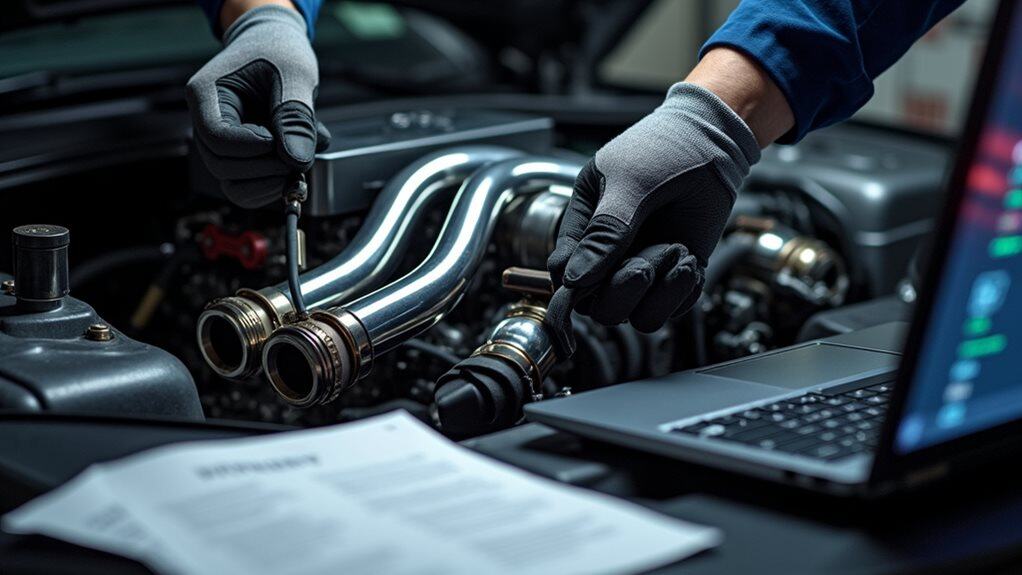
While installing headers alone raises warranty concerns, pairing them with ECU tuning dramatically escalates your risk of claim denials because modified engine parameters create measurable changes that manufacturers can detect.
When you adjust air/fuel ratios, ignition timing, or boost levels through a remap, you’re fundamentally creating a digital fingerprint that remains in your vehicle’s computer system even if you flash it back to stock settings. Dealers now routinely check ECU histories during warranty inspections, and if they find evidence of tuning—especially combined with performance parts like headers—they’ll likely deny coverage for any powertrain-related failures.
ECU Tuning Increases Risk
When you modify your vehicle’s ECU software, you’re fundamentally changing how the engine management system controls critical functions like fuel delivery, ignition timing, and turbocharger pressure.
These alterations push components beyond factory specifications, accelerating wear and potentially causing mechanical failures.
Manufacturers can detect tuning through electronic logs stored in the ECU, even after reverting to stock settings, making warranty denials on powertrain repairs much more likely.
Manufacturer Detection of Remaps
Manufacturers have developed sophisticated methods to detect ECU remapping, and understanding these detection capabilities helps you grasp why warranty claims often fail after tuning.
Dealerships use diagnostic tools that read Calibration Verification Numbers (CVN), which immediately flag non-factory software.
Your ECU stores flash counters and reprogram logs in non-volatile memory, creating permanent digital footprints.
Even after reverting to stock settings, these records remain accessible to technicians during warranty inspections.
Performance Gains Vs Potential Heat Damage to Exhaust Systems
Headers deliver meaningful performance improvements, but they introduce heat-related challenges that cast iron manifolds don’t typically face.
You’ll gain around 25-30 horsepower, especially at higher RPMs, through better exhaust flow and reduced back pressure. However, their thinner tubing and welded joints make them vulnerable to heat stress and cracking. This can damage oxygen sensors, catalytic converters, and gaskets if you don’t use proper heat shielding or coatings.
Documentation and Proof: Protecting Your Warranty Rights During Claims
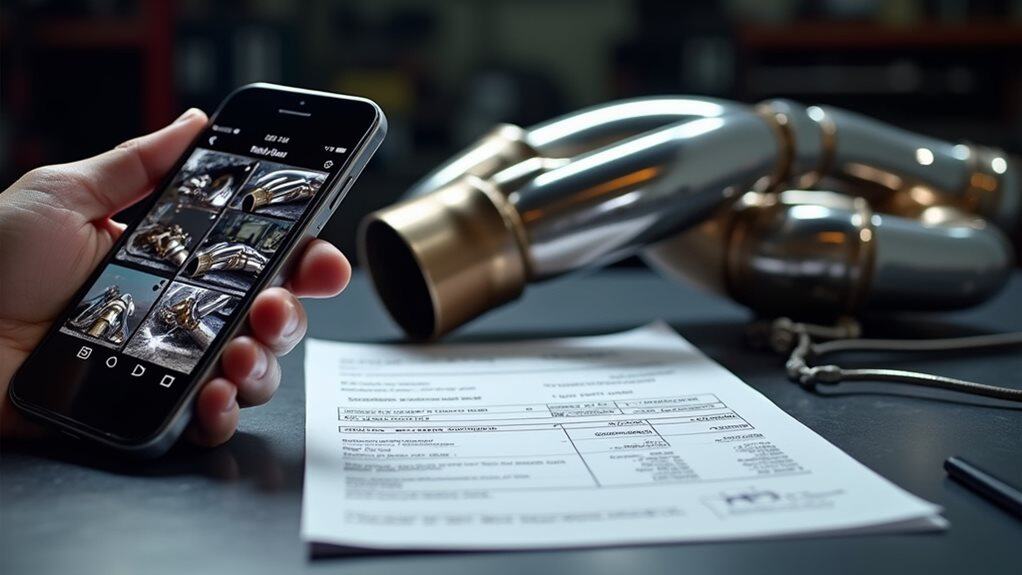
Before you install headers or file a warranty claim for an unrelated issue, you’ll need to understand that thorough documentation serves as your primary defense against wrongful warranty denials.
Keep detailed service records with dates, mileage, and repair descriptions.
Retain all receipts for parts and labor, including installation documentation from certified technicians.
Store both digital and physical copies in organized folders, ensuring you can quickly access proof that modifications didn’t cause unrelated failures.
Best Practices Before Installing Headers on Your Vehicle
With your documentation strategy in place, you’re ready to focus on the practical steps that’ll make your header installation successful and minimize the risk of warranty complications down the road.
Before starting, let the engine complete a full cooling cycle—working on hot exhaust systems causes burns and component damage.
Consult your owner’s manual to locate proper jack points, then secure your vehicle with jack stands and wheel chocks.
Wrapping Up
Installing headers doesn’t automatically void your entire warranty, but it can complicate claims. You’ll need to understand the Magnuson-Moss Warranty Act, which protects your rights and requires dealerships to prove modifications caused specific failures. Before installation, document everything, keep stock parts, and consider catted options to maintain emissions compliance. If you’re adding ECU tuning or going catless, expect increased scrutiny on warranty claims. Weigh performance gains carefully against potential coverage risks, and always research your manufacturer’s specific policies beforehand.


