
Connect an OBD‑II scanner that supports TPMS battery‑test mode, then the vehicle’s make and model. Choose the quick‑mode or TPMS‑test option; the tool emits a low‑frequency magnetic field to wake each sensor and captures its 434 MHz UHF signal. The display will show the sensor’s voltage—typically around 3 V for a healthy lithium‑ion cell—and a signal‑strength indicator; low voltage or weak signal flags a failing battery and may generate a C121 fault code. Follow the on‑screen prompts to verify each wheel without removing the sensors, and you’ll discover more details if you keep exploring.
Quick Tips
- Connect a compatible OBD2 scanner (e.g., Bartec, Autel) and select the TPMS battery test mode.
- Place the scanner’s antenna near each wheel valve stem to wake the sensor with a low‑frequency magnetic field.
- The tool captures the sensor’s UHF signal at 434 MHz and displays the battery voltage, typically around 3 V when healthy.
- Interpret low voltage or weak signal strength as a “low‑battery” condition, often triggering fault code C121.
- If the scanner shows low voltage or a low‑battery icon, replace the sensor; otherwise, the battery is still adequate.
Select the Correct TPMS Test Mode for Reading Battery Voltage

How do you choose the right TPMS test mode for checking battery voltage? First, connect the scanner to the OBD2 port and enter the vehicle’s make and model. Then select quick mode, which bypasses extended diagnostics and forces sensors to transmit voltage data. The tool’s receiver captures the signals, displaying “BATT OK” or low‑battery warnings, allowing you to assess each sensor’s battery health instantly. Driving increases transmission frequency, which can affect battery life. For more accurate readings, verify the sensor type and mount hex nut torque to ensure proper sensor grounding and signal integrity.
Read TPMS Battery Voltage With Bartec or Autel Scanners
Ever wondered how to pull battery voltage data from your TPMS sensors using Bartec or Autel tools? Connect the scanner, select the TPMS battery test mode, and place it near the wheel. The device emits a low‑frequency magnetic field, wakes the sensor, and captures the UHF signal at 434 MHz. Software version 65.1 (or 5.1 for newer models) displays voltage, color‑coded life indicators, and low‑battery warnings. Choosing the wrong exhaust component could cost you serious horsepower and money, so be aware of the differences between downpipes and headers.
Interpret TPMS Battery Voltage, Signal Strength, and Error Codes

What does a TPMS reading actually tell you about battery health, signal strength, and error codes?
You’ll see a pass/fail voltage status; a 3 V lithium‑ion cell near 3 V is healthy, while lower readings trigger C121.
Signal strength indicates transmission quality—weak signals often mean low battery.
Error codes like SU13 point to loss problems, not battery issues, helping you pinpoint the exact fault.
Regular inspections can also reveal clogged cabin air filters that indirectly affect sensor signal quality.
Run a Hand‑Held Retrain Test to Check Battery Health
After interpreting voltage, signal strength, and error codes, the next step is to verify those readings with a hand‑held retrain test. Connect an Autel ITS600, XTOOL TP150, or Schrader ST‑1 to the OBD2 port, place its antenna near each valve stem, and activate the sensor. The tool will display real‑time pressure, temperature, and a low‑battery icon if the battery is weak, confirming health without removal. A typical full tank can allow most vehicles to travel 300–360 miles, so consider fuel level when planning longer diagnostic sessions.
When to Replace a Low‑Battery TPMS Sensor?
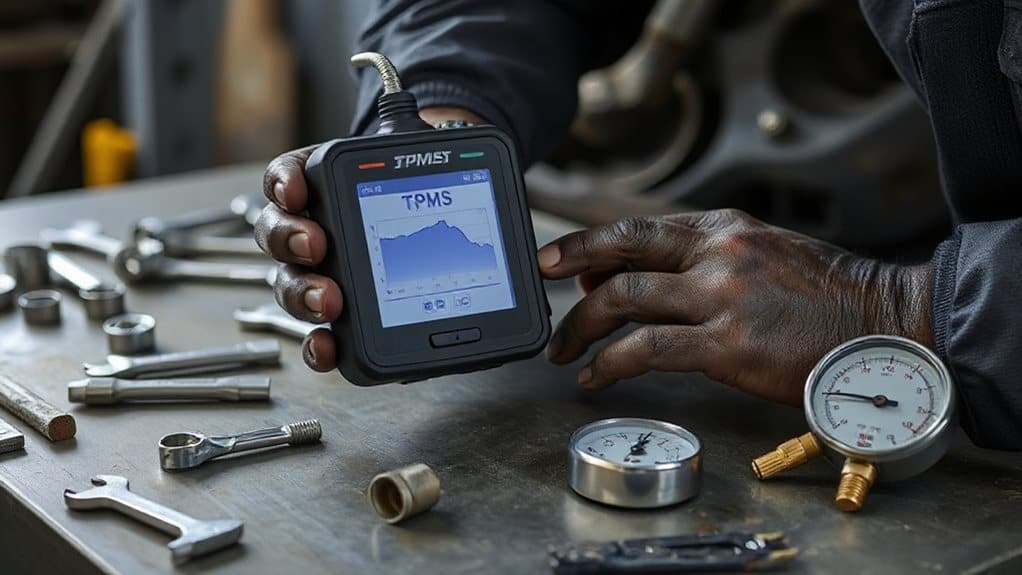
If the TPMS warning light stays on, the sensor’s battery is likely nearing the end of its service life, and you should plan a replacement before it fails completely.
You’ll need a new sensor when the scan tool shows “low” or 10 % battery, typically six months to a year left.
Replace all four units together, program them, and avoid driving with a dying battery.
Portable jump starters deliver 1,000A to 5,000A with spark-proof technology and USB ports, which can help in emergencies with high-current starts but do not prevent TPMS sensor battery failure.
Wrapping Up
By following the steps above, you can accurately assess a TPMS sensor’s battery without removal. Select the proper test mode, use a compatible scanner to read voltage, and interpret signal strength alongside error codes. If a handheld retrain test confirms weak voltage, plan replacement before the sensor fails. Monitoring battery health proactively guarantees reliable tire pressure alerts and avoids unexpected sensor loss.


