
Headers bolt directly to your engine’s cylinder head with individual tubes per cylinder, optimizing exhaust flow in naturally aspirated vehicles by reducing backpressure and improving scavenging. Downpipes, however, connect your turbocharger’s turbine housing to the exhaust system in forced-induction engines, minimizing post-turbo restrictions to enhance surge response. You can’t interchange them—headers suit non-turbocharged setups, while downpipes address turbocharged configurations. Each modifies different exhaust sections, delivers distinct power gains, and requires unique installation approaches. Understanding these fundamental distinctions helps you choose the right upgrade for your engine’s aspiration method and performance goals.
Quick Tips
- Headers bolt to naturally aspirated engines to optimize exhaust scavenging; downpipes connect turbochargers to exhaust systems in forced-induction applications.
- Downpipes integrate catalytic converters directly, while headers require separate downstream converter mounting, affecting emissions efficiency and light-off temperatures.
- Downpipes typically add 10–30 HP on turbocharged engines; headers add 5–20+ HP on naturally aspirated engines depending on design.
- Downpipes require ECU tuning due to altered backpressure and sensor readings; headers rarely need extensive software modifications on naturally aspirated engines.
- Downpipes cost $150–$800 with 1–3 hour installation; headers cost $300–$1,200 with several hours to full-day installation required.
What Are Headers and Downpipes?
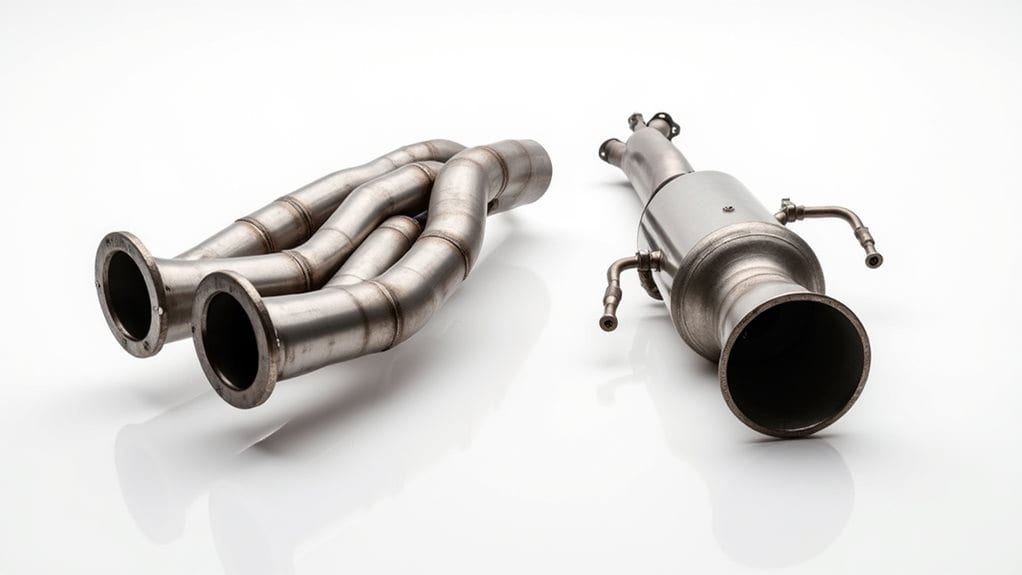
When you’re looking to improve your vehicle’s exhaust system, understanding the difference between headers and downpipes is essential because these components serve distinct purposes in different engine configurations.
Headers are exhaust manifolds with individual tubes for each cylinder that bolt directly to your engine block, while downpipes connect turbocharged engines to the exhaust system by channeling gases from the turbocharger’s turbine housing downstream. TMU vehicles can sometimes suffer from performance issues that affect their exhaust systems, making the choice between headers and downpipes even more critical.
Downpipes are typically positioned between turbo and centre muffler, serving as the critical link in the turbocharged exhaust pathway.
Engine Compatibility and Application
Your engine’s aspiration method—whether it’s naturally aspirated or turbocharged—fundamentally determines whether you’ll benefit from headers or a downpipe upgrade.
Headers optimize exhaust scavenging in non-turbocharged engines by reducing backpressure from the manifold to the collector, while downpipes specifically address the restrictive exhaust path between the turbocharger outlet and catalytic converter in forced-induction applications. This is similar to how auxiliary switches enhance vehicle functionality by allowing customization based on the user’s needs. Your engine’s cylinder count and arrangement also influences the complexity of downpipe design, with V-configuration engines requiring more intricate collector systems to merge exhaust streams from dual banks compared to simpler inline layouts.
Understanding which modification aligns with your engine’s design is critical, as installing a downpipe on a naturally aspirated vehicle yields zero performance gains, just as headers won’t address turbocharger exhaust flow limitations.
Naturally Aspirated Vs Turbocharged
Understanding the difference between naturally aspirated and turbocharged engines is essential because these two powerplants require completely different exhaust components to optimize performance.
Turbocharged engines need downpipes to connect the turbine housing to the exhaust system, reducing backpressure for faster turbo spool.
Naturally aspirated engines use headers instead, which attach directly to the exhaust manifold to improve flow and scavenging efficiency without managing turbo pressure.
Optimal Application by Engine
Choosing between a downpipe and header upgrade depends primarily on your engine’s displacement, with smaller powerplants under 2.0L typically showing the most dramatic performance improvements from downpipe installations.
Four-cylinder engines benefit from downpipes first due to limited manifold space, while V6 and V8 configurations accommodate headers more readily.
Mid-range displacement engines (2.0L-3.5L) demonstrate balanced compatibility with both modifications depending on valve timing characteristics.
Performance Tuning Strategy Differences
Beyond selecting the right component for your engine size, you’ll need to take into account how each modification affects your vehicle’s computer system and whether professional tuning becomes necessary.
Downpipes typically allow your ECU to compensate through adaptive parameters, making tunes optional for basic installations. Headers, however, dramatically alter exhaust flow and scavenging, pushing operation outside your ECU’s adaptive range and requiring custom dyno tuning for peak performance.
Performance Gains and Power Output
When you’re comparing the real-world performance benefits of these two exhaust modifications, you’ll find that both downpipes and headers deliver remarkably similar horsepower gains in their respective applications.
Quality aftermarket downpipes designed for turbocharged engines typically add 10 to 20 horsepower, and you’ll notice these gains most prominently when your turbo spools up under acceleration.
Headers for naturally aspirated vehicles produce nearly identical power increases in the same 10-20 horsepower range, though they achieve this by improving your engine’s ability to evacuate exhaust gases from the cylinder heads rather than optimizing turbo system efficiency. Additionally, the effectiveness of these upgrades can be enhanced with modifications to air intake and exhaust systems, which are critical for maximizing overall performance.
Downpipe Horsepower Increase Potential
A high-flow downpipe installation on a turbocharged engine typically delivers a 15-30 horsepower increase by reducing exhaust backpressure and improving exhaust gas flow.
Real-world gains often reach 20-30 HP, with turbocharged vehicles like the BMW 335i, Subaru WRX, and Volkswagen GTI showing the most significant improvements.
When combined with ECU tuning and supporting modifications, you’ll unleash the downpipe’s full potential, sometimes exceeding 50 horsepower.
Header Power Gain Range
Headers typically deliver more modest power gains than downpipes, adding between 5 to 20+ horsepower to naturally aspirated engines depending on the header design and existing engine modifications.
Long tube headers generally produce the largest increases, especially in low to mid-RPM ranges, while short tube designs offer smaller improvements.
Your actual gains depend heavily on engine displacement, camshaft profile, cylinder head design, and complementary performance upgrades like intake systems.
Impact on Turbo Spool and Boost Response
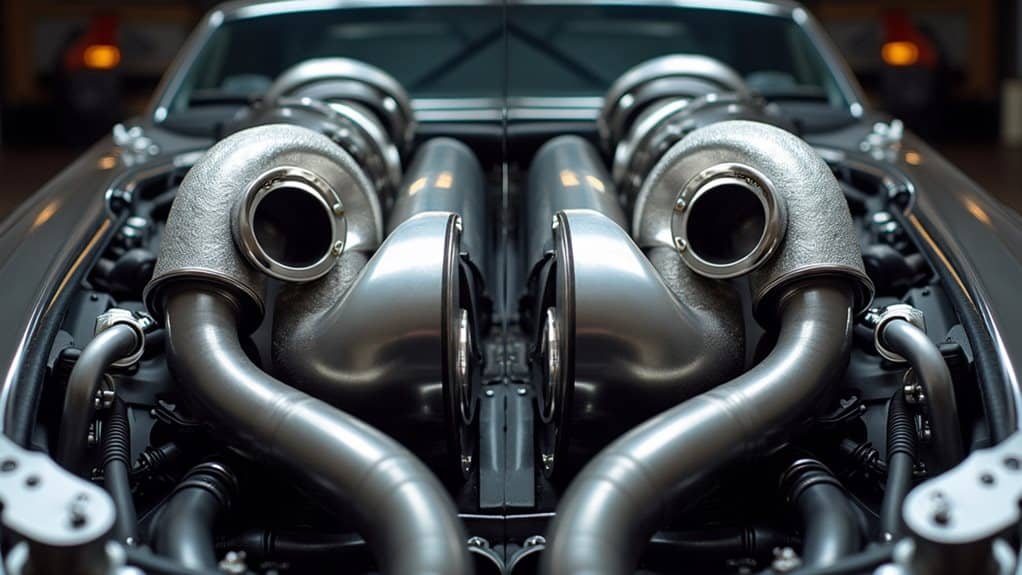
Understanding how your turbo spools and delivers pressure requires examining both the exhaust manifold (or header) and downpipe, since each component influences turbocharger performance at different stages of the exhaust cycle.
Headers optimize exhaust pulse timing and velocity to initiate turbine spin, reducing initial lag.
Downpipes minimize backpressure after the turbo, allowing faster exhaust evacuation and maintaining consistent pressure increase.
Together, they create seamless flow that accelerates spool speed and sharpens throttle response across your RPM range. Additionally, a well-functioning exhaust system helps prevent issues such as exhaust leaks, which can disrupt performance and lead to misfires.
Exhaust Sound Characteristics
When you modify your exhaust system, the resulting sound characteristics depend heavily on which components you replace and how those parts interact with your engine’s exhaust pulses.
Downpipes primarily increase overall volume and deepen tone, especially at startup and idle. They amplify burbles and crackles during deceleration.
Headers mainly alter sound frequency and pulse timing, creating raspier notes at higher RPMs rather than markedly enhancing loudness.
Installation Requirements and Complexity
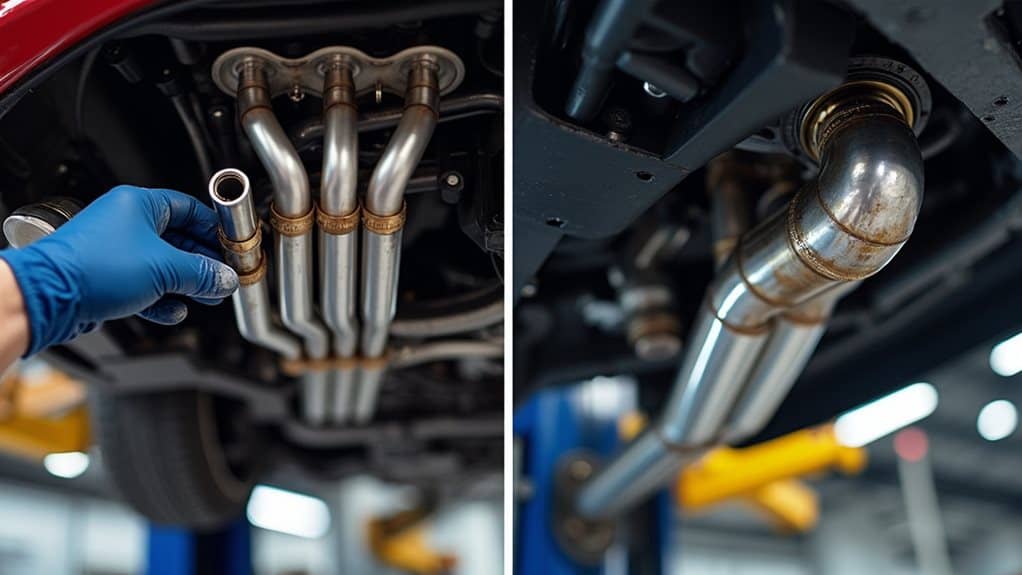
Before you commit to changing your exhaust system’s sound profile, you’ll need to understand what each upgrade actually demands regarding installation work.
Downpipes typically require one to three hours of labor, as they connect near the turbocharger with basic hand tools.
Headers demand considerably more effort, often taking several hours to a full day, since they attach directly to the cylinder head and may require engine bay disassembly.
ECU Tuning and Software Considerations
While installation complexity matters, the software running your engine’s brain plays an equally critical role in determining whether your exhaust upgrade delivers real results or just throws error codes across your dashboard.
Downpipes typically require ECU tuning because they alter turbocharger backpressure and oxygen sensor readings. Without proper calibration, you’ll face check engine lights, poor fuel economy, and limited performance gains. Headers, especially on naturally aspirated engines, rarely need extensive software modifications.
Catalytic Converter Integration and Emissions
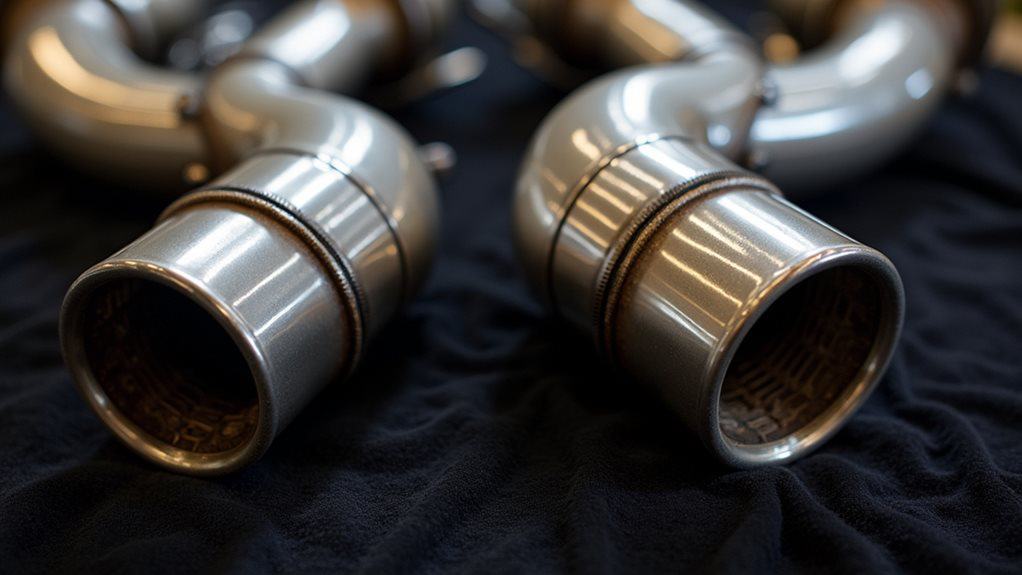
Understanding where catalytic converters sit in your exhaust system reveals fundamental differences between downpipes and headers.
Downpipes in turbocharged engines typically integrate catalytic converters directly, leveraging high exhaust temperatures for peak emissions control.
Headers, used in naturally aspirated engines, don’t include cats; instead, converters mount downstream separately. This placement difference markedly impacts emissions efficiency, with downpipe-integrated cats achieving faster light-off temperatures and superior pollutant conversion rates.
Cost Comparison and Value Analysis
When you’re evaluating exhaust upgrades, the price tag tells only part of the story—you’ll need to weigh initial costs against installation expenses, performance returns, and long-term durability to determine true value.
Downpipes typically cost $150-$800 with $100-$300 installation, while headers range $300-$1,200 with $300-$1,000+ labor.
For turbocharged vehicles, downpipes deliver superior performance-per-dollar through easier installation and significant horsepower gains.
Wrapping Up
You’ll need to choose between headers and downpipes based on your engine type. If you’ve got a naturally aspirated engine, headers deliver better gains by improving exhaust flow from the cylinder head. However, if you’re running a turbocharged setup, downpipes offer superior performance by reducing backpressure after the turbo. Both modifications require ECU tuning for peak results, and you should consider your budget, as downpipes typically cost less than quality headers.


