You’ll get about 5.0–5.3 seconds 0–60 mph in a 2007 Mustang GT with the 4.6L 3‑valve V8 (300 hp, 320 lb‑ft) and Tremec 5‑speed manual, while automatics typically run ~5.5–5.6 s due to gearing and final‑drive differences; curb weight (~3,483–3,658 lb), traction, and testing method affect times. Simple bolt‑ons and a tune can trim a few tenths, and quarter‑mile traps sit near 99–103 mph — more specifics follow.
Quick Tips
- 2007 Mustang GT 0–60 mph typically runs about 5.0–5.3 seconds (manual) and ~5.5–5.6 seconds (automatic).
- Engine: 4.6L all‑aluminum 3‑valve SOHC V8 rated ~300 hp at 5,750 rpm and 320 lb‑ft at 4,500 rpm.
- Transmission options: Tremec 5‑speed manual (3.55 final) or automatic with 3.31 final drive, affecting acceleration.
- Curb weight ~3,483 lb (coupe) gives ~11.6 lb/hp power‑to‑weight, supporting ~5.2s 0–60 typical performance.
- Common improvements (intake, exhaust, ECU tune, tires, gearing) can trim 0–60 by ~0.5–0.8 seconds.
Quick Answer: 2007 Mustang GT 0–60

Start with the headline figure: the 2007 Mustang GT typically does 0–60 mph in roughly 5.0–5.3 seconds, depending on drivetrain and testing conditions.
You’ll typically see manuals around 5.0–5.3 seconds, automatics slightly slower near 5.5–5.6, and verified tester averages close to 5.1.
Variations stem from testing methods, modifications, and environmental factors that affect traction and measured acceleration.
The Mustang has long been regarded as a performance icon with acceleration figures compiled from Ford and independent publications.
Engine & Drivetrain Specs That Set Performance
Because the 2007 Mustang GT pairs a 4.6‑liter, all‑aluminum 3‑valve SOHC V8 with a rear‑drive layout, you’ll get a clear view of how its engine and drivetrain set its performance characteristics: you’ll have 300 hp at 5,750 rpm and 320 lb‑ft at 4,500 rpm, a lightweight block, Tremec 5‑speed manual option, 3.31 ring‑and‑pinion gearing, mechanical clutch, and sequential fuel injection. The 3‑valve design also incorporates Variable Valve Timing to enhance horsepower and fuel efficiency.
0–60: Manual Vs Automatic 2007 GT
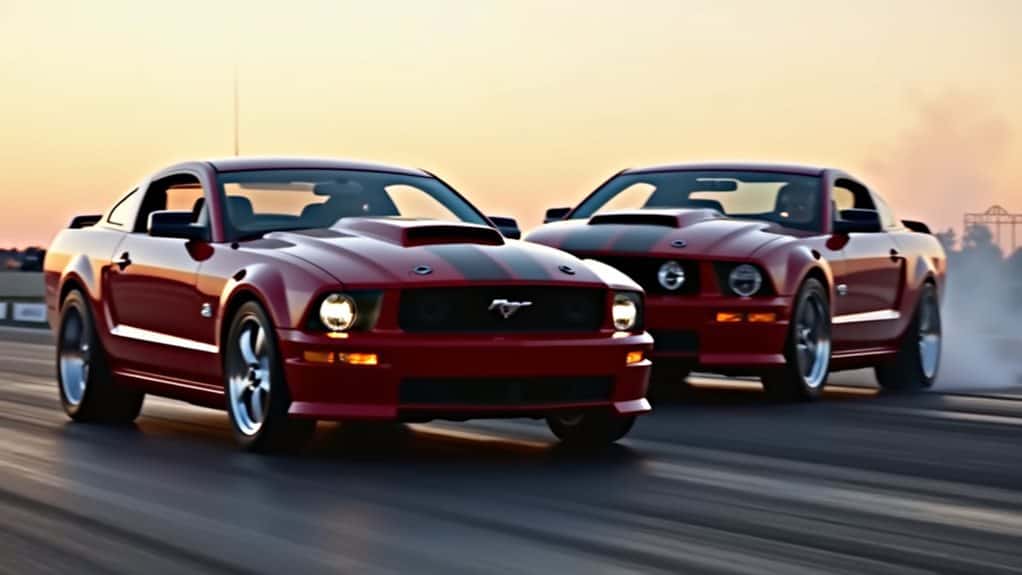
While both the manual and automatic 2007 Mustang GT share the same 4.6‑L, 300‑hp V8 and 320 lb‑ft of torque, their differing gear ratios and final drives produce measurable gaps in 0–60 performance, so you should look at drivetrain details as closely as the engine numbers.
The automatic’s 3.31 final drive and taller gears yields about 4.4–4.6s, the manual’s 3.55 and shorter 1st gives roughly 4.8–5.2s.
Real‑World 0–60 Tests And Owner Reports
After comparing drivetrain gearing and factory figures, you should look at real‑world tests and owner reports to see how the 2007 Mustang GT actually performs on the street.
Media tests cluster around 5.0–5.4 seconds 0–60, owners report 4.69–5.4s depending on tune and transmission, and consistent street runs (no drag prep) usually fall near 5.2s.
2007 Mustang GT Quarter‑Mile Times & Trap Speeds
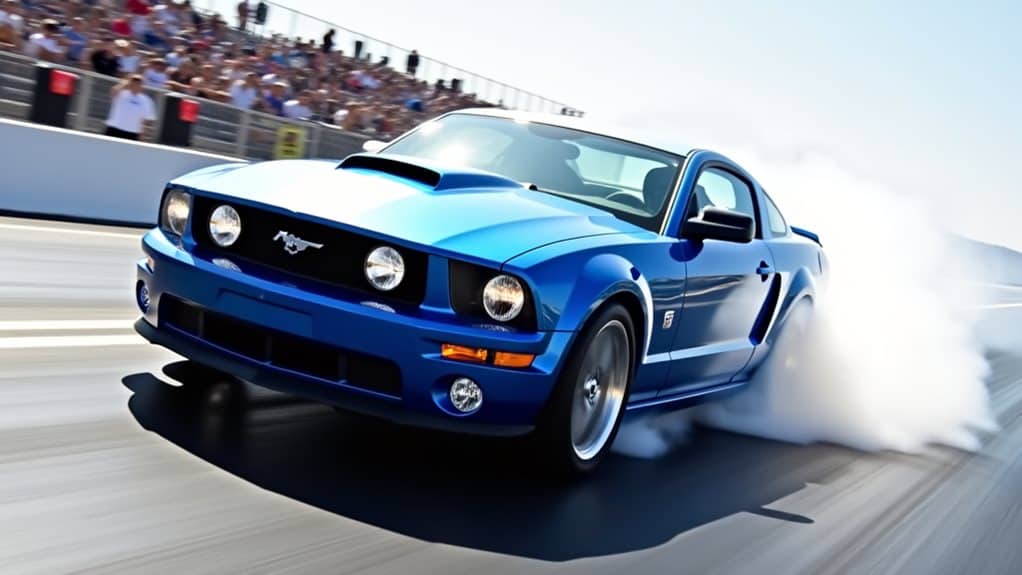
When you look at 2007 Mustang GT quarter‑mile results, you’ll see a tight band of consistent performance that reflects drivetrain choices, gearing, and testing conditions.
You’ll find times from about 13.3 to 14.3 seconds, traps mostly 99–103 mph; automatics often run slightly quicker trap speeds, manuals vary with TR3650 and gearing, and package differences produce small, measurable changes.
How 3.31 Vs 3.55 Final Drives Change Launches
Quarter‑mile results help set the stage for understanding how final drive choices change launch behavior, because trap speeds and shift patterns you saw earlier directly reflect gearing and torque use.
Choosing 3.55 increases wheel torque about 6.9%, raising rpm at low speeds, so launches are quicker and require fewer shifts.
3.31 favors economy, needs earlier upshifts, and slows 0–60 by ~0.3–0.5s.
Weight, Aero, And Their Effect On 0–60
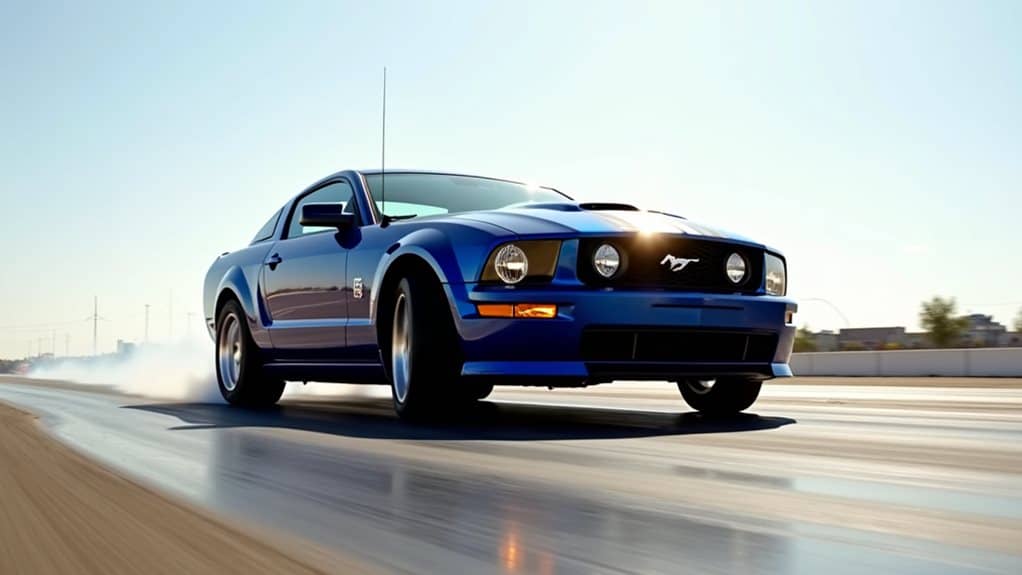
You’ll first look at how curb weight — roughly 3,483 lbs for the GT coupe and about 3,658 lbs for the convertible — directly affects launch acceleration, since extra mass requires more force to accelerate and empirically adds about 0.1 seconds to 0–60 for each 100 lbs.
Then consider aerodynamic drag: with an estimated Cd of 0.36 and a frontal area near 22.3 sq. ft., wind resistance rises with the square of speed and increasingly limits acceleration at higher velocities and toward the car’s 156 mph drag-limited top speed.
Finally, combine those factors into the GT’s ~11.61 lbs/hp ratio (3,483 lbs / 300 hp) is a primary predictor of its ~5.2 s 0–60 time, so changes in weight or aero that alter effective load on the engine will shift that number predictably.
Inspecting for external burn marks can reveal unusual heat or electrical damage that may affect structural integrity and aerodynamics.
Curb Weight Impact
A car’s curb weight plays a direct role in its 0–60 performance, and you should understand both the simple physics and the practical trade-offs involved.
Heavier mass requires more force to accelerate, so the engine and drivetrain must work harder, which lengthens 0–60 times.
Reducing curb weight improves acceleration, but you’ll balance structure, safety, and comfort against gains in straight-line performance.
Aerodynamic Drag Effects
Consider how aerodynamic drag and vehicle weight work together to shape 0–60 performance, because drag steals engine power as speed rises while mass determines how much force is needed to change velocity.
You’ll notice the GT’s 7% Cd drop cut drag at 60 mph by ~15–20 lb, lowering required thrust; smoother bodywork and reduced lift improve stability and maintain tire contact for quicker, consistent acceleration.
Power-To-Weight Ratio
Most drivers can get a clear sense of how power-to-weight ratio shapes 0–60 times by comparing the Mustang GT’s 300 hp to its 3,483 lb curb weight, which yields about 0.086 hp per pound (or 1.16 lb per hp); that numeric relationship sets the fundamental limit on how quickly the car can accelerate because the engine must overcome the vehicle’s mass before aerodynamic and traction factors dominate.
You’ll see 5.0–5.3 s 0–60, quarter‑mile mid‑13 s, and modest gains from weight reduction or taller gearing, since less mass or better gear ratios improve acceleration efficiency.
Bolt‑Ons & Tuning For The 2007 GT (Expected Gains)
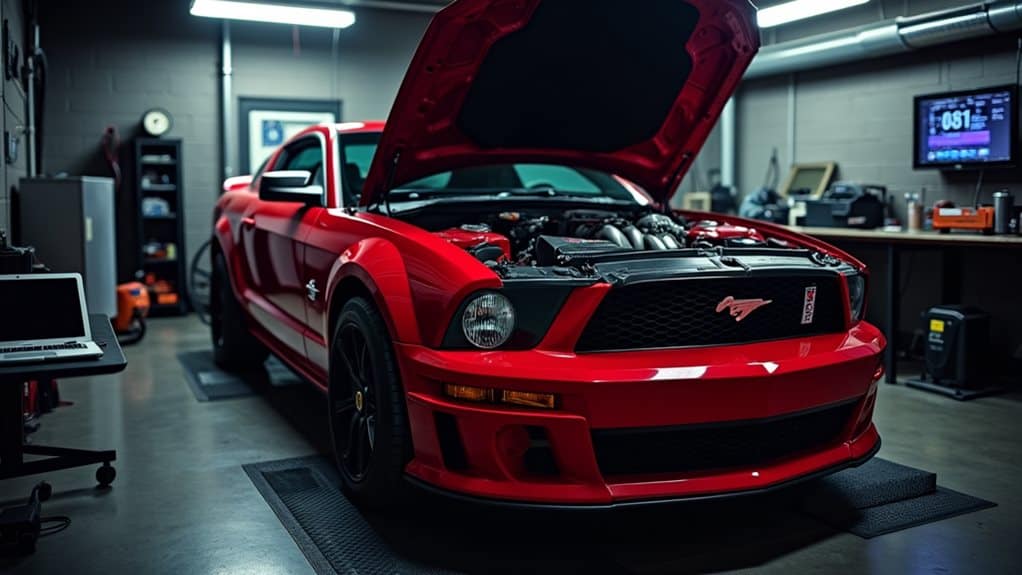
You’ll see the biggest, most reliable gains from a combined approach: cold‑air intakes and throttle upgrades improve intake temps and throttle response, while header and high‑flow exhaust swaps cut backpressure and shed 15–20 lbs for better launches.
Pairing those hardware changes with ECU tuning or a performance programmer recalibrates fuel, ignition, and shift maps—adding roughly 10–25 hp and trimming 0–60 times by a few tenths, depending on calibration and transmission.
Start with intake and exhaust, then tune the ECU to match the hardware so you get safe, measurable improvements without exceeding engine limits.
Proper professional tuning is strongly recommended after installing long tube headers to recalibrate air-fuel and timing maps and prevent lean conditions from causing engine damage, since headers can alter exhaust flow and oxygen sensor readings and require ECU recalibration.
Intake And Throttle Upgrades
When you upgrade the intake and throttle components on a 2007 Mustang GT, you’re changing how much air the engine can breathe and how quickly it responds, and those changes directly affect horsepower, torque, and drivability.
cold air intakes (CAIs) typically add between 10–35 hp depending on design and filter/media, while ported or high‑flow intake manifolds can add 15–50 hp but almost always need a custom tune to run correctly.
Choose CAIs like BBK or JLT for modest gains without immediate tuning, upgrade throttle bodies to improve response, and plan a custom tune when swapping plenums or manifolds to safely realize advertised horsepower and torque increases.
Exhaust And Header Swaps
Although exhaust and header swaps might seem like simple bolt‑on upgrades, they change flow behavior, backpressure, and scavenging in ways that directly affect horsepower, torque, and drivability.
You can fit cat‑back or axle‑back systems to gain 5–25 hp and 10–20 lb‑ft; headers add 20–50 hp.
Install carefully, relocate O2 sensors when needed, and expect improved mid‑range response and slightly faster 0–60 times.
ECU Tuning And Tunes
Because an ECU tune changes how the engine manages fuel, spark, and throttle, it’s one of the most effective bolt‑on upgrades you can do for a 2007 Mustang GT. You’ll see 20–40 WHP and 20–35 ft‑lbs gains, sharper throttle response, and roughly 0.5–0.8s quicker 0–60.
Tunes require 93 octane, support bolt‑ons, enable datalogging, and improve efficiency.
Fuel Economy vs Performance: What Tuning Costs
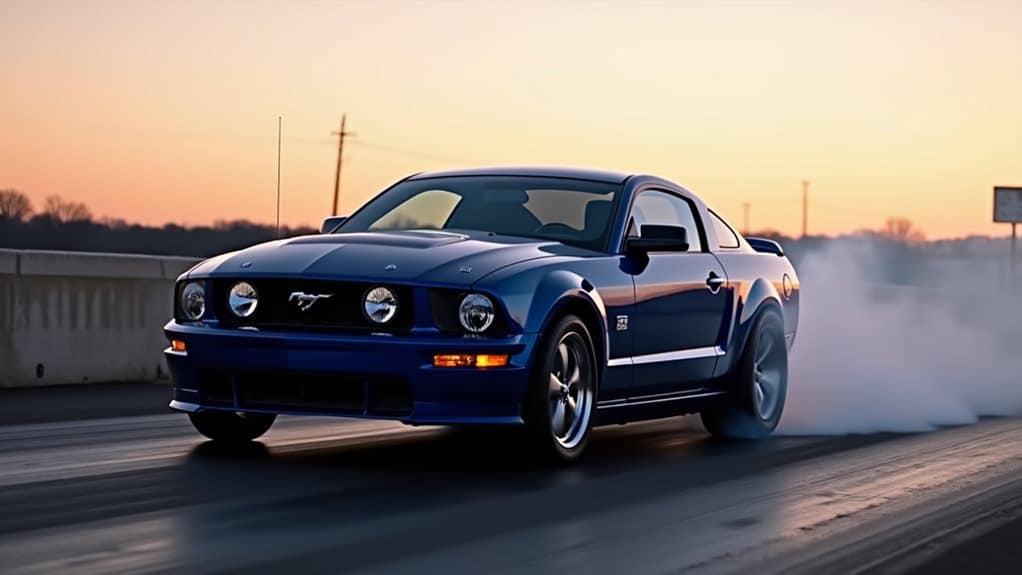
If you want to increase your Mustang GT’s performance, be prepared to trade some fuel economy for measurable power gains and quicker 0–60 times, and understand exactly where those losses come from so you can make informed choices.
Small mods (intake, cat-back) can slightly improve MPG or keep it similar, while tunes and forced induction raise power but cut MPG substantially; weigh cost, longevity, and drivability.
Professional dyno tuning can help optimize gains while minimizing negative impacts on fuel economy and reliability by precisely adjusting timing, fuel delivery, and other parameters dyno tuning.
Best 2007 GT Setups: Street, Drag, Daily
You’ll want distinct setups for street, drag, and daily use to get the most from a 2007 GT, because tuning priorities like traction, gearing, and power delivery differ for each application.
For street performance focus on intake/exhaust/tune, sticky tires, and adjusted suspension for improved grip and handling without sacrificing daily drivability.
For drag prep prioritize gearing (3.55 or specific rear-end ratios), a short-throw shifter or upgraded clutch, launch-optimized suspension and tires, while daily optimization balances mild power upgrades, comfort-oriented suspension bushings, and reliability-focused maintenance.
Regular inspections and using quality parts that meet OEM standards help prevent failures like a bad serpentine belt or belt tensioner that can hurt drivability.
Street Performance Setup
When preparing a 2007 Mustang GT for street performance, start by balancing power, handling, and daily drivability so the car stays dependable for regular use while still providing noticeable improvement; this means focusing on bolt-on engine mods, suspension upgrades, and braking enhancements that work together rather than in isolation.
Add cold-air intake, cat-back exhaust, tuned programmer, adjustable coilovers, upgraded sway bars, better pads.
Drag Strip Preparation
Before you hit the beams at the strip, set up your 2007 Mustang GT specifically for drag work by focusing on traction, launch control, staging technique, and basic safety checks so every pass is repeatable and legal.
Use drag slicks or radials, drop rear pressures to 20–25 psi, raise fronts to 40–45 psi, perform burnouts in the box, use drag mode and hold 1,800–2,000 rpm, confirm helmets and fluids.
Daily Driver Optimization
Frequently, daily-driving a 2007 Mustang GT means balancing performance, comfort, and economy, so you’ll want a setup that keeps the car reliable and pleasant to use every day while preserving its sport character.
Prioritize routine maintenance, use correct TR3650 gear oil, fit 17-inch performance tires, keep factory suspension settings for comfort, and retain power seat and audio options for practical daily usability.
Wrapping Up
You can expect the 2007 Mustang GT to reach 0–60 mph in about 4.8–5.3 seconds depending on transmission, tires, and conditions, with the 4.6L V8, 3.31–3.55 axle ratios, and manual gearing affecting launch. Quarter‑mile runs mid‑12s, and weight, aerodynamics, and traction play measurable roles. Simple bolt‑ons and tuning typically yield 10–30% gains but can reduce fuel economy; choose setups aligned with street, drag, or daily use.