The quickest way to tell a 4L60E from a 4L80E is to count the bolts on the transmission oil pan. The 4L60E pan has 16 bolts. The 4L80E pan has 17, and it is oval rather than rectangular. If the count is not conclusive, measure the length, check the output shaft spline count and read the case tag. All four checks are below, with the numbers to expect.
Quick Answer: 16 Bolts or 17
Three checks settle it in a couple of minutes on a creeper.
- Pan bolts. 16 is a 4L60E. 17 is a 4L80E.
- Pan shape. The 4L60E pan is roughly rectangular and normally has no drain plug. The 4L80E pan is longer, more oval and usually does carry one.
- Length. The 4L80E is around 3 inches longer overall and sits noticeably further back under the truck.
Those three catch almost every unit. The spline count and the tag settle the rest.
4L60E vs 4L80E at a Glance
| Spec | 4L60E | 4L80E |
|---|---|---|
| Family it descends from | 700R4 / 4L60 | TH400 |
| Rough production years | 1993 to 2008 | 1991 to 2009 (including 4L85E) |
| Oil pan bolts | 16 | 17 |
| Pan shape | Rectangular, usually no drain plug | Oval and deeper, usually has a drain plug |
| Dry weight | About 150 lb | About 230 to 236 lb |
| Overall length | Baseline | About 3 in longer |
| Output shaft spline | 27 spline | 32 spline |
| Stock torque rating | About 360 lb-ft | About 440 lb-ft |
| Fourth gear overdrive | 0.696:1 | 0.750:1 |
| Fluid | Dexron III or VI | Dexron III or VI, about 2 quarts more |
Weights and lengths move a little with the tailshaft housing, the converter and whether the unit is wet, so treat these as dry figures for comparison rather than a spec sheet for one part number.
Count the Pan Bolts
Pull the pan bolts into focus and count them one at a time around the perimeter. Sixteen means the 4L60E family. Seventeen means a 4L80E or 4L85E. The factory bolts take a 13 mm socket on both, so socket size tells you nothing.
This is the single most reliable field test because the number does not change with model year, engine or application. It is also the check that most online guides get wrong, so confirm it yourself rather than trusting a forum post.
Check the Pan Shape and Drain Plug
Shape is the second clue. A 4L60E pan is close to a rectangle with squared corners. A 4L80E pan is longer and more oval, and the extra depth is there because the unit carries more fluid.
Most 4L80E pans also have a drain plug. Most 4L60E pans do not, so a plug under the pan is a strong hint you are looking at the heavier transmission. A pan that has been swapped for an aftermarket deep pan breaks both rules, which is why the bolt count still comes first.
Measure the Length and Weight
The 4L80E is roughly 3 inches longer overall than a 4L60E in the same application, and around 80 lb heavier dry. That difference shows up in the driveshaft length, the crossmember position and the clearance around the tunnel.
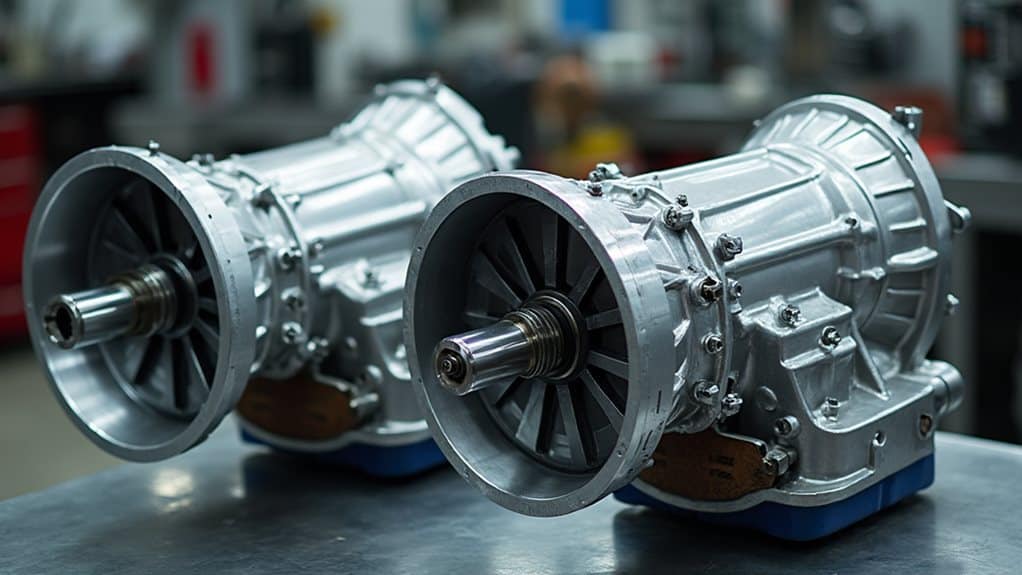
Measure from the bellhousing face to the end of the tailshaft housing. Do not measure to the end of the output shaft, because 2WD and 4WD shafts differ in how far they protrude and will mislead you.
If the transmission is still in the vehicle, check the badge on the door jamb instead. A 2500 or 3500 series truck or a full-size van is far more likely to have the 4L80E from the factory.
Look at the Output Shaft Spline
The 4L60E uses a 27 spline output shaft. The 4L80E uses a 32 spline shaft, inherited from the TH400. If the driveshaft is out, counting splines is conclusive.
This matters when you are buying a used unit, because the wrong spline means a new yoke and often a new driveshaft as well.
Bellhousing and Case Differences
Both units bolt to the Chevrolet 90 degree bellhousing pattern, so the engine side does not separate them. The case side does. The 4L80E has an integral bellhousing and a much larger, squarer case. Later 4L60E units have a removable bellhousing and a six bolt tailshaft housing pattern.
Do not use bellhousing shape alone as your test. It varied across the 4L60E run and it is the claim most often repeated incorrectly online.
Gear Ratios: The Difference You Feel
The ratios explain why the two units drive so differently even though both are four speed overdrives.
| Gear | 4L60E | 4L80E |
|---|---|---|
| First | 3.059:1 | 2.482:1 |
| Second | 1.625:1 | 1.482:1 |
| Third | 1.000:1 | 1.000:1 |
| Fourth | 0.696:1 | 0.750:1 |
| Reverse | 2.294:1 | 2.077:1 |
The 4L60E has the deeper first gear, which helps a lighter vehicle get moving and feels stronger off the line. The 4L80E trades some of that launch for a closer spread and a slightly shorter overdrive, which suits a heavy truck pulling a load.
If a swap changes your first gear from 3.059 to 2.482, expect the truck to feel softer from a standstill unless you also change the rear axle ratio. The heavier internals and larger pump also take a little more power to turn, which is the small power loss people notice after a swap.
Strength and Torque Rating
Stock, GM rated the 4L60E to about 360 lb-ft and the 4L80E to about 440 lb-ft. The gap is not just the number: the 4L80E runs larger shafts, drums and clutch packs throughout, and it is the unit that survives sustained towing and higher power without a rebuild.
A built 4L60E closes a lot of that gap, which is why the answer to which one is better depends on what you are asking it to do rather than on the badge.
Read the Tag and Casting Numbers
Every unit carries a tag or a stamped code that identifies the family, the model year and the original application. Decode that and you stop guessing. The tag is normally on the case near the pan rail or on the tailshaft housing, and the format differs by manufacturer.
Our Borg-Warner transmission identification guide covers tag formats in detail, and the Ford C4 identification page shows the same method applied to a different family. If you are working on a Ford instead, start there.
Which One Should You Have
| Your situation | Better fit |
|---|---|
| Half ton truck, stock or mild engine, daily driving | 4L60E |
| 2500 or 3500 truck, heavy towing, big block or diesel | 4L80E |
| Engine comfortably above 400 lb-ft | 4L80E |
| Tight tunnel or floor clearance | 4L60E |
| Budget swap with the existing driveline kept | 4L60E |
Remember that the transmission is only one part of the combination. Vehicle weight, traction, gearing, converter choice and the tune all decide whether a given unit feels right.
If your unit is already fitted and the complaint is behaviour rather than identity, the symptom is usually more useful than the model number. A unit that shifts fine until it warms up is pointing at pressure or electronics, not at which family it belongs to. A TH350 with a badly set cable shows up as harsh or late shifts, which is a kickdown cable adjustment before it is anything else.
For everything else in this family, start from the transmission guides hub.
Frequently Asked Questions
How can I tell a 4L60E from a 4L80E quickly?
Count the oil pan bolts. Sixteen is a 4L60E, seventeen is a 4L80E. If the pan is out of reach, check the pan shape and measure the overall length, which is about 3 inches longer on the 4L80E.
Does the 4L80E pan have 17 bolts?
Yes. The 4L80E and 4L85E use a 17 bolt oval pan with a drain plug. The 4L60E uses a 16 bolt rectangular pan, normally without a drain plug.
When did GM stop using the 4L80E?
The 4L80E family ran from 1991 to 2009, including the heavier duty 4L85E variant. The 6L90 replaced it in most heavy truck applications.
Is the 4L80E stronger than the 4L60E?
Yes. GM rated the 4L80E to about 440 lb-ft against about 360 lb-ft for the 4L60E, and the 4L80E uses larger internal components. A built 4L60E can handle far more than its stock rating, but it needs the build.
How much longer is a 4L80E than a 4L60E?
About 3 inches overall in the same application, which normally means a shorter driveshaft and a different crossmember position when you swap.
Can I swap a 4L80E into a 4L60E truck?
Yes, but it is not a bolt in job. You need a 32 spline yoke, a modified or new driveshaft, the right crossmember and mount, the 4L80E wiring and connector, and a tune that knows the transmission is different.
Do both use the same transmission fluid?
Both take Dexron III or Dexron VI, but the 4L80E holds about 2 quarts more. Check the level on the dipstick after any service rather than filling to a fixed quantity.
Was the 4L80E a good transmission?
It has a strong reputation for durability in heavy trucks and towing, and it is the usual upgrade target for a 4L60E that keeps failing. Its weaknesses are weight, size and the extra work needed to fit it.