When you hear “deck” on a car, it usually means the rear upper surface and its hinged cover — the decklid or trunk lid — plus the enclosed cargo area (trunk or boot) beneath it; the term can also apply to a front-mounted frunk on electric or rear-engine cars. The deck provides weather sealing, mounting for trim and spoilers, structural stiffness, and crash-energy routing, and engine builders use “deck surface” for the block face that mates to the head; keep going and you’ll learn more.
Quick Tips
- “Deck” commonly refers to the rear upper exterior surface of a car, forming the top of the trunk area.
- The movable cover over the cargo area is often called a decklid or trunk lid, providing access to the trunk/boot.
- In some cars (electric/rear‑engine) the front compartment is called a “frunk” or front deck, serving as extra storage.
- Engine terminology: the block’s flat top where the head mounts is also called the deck and is machined for proper sealing.
- Deck structure contributes to rear stiffness, crash energy management, and can be made from steel, aluminum, or composites.
Definition of the Deck on a Car Body

Think of the deck as the car’s rear shoulder: it’s the exterior upper surface of the body located immediately behind the rear window and forming the top of the vehicle’s rear section.
You’ll see it on front-engine cars, covering the cargo area, integrating with quarter panels and spoilers, made from steel, aluminum, or composites, and finished precisely to support lids and maintain aerodynamics. Regular care and maintenance can prevent corrosion and preserve finish. The deck also serves as a primary part of the vehicle’s main body structure.
Decklid Versus Trunk Lid: What’s the Difference?
Terminology matters: “decklid” and “trunk lid” both refer to the hinged cover at the rear of a passenger vehicle that gives you access to the cargo compartment, but they carry different connotations and sometimes different materials and design details.
You’ll find “decklid” used for luxury or sports cars, often lighter materials and aerodynamic detailing, while “trunk lid” suits standard passenger models. Some vehicle manufacturers also use different mounting and hardware designs for rear lids, which can affect compatibility with replacement parts.
Many people mix the terms up, but the key distinction is that the decklid is the movable cover while the trunk is the storage space beneath it.
Deck as the Vehicle’s Cargo Area (Trunk/Boot)

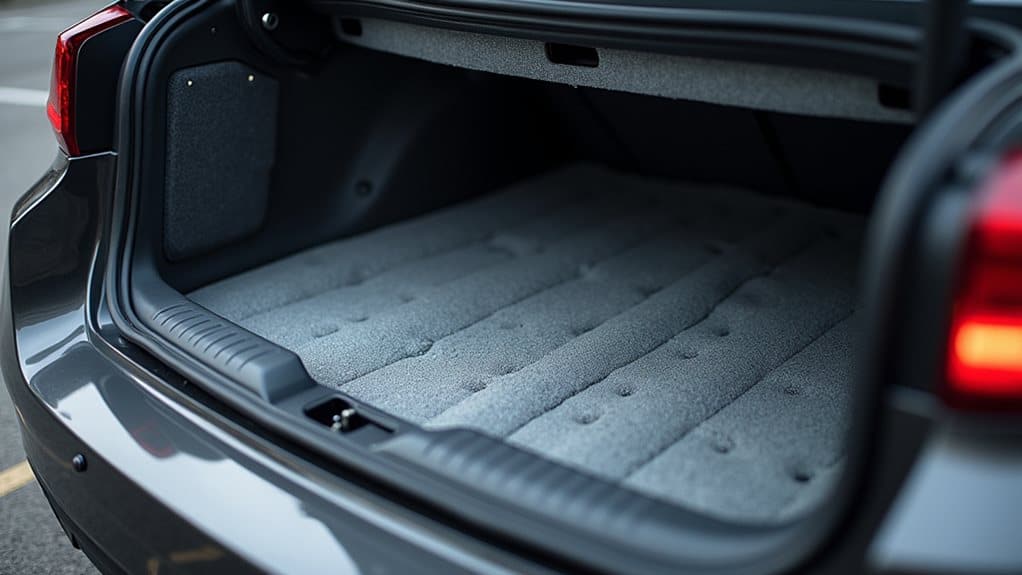
A car’s deck—commonly called the trunk in American English or the boot in British English—is the enclosed cargo compartment at the rear of most passenger vehicles, and it’s designed to store luggage, groceries, tools, and other items securely while keeping them separate from the passenger cabin.
You access it via a hinged or liftgate lid; it’s metal-lined, carpeted, weather-sealed, and may include fold-down seats for extra volume.
Many vehicles with larger engines, such as certain Ford trucks that transitioned from 2V to 3V designs, may have different rear cargo configurations to accommodate exhaust or drivetrain components.
Front Decks and “Frunks” in Electric and Rear-Engine Cars
Beyond the rear trunk, many cars put usable storage under the front bodywork, often called the front deck or “frunk” (front + trunk), and you’ll find this especially on electric vehicles and rear-engine designs.
You can use frunks for extra cargo, they often seal against water, include drains and lights, and may be power‑assisted; designers balance volume, access, safety, and weight distribution.
Regular checks like replacing the cabin air filter can help maintain airflow and prevent debris from accumulating in vents and ducts, which protects climate control performance and passenger comfort cabin air filter.
Deck Surface in Engine Terminology
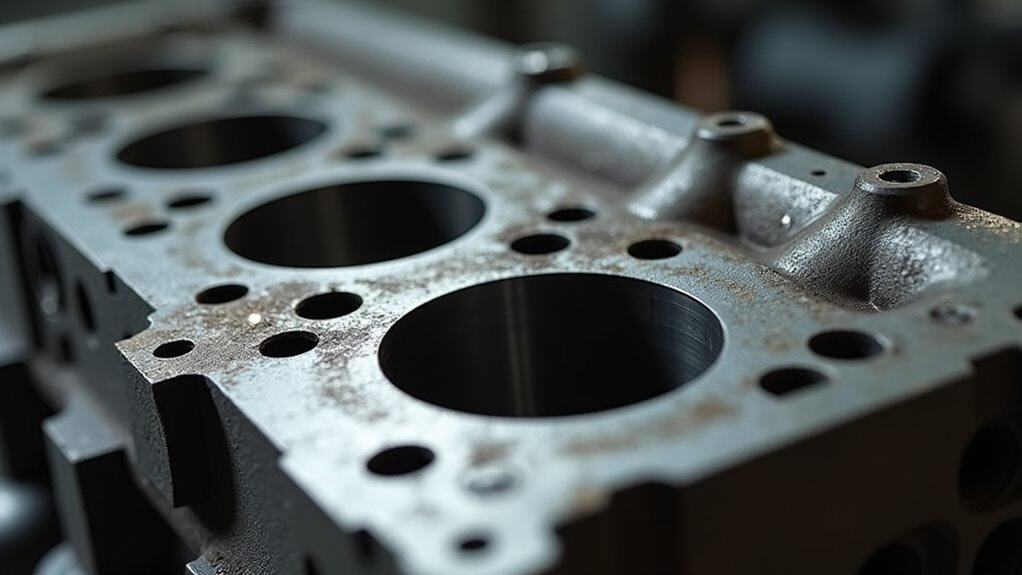
Think of the deck surface as the flat tabletop on which the cylinder head sits; it’s the top face of the engine block that must be perfectly flat and square so the head and block seal correctly.
You must machine (deck) this surface to remove warp, set deck height relative to the crank centerline, guarantee piston-to-deck clearance, and secure reliable head gasket sealing for proper compression.
Open, Semi-Closed, and Closed Engine Deck Designs
In engine design, deck type describes how much of the block surrounds each cylinder and directly affects cooling, strength, and suitability for pressurized or high‑stress use.
Open decks maximize coolant flow but reduce rigidity, semi‑closed decks add small bridges for better support while keeping cooling, and closed decks prioritize structural integrity with limited coolant passages, favorable for high‑boost or high‑longevity applications.
How Deck Design Affects Engine Strength and Longevity
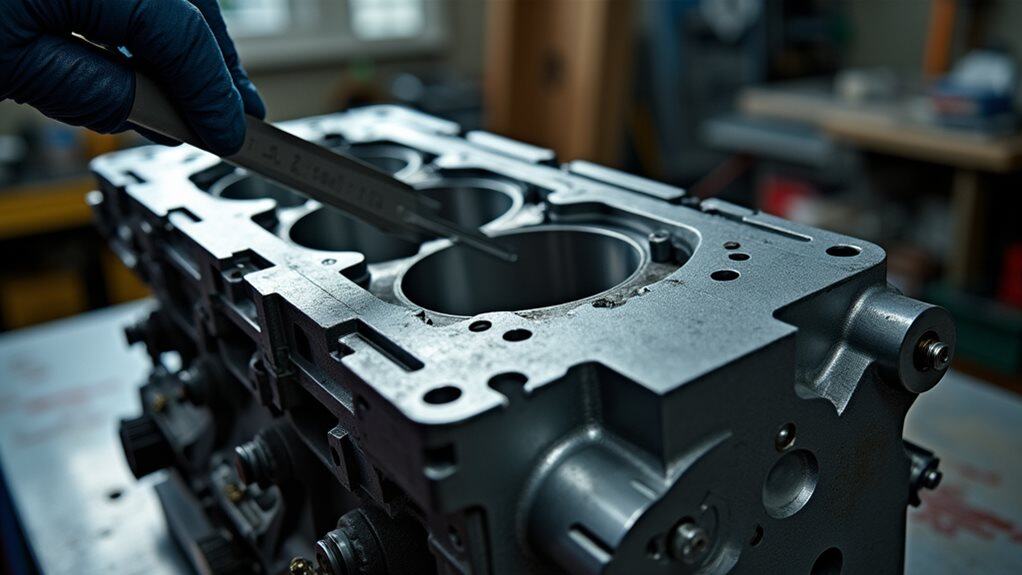
You’ll see that the deck type—open, semi-closed, or closed—directly affects how the block handles combustion pressures and heat, with closed decks generally giving greater rigidity and resistance to distortion.
That rigidity lowers head gasket stresses by keeping the cylinder head and deck surface flat and evenly loaded, which helps prevent leaks or gasket failure under high turbocharging or heavy loads.
When you choose or modify an engine, consider how deck design changes sealing requirements, quench behavior, and the need for reinforcements like studs or thicker gaskets to preserve strength and longevity.
Deck Type Impact
Several common deck designs—closed, semi-closed, and open—directly affect an engine’s structural strength and how long it will last, so you should understand their differences before choosing or modifying a motor.
Closed decks give maximum rigidity, reduced cylinder distortion, and better cooling under pressure, increasing longevity.
Semi-closed offers compromise; open decks trade strength for lighter weight and easier coolant flow, risking warping and premature wear.
Head Gasket Stresses
Consider how the deck design sets the stage for every load the head gasket must carry: thermal expansion, mechanical clamping, and combustion pressure all converge at the block-to-head interface, so differences in deck height, thickness, rigidity, and surface finish directly change gasket stress patterns.
You should guarantee flatness, appropriate thickness, and material choice to reduce thermal mismatch, distribute bolt clamping evenly, and limit flex that causes gasket fatigue.
Decklid Styles: Hinges, Hatchbacks, and Liftgates
When you compare trunk openings across vehicle types, hinge placement and panel design determine how the rear loads and how you access cargo, so understanding decklids, hatchbacks, and liftgates helps you choose or service the right part.
Decklids hinge at the bottom on sedans, are lighter (aluminum/carbon fiber), and separate from the rear glass. Liftgates hinge at the top, are heavier, and give larger access.
Decking as a Customization Practice

Modifying the rear deck—often called “decking”—means building or fitting custom panels, enclosures, and mounts in the car’s rear area to house audio components and improve both looks and sound.
You’ll choose materials like MDF, fiberglass, or plastics, design subwoofer and amplifier mounts for best enclosure volume, add upholstery or lighting, and follow installation and acoustic treatment practices to balance performance and trunk usability.
Regional Terms for the Deck and Trunk (Dickey, Boot, Compartment)
Vocabulary differences—like trunk, boot, or dickey—reflect how the same car feature is named across regions, and knowing them helps you communicate clearly about the rear storage area.
In the US you’ll hear trunk, in the UK boot, and in South Asia dickey or dikki; Australia/New Zealand favor cargo or luggage compartment.
Regional history and carriage or luggage origins explain these variants.
Structural Role of the Deck in Rear Bodywork and Safety
You’ll see the rear deck functions as a key structural support, tying suspension mounts and body panels together to increase rear rigidity and control flex under load.
This stiffness helps distribute forces from bumps and cargo across the chassis, and in a collision the deck’s design and connections guide crash energy away from the passenger compartment.
Understanding these roles—how the deck supports rear structures and manages impact energy—lets you appreciate why material choice, geometry, and attachment methods matter for safety and handling.
Rear Structural Support
In the rear of a vehicle, the deck serves as a key structural element that stiffens and ties together otherwise flexible panels, so it’s critical for maintaining body rigidity and protecting rear-mounted components.
You’ll see crossbraces, filler panels, and high‑strength steel or aluminum supports that reduce flex, preserve aerodynamic shape, distribute loads to the chassis, and shield fuel and trunk components from deformation.
Crash Energy Management
Crash energy management in the rear bodywork depends heavily on the deck, a horizontal structural platform that’s engineered to absorb, distribute, and redirect collision forces away from the passenger compartment.
You should know the deck transfers loads to crush zones, uses bending and axial deformation to dissipate energy, and preserves survival space by preventing intrusion, working with bumpers, rails, and reinforced features.
Decks on Ships and Other Non-Automotive Uses of the Term
A ship’s deck is the horizontal surface that serves as both the “roof” of the hull and a key structural element, so you should think of it as the backbone for onboard activity and strength: main, upper, and various specialized decks distribute loads, enclose compartments, and provide working and living spaces.
You’ll learn deck types, numbering, superstructure roles, and how decks tie into hull frames and stability.
Wrapping Up
You’ve learned that “deck” usually refers to the car’s rear exterior panel or the cargo area (trunk/boot), and that decklid and trunk lid are often used interchangeably though they can emphasize different surfaces; electric and rear‑engine cars can have front “frunks”; engine decks refer to cylinder head surfaces; and decking can mean cosmetic customization. Remember the deck contributes to structure and safety, and regional terms vary, so check circumstance when you read or speak about a car’s deck.