Most passenger cars have one catalytic converter, but your vehicle can have from one to four depending on engine layout and exhaust design. Inline‑4 engines usually use a single converter; V6 and V8 engines commonly use one per bank plus an underfloor or rear main cat, and turbocharged or Euro‑6 vehicles may add pre‑cats to cut cold‑start emissions. You can confirm count by visual inspection, O2 sensor bungs, the VECI label, or VIN/service manual — continue for specifics.
Quick Tips
- Most passenger cars have one catalytic converter required by federal rules to control emissions.
- Engine layout matters: inline-4s usually use one, V6s commonly have two or three, V8s often two or more.
- Dual exhaust or true dual-bank engines typically need one converter per bank; twin tailpipes can be cosmetic.
- Modern cars may add pre-cats (front) and underfloor/main cats, increasing total converters for stricter emissions.
- Confirm exact count by visual inspection (heat-shielded bulges, O2 sensor bungs), VECI label, or VIN/service documentation.
How Many Catalytic Converters Does a Typical Car Have? (Quick Answer)
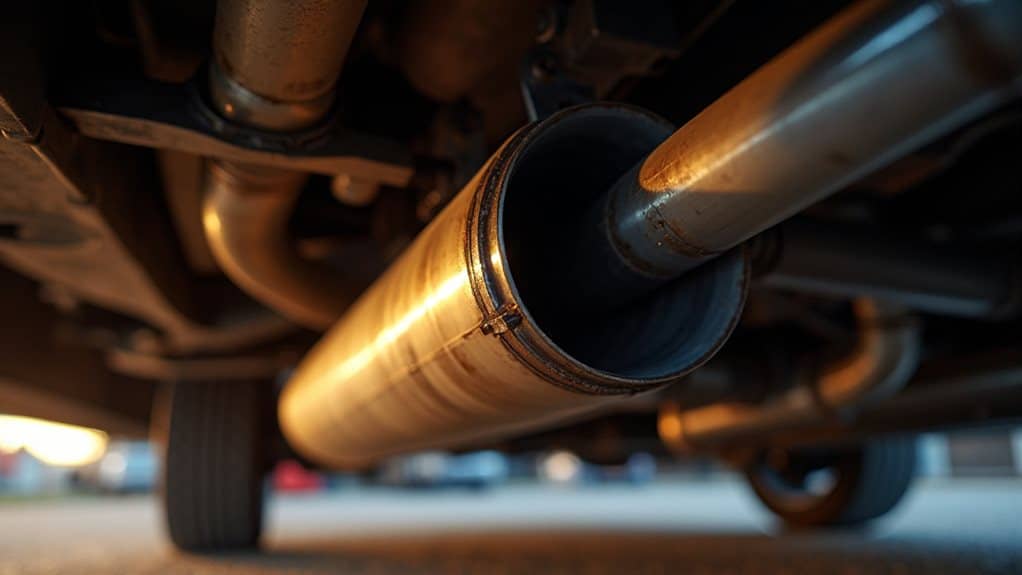
Although designs vary, most everyday passenger cars come with just one catalytic converter, and knowing this helps you quickly assess basic maintenance and repair needs.
You’ll usually find a single unit on typical sedans and many compact cars; federal rules require at least one working cat.
Check manuals or inspect the exhaust to confirm, since dual systems or pre‑cats raise the total.
Some newer vehicles may have two converters [pre-cat
A clogged catalytic converter can cause rough idle and other performance issues by creating exhaust back pressure that disrupts engine combustion.
How Engine Type (4‑Cyl, V6, V8) Affects Catalytic Converter Count
When you look at four-cylinder engines, you’ll usually find a single catalytic converter mounted directly after the exhaust manifold, because inline-fours have one exhaust bank and don’t need separate units.
With V6 engines, you’ll see dual-bank configurations—each cylinder bank has its own primary converter and many designs add a downstream converter between the banks, bringing the total to two or three units depending on layout and emissions requirements.
V8s commonly require two or more converters due to their dual exhaust banks, and high-performance or turbocharged V8s often use four converters (two primary units per bank plus downstream or pre-catalysts) to meet stricter emission controls.
A failing catalytic converter can cause the downstream O₂ sensor to report reduced efficiency, triggering diagnostic trouble codes and a check-engine light.
Four‑Cylinder Converter Placement
Because four-cylinder engines have a single exhaust bank, you’ll typically find just one catalytic converter on these cars, mounted close to the mid-pipe or near the muffler to fit compact exhaust layouts.
You’ll see smaller main cats and sometimes tiny pre-cats by the manifold for cold-start control; placement balances packaging, emission standards, and flow, keeping systems simple and cost-effective.
V6 Dual‑Bank Configurations
Four-cylinder cars usually have a single catalytic converter because they use one exhaust bank, but V6 engines split exhaust flow across two banks and that changes how many converters you’ll see.
In most V6 designs you get two primary converters, one per bank; manufacturers may add pre‑cats or a third close‑coupled unit for emissions, while dual exhaust builds can raise the count.
V8 Dual‑Exhaust Needs
Typically, V8 engines demand more catalytic hardware than smaller engines because they produce higher exhaust volume and greater pollutant loads, so you’ll often see dual‑exhaust layouts with multiple converter stages.
You’ll find pre‑cats near the manifolds and main cats downstream; dual‑bank designs often use two to four converters, increasing catalyst surface area to reduce HC, CO and NOx and meet strict emissions rules.
How Single Vs Dual Exhaust Systems Change Converter Numbers
When you see a single exhaust pipe, it usually means all engine gases are routed through one manifold and one catalytic converter, so a compact car or inline engine will typically have a single converter handling the full exhaust flow.
In contrast, a true dual exhaust setup splits gases into two separate pipes and generally requires one converter per bank—common on V6 and V8 engines—to make sure each stream is treated for emissions.
Note that twin tailpipes can be cosmetic without changing converter count, but when the internal piping is duplicated you’ll normally find two converters, one for each exhaust path.
Single Pipe Implications
Because a single-pipe exhaust sends all combustion gases through one continuous route, you’ll usually find only one primary catalytic converter in these systems, and that single unit has to be sized and engineered to handle the entire engine output.
You’ll see one manifold, one converter, one muffler; oxygen sensors sit before and after the cat, and diagnostics focus on that single unit’s efficiency.
Dual Pipe Configuration
If your vehicle uses a dual-pipe exhaust instead of the single-pipe layout described previously, you’ll usually find two separate catalytic converters—one serving each bank of cylinders—because exhaust gases are routed independently from each side of the engine.
Dual setups, common on V6/V8 engines, place pre-cats and secondary converters per bank; check the VECI label, scan codes, or visually inspect under the car.
Where Are Catalytic Converters Located: Front, Underfloor, Or Rear?
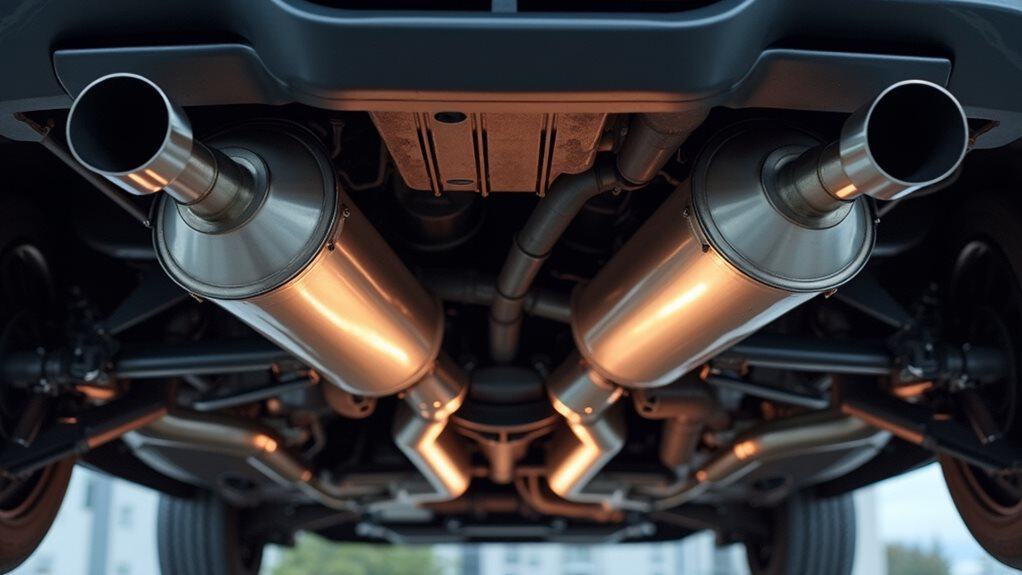
V6 and V8 engines often use multiple converters—one per exhaust bank—with arrangements that combine a front pre‑cat and an underfloor main cat, so check the exhaust pipe for the first prominent bulge, consult the owner’s manual, or safely view the undercarriage on ramps or jack stands to confirm the exact location.
You’ll find front pre‑cats close to the engine, underfloor cats mid‑car, and rear units near the muffler, with heat shields and bulging housings as visual clues. Follow fuel-system safety steps such as disconnecting the negative battery terminal before working under the vehicle to reduce ignition risk and prevent pump activation, and always keep a fire extinguisher nearby.
Why EPA And Euro 6 Rules Affect How Many Catalytic Converters Are Used
You’ll see more catalytic converters on modern cars because stricter EPA and Euro 6 emission limits force manufacturers to control pollutants more tightly. To meet those limits, cars often use mandatory pre-catalysts (small converters placed close to the engine) plus main catalytic units downstream, so hydrocarbons, carbon monoxide, nitrogen oxides, and particulates are reduced across different temperature zones and operating conditions.
Understanding this helps you recognize why exhaust layouts now include multiple catalyst stages, each with specific substrates and washcoat chemistries designed for durability and regulatory compliance. Proper maintenance and monitoring — including attention to soot buildup in particulate filters and regeneration needs — help ensure these systems continue to meet emissions limits.
Stricter Emission Limits
Because regulators have tightened both fuel and tailpipe limits, manufacturers are moving toward fewer, higher‑performance catalytic converters to meet new standards without adding complexity.
You’ll see single, high-efficiency three-way converters replace multi-unit layouts because Tier 3 and Euro 6 lower sulfur and tighten NOx/PM limits.
These catalysts use advanced materials and oxygen storage to hit real-driving and lab limits while reducing cost and maintenance.
Mandatory Pre-Catalysts
In discussing mandatory pre-catalysts, it helps to know they were introduced to cut cold-start emissions before the main catalytic converter reached operating temperature.
You should know Euro 1 required pre-catalysts, often creating dual-converter setups; modern Euro 6 and EPA-compliant cars use single, heated or integrated converters with SCR or NOx adsorbers, so manufacturers meet limits without separate pre-catalysts.
Why Turbocharged And Performance Cars Add Pre‑Cats For Emissions Control
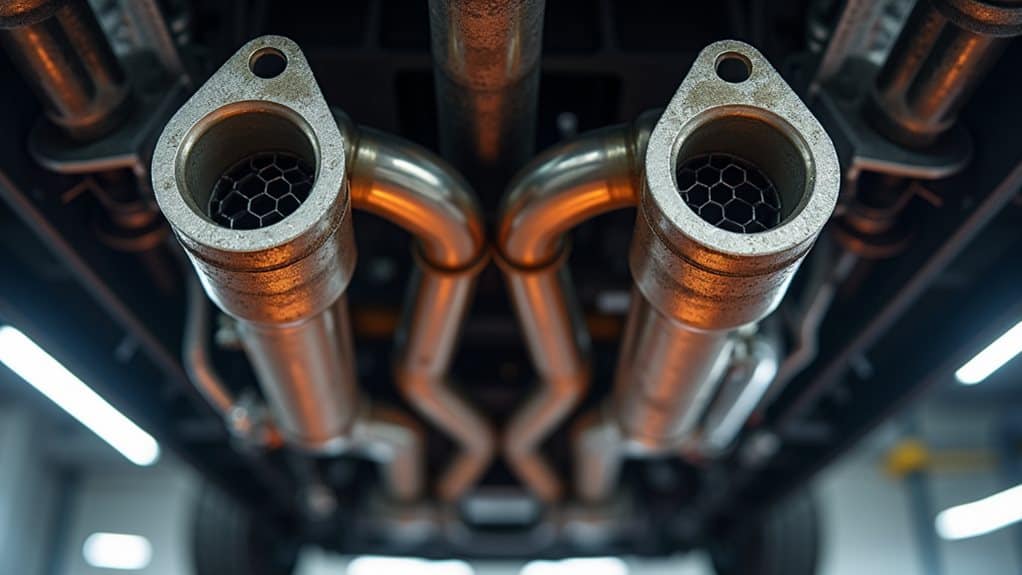
When a turbocharger is added to an engine, the exhaust gases reach the main catalytic converter more slowly and at lower temperatures during the first moments after startup, so manufacturers fit a small “pre‑cat” in the up‑pipe to treat emissions before they hit the turbo’s hot side.
You’ll use pre‑cats to cut cold‑start hydrocarbons 40–60%, heat the catalyst faster, and meet EPA limits.
Pre‑cats are placed close to the engine to take advantage of higher temperatures and reduce cold‑start emissions more effectively.
How To Visually Identify How Many Catalytic Converters Are On Your Vehicle?
After addressing why turbocharged and high‑performance engines sometimes use pre‑cats, you’ll often want to know exactly how many catalytic converters your vehicle has and where they sit.
Look under the car for 6–10 inch cylindrical canisters along the exhaust, note heat‑shielded bulges, find upstream/downstream oxygen sensor pairs, check the VECI label under the hood, or confirm with factory schematics by VIN. New converters can emit temporary odors as manufacturing coatings and adhesives off‑gas during initial heat cycles, so if you notice a persistent rotten‑egg smell beyond a few weeks alongside reduced performance or warning lights, have the exhaust system inspected.
How Do OBD‑II Codes Reveal Missing Or Failing Catalytic Converters?
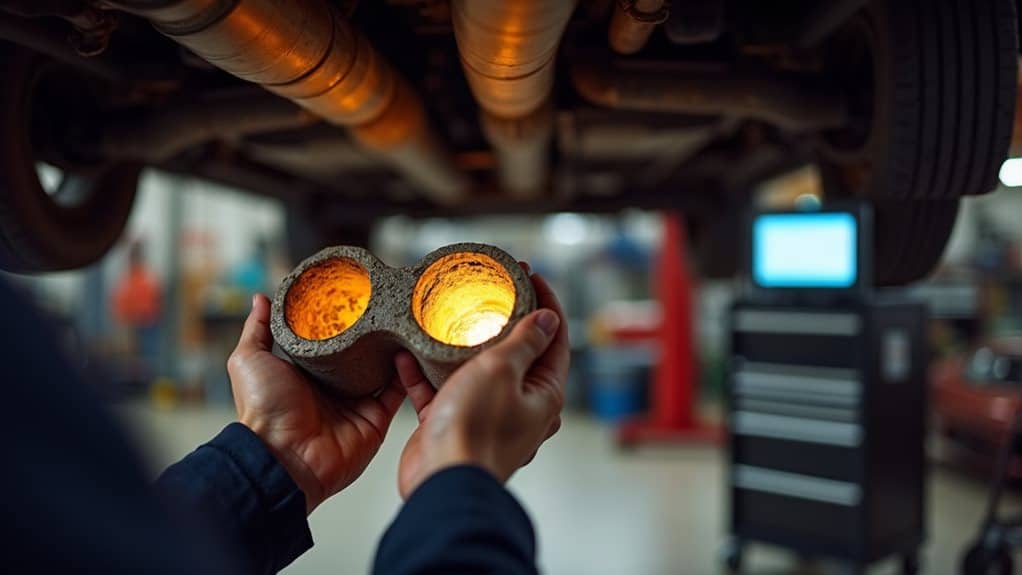
How can OBD‑II codes tell you that a catalytic converter is missing or failing?
Your car sets P0420 (bank 1) or P0430 (bank 2) when catalyst efficiency falls below thresholds.
The ECU compares upstream and downstream O2 voltages; if downstream mirrors upstream or stays low, the converter’s dead or missing.
Check for exhaust leak, temperature, misfire, or fuel codes first to avoid misdiagnosis.
How Much Does Replacing One Or Multiple Catalytic Converters Cost?
A failing or missing catalytic converter can trigger OBD‑II codes like P0420 or P0430, but deciding to replace one—or more—means evaluating parts, labor, and related repairs, so you’ll want a clear view of likely expenses before authorizing work.
Expect $400–$2,500 per unit typically: economy cars lower, luxury and hybrids higher.
Multiple converters multiply costs; diagnostics, sensors, emissions tests and repairs add modest fees.
How To Confirm Your Vehicle’s Exact Converter Count By VIN Or Service Manual?
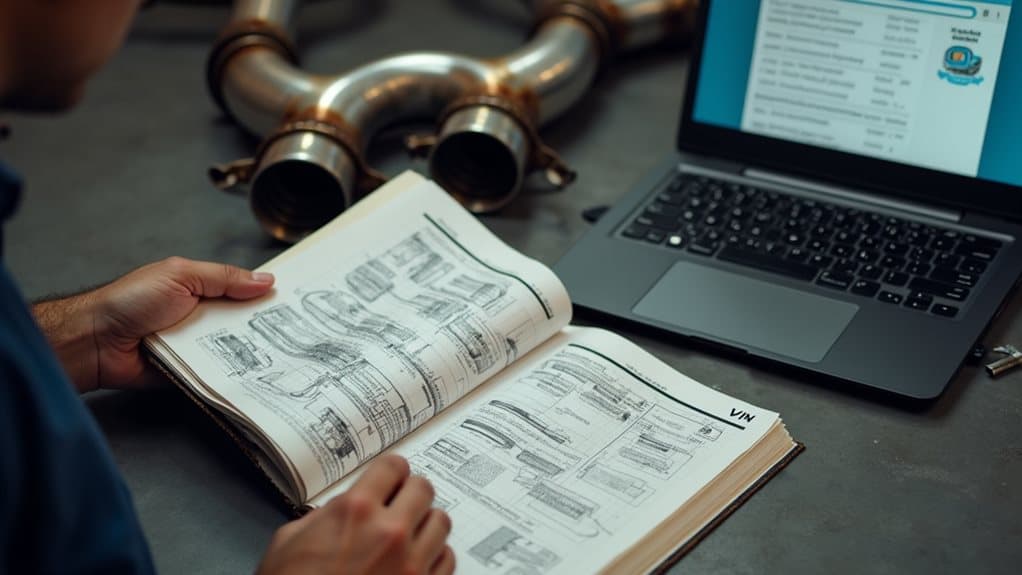
Want to know exactly how many catalytic converters your vehicle has? Check the VECI label under the hood first; it lists converter part numbers and locations.
Enter your VIN into manufacturer or NHTSA decoders to pull engine family and converter configurations.
Cross-reference VECI part numbers with the service manual or TSBs, and visually verify distinct cylindrical housings and O2 sensor bungs on the exhaust.
Wrapping Up
You can usually determine how many catalytic converters your car has by checking engine type, exhaust layout, and emissions controls; 4‑cylinder engines often have one, V6 and V8 engines may have two or more, and dual exhausts typically add converters. Inspect under the vehicle, read OBD‑II codes, or check the VIN/service manual to confirm. Replacement costs vary by number and location. Use this info to diagnose issues, plan repairs, and verify regulatory compliance.