
You’ll find the 292’s 3.875‑inch bore and 4.125‑inch stroke give it a long‑stroke, cast‑iron block that naturally produces about 260 lb‑ft of torque at 1,600 rpm, far exceeding its modest 165 hp rating. Stock output is roughly 165 hp, but dyno tests show 15‑20 % more torque and 300 hp in street‑built examples, especially with a 450‑500 CFM carb or EFI and a modest turbo (7‑10 psi). Upgrading to forged internals, CNC‑ported heads, and a reinforced oil system lets you safely target 400‑600 hp, while proper transmission ratios and cooling keep the engine reliable. Continue and and you’ll see detailed build steps.
Quick Tips
- Stock 292 delivers ~165 hp and 260 lb‑ft, but dyno‑tested builds regularly reach 300 hp and 300 lb‑ft with proper tuning.
- Upgrading to a 450‑500 CFM carb or EFI system, matched to a 5,500 rpm cam, unlocks the engine’s low‑end torque potential.
- A modest 7‑10 psi turbo (e.g., Garrett 5020 Gen2) can push output to 220‑310 hp while preserving reliability on stock internals.
- For 400‑600 hp targets, reinforce the bottom end with forged crank, ARP rods, CNC‑ported heads, and an upgraded oil pump and cooling system.
- Proper wiring (e.g., 12‑gauge for 20 A circuits) and a reliable ECU are essential to prevent electrical failures at higher boost levels.
292 Engine Overview: Specs, History, and Core Strengths
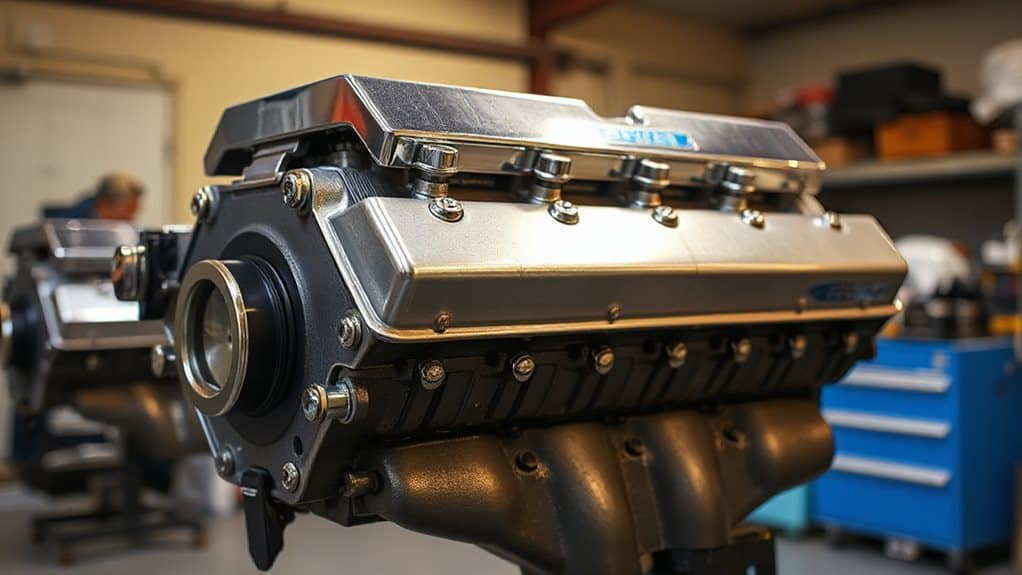
What makes the Chevy 292 Inline‑6 stand out? You’ll find a 3.875‑inch bore, 4.125‑inch stroke, yielding 292 cu in (4.8 L) displacement and an 8.0:1 compression ratio. Produced 1963‑1990, it served trucks, vans, and SUVs with a cast‑iron block and OHV head. Its long stroke, forged crank, thick walls, and natural balance give durability and low‑oil‑pressure tolerance. The engine’s iron‑iron construction contributes to its reputation for high stress and abuse resistance. It is also prized for its durability and simplicity in many restoration and upgrade projects.
How the 292’s Overbuilt Design Generates Massive Low‑End Torque
Ever wondered why the 292 feels like a low‑end powerhouse? Its long‑stroke, 4.125‑inch crank and 6.75‑inch rods give high influence, while seven main bearings create a rigid bottom end.
Forged steel crank, thick walls, and oversized journals distribute force, so 280 lb‑ft appears at 1,600 rpm. This overbuilt framework yields steady, linear torque without high‑rpm stress. Measured under load, this durable architecture helps maintain consistent performance even when operating in high‑heat conditions, reducing the likelihood of power loss.
Stock Power vs. Real‑World Dyno Numbers: What to Expect on the Street?
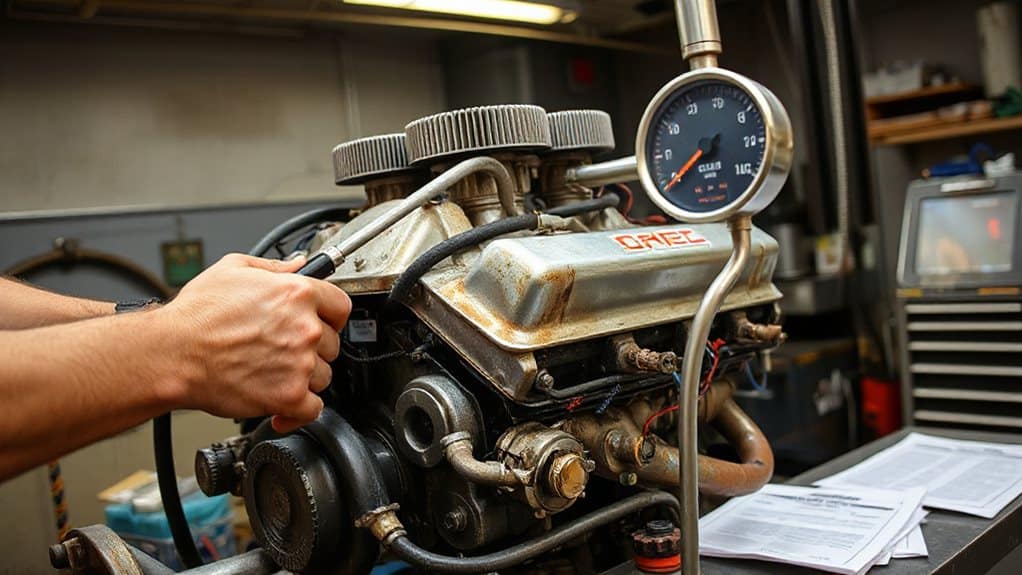
How much power you’ll actually feel on the street can differ dramatically from the numbers on the brochure. Factory ratings list 165 hp and 260 lb‑ft, but dyno tests show 15‑20 % more torque and often 300 hp+ on a street‑built 292.
Expect 0‑60 around 7 seconds, quarter‑mile near 15.4 seconds, and stronger low‑end pull than the official specs suggest.
Be sure to size wiring correctly for upgrades to avoid overheating risks, especially keeping 14‑gauge wire off 20‑amp circuits.
Choosing the Right Carburetor or EFI for the 292 Engine (150‑200 hp)
Where should you start when picking a carburetor or EFI system for a 292‑cid engine that aims for 150‑200 hp?
Calculate the required CFM: 292 × 5,500 ÷ 3,456 ≈ 465 CFM.
Choose a 450‑500 CFM carburetor or a matching EFI flow rate to avoid over‑size penalties.
Verify manifold compatibility, use proper gaskets, and tune for the Rochester single‑barrel replacement or a 2‑barrel upgrade if cam timing demands more airflow.
Also, check oil level and related sensors after work to avoid triggering a check engine light from installation issues.
What Power Gains to Expect From Turbocharging the 292?
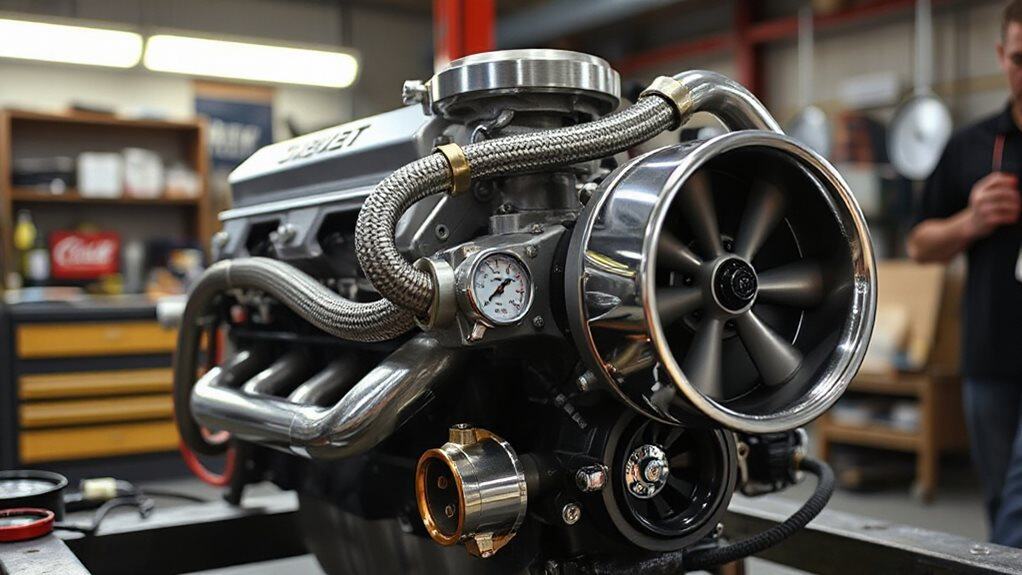
Choosing a carburetor or EFI system for a 292‑cid engine that targets 150‑200 hp involves matching airflow to the engine’s demand, which is roughly 465 CFM (cubic feet per minute).
With a modest 7 psi boost you’ll see about 227 hp and 352 ft‑lb torque; at 10 psi the output climbs to roughly 310 hp and 510 ft‑lb.
Extreme builds can reach 1 320 hp at 42 psi, but those require extensive reinforcement and specialized hardware.
Owners should also inspect and update aging electrical and fuel delivery components to avoid reliability problems, particularly common in classic vehicles with fuel delivery and wiring deterioration.
Turbocharging the 292: Boost, Reinforcement, Gains
You’ll start by installing reinforced forged internals—larger rod journals, a heavy damper, and a taller deck—to let the block survive the extra pressure of boost.
Then you’ll follow the turbocharger selection guide, choosing a smaller‑displacement turbo like the Garrett 5020 Gen2 for quicker low‑end response while keeping the boost target around 5 psi to hit 300‑350 hp efficiently.
Finally, the boost‑driven power gains become evident as the reinforced engine, proper airflow, and precise tuning combine to deliver a smooth, high‑rpm power curve without compromising reliability.
Reinforced Forged Internals
How much increase can a 292 inline‑six handle before the stock cast‑iron block gives out? You’ll find the stock block survived 42 psi, 1,320 hp after de‑stroking to 285 ci, but any higher boost demands forged internals.
Replace pistons, rods, and crank with forged steel to resist fatigue. Use a ported head, custom cam, and robust ECU to manage timing and fuel.
Expect 300‑400 hours of build and 1,000 hours research for durability.
Turbocharger Selection Guide
What increase level you’re aiming for will dictate the turbo size, supporting hardware, and reinforcement strategy for a 292 inline‑six. Choose a compressor that matches your target horsepower and the 4.8 L displacement; a 300‑cased BorgWarner or a Garrett sized via a 690 hp, 4.8 L filter works well.
Avoid undersized turbos that overspeed, and oversized ones that cause lag. Pair with ARP rods, a Melling oil pump, and a 1025 head gasket for durability.
Use a blow‑through setup with a Holley Sniper XFLOW throttle body or a 750 carburetor, and upgrade the exhaust to fit the turbo inlet.
Boost‑Driven Power Gains
Choosing the right boost level sets the foundation for how much power the 292‑inch‑six can safely produce, and it directly influences the reinforcement strategy you’ll need. At 30‑35 psi you’ll see 300‑350 hp with stock internals, while 42 psi pushes the block to 1,300 hp if you upgrade heads, cam, and fuel system.
Four 120 lb/hr injectors cover up to 800 hp; eight‑injector setups reach 1,375 hp. Proper cooling, stronger rings, and ECU timing control keep durability high.
CNC‑Machined vs. Stock Cast‑Iron Bottom Ends: When to Upgrade
Ever wonder when a CNC‑machined bottom end truly outperforms the stock cast‑iron version in a Chevy 292? If you’re chasing 300 hp+, turbocharging, EFI, or stroke extensions beyond 4.125 in., the CNC’s tighter tolerances, superior oil flow, and refined surface finish boost high‑RPM stability and crankshaft durability. Stock cast‑iron suffices for under‑300 hp street use, but upgrade when loads exceed factory ratings. Removing emissions gear like the secondary air pump can simplify the engine bay but may increase emissions and require ECU programming.
Best Transmission Ratios for the 292’s Torque Curve
When you’ve decided that a CNC‑machined bottom end is worth the upgrade for high‑RPM power, the next step is matching the 292’s torque curve to the right transmission ratios.
Pair 3.73 rear gears with a 3200‑stall converter for street driving, or 4.11 gears with a 2500‑stall for steep‑grade, non‑freeway use.
Choose a close‑ratio manual (Z‑code) to keep engine speed in the 3000‑4500 RPM sweet spot, maximizing the flat 200‑250 lb‑ft torque band.
Cooling and Oil System Upgrades for High‑Boost 292 Builds
How does a high‑boost 292 stay cool and lubricated under extreme loads? Install an all‑aluminum radiator with narrower tanks and a 13 PSI cap; it tolerates 210‑220 °F and fits direct‑fit kits.
Use a polished‑aluminum water outlet and verify hose compatibility, adding adapters for ¾‑inch pump outlets if needed.
Route overflow hoses cleanly, check for bubbles, and pressure‑test the head gasket.
Upgrade oil pump and cooler lines for sustained lubrication.
Practical Budget 292 Engine Builds: 250 hp, 400 hp, 600 hp Options
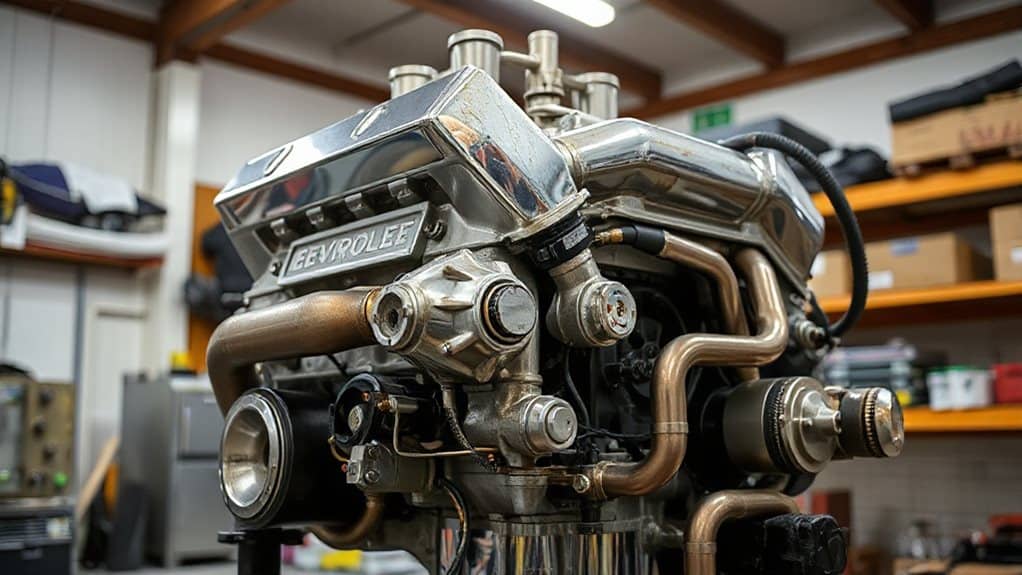
What you need to know before choosing a budget‑friendly 292 build is how each power target—250 hp, 400 hp, or 600 hp—affects the engine’s components and tuning strategy.
A 250 hp build relies on a tuned carb, upgraded intake manifold, and performance exhaust, with a harmonic balancer for RPM stability.
For 400 hp, install electronic fuel injection, a moderate turbo, CNC‑ported heads, and a reinforced oil system.
A 600 hp build adds a high‑capacity turbo, reinforced internals, and advanced EFI, pushing the stock bottom‑end to its limits.
Wrapping Up
In summary, the Chevy 292’s robust cast‑iron block and generous low‑end torque make it a versatile platform for modest street power or high‑performance builds. By selecting the appropriate carburetor or EFI, reinforcing the bottom end with CNC‑machined components, and upgrading cooling and oil systems, you can reliably reach 250 hp, 400 hp, or even 600 hp. Proper transmission ratios and, if desired, turbocharging further expand its potential, while staying within budget and reliability constraints.


