
Your 2012 Toyota Camry’s TPMS display shows real-time pressure levels using four icons in a fixed clockwise order: driver front, passenger front, passenger rear, then driver rear. The system alerts you when any tire drops below the recommended 35 PSI, especially in cold weather. You’ll see pressure trends, not labels, so position matters. If readings seem off after rotation or service, a relearn procedure resets sensor alignment—keep going, and you’ll understand how to maintain accurate monitoring.
Quick Tips
- The 2012 Toyota Camry TPMS display shows four tire positions clockwise: driver front, passenger front, passenger rear, driver rear.
- Each icon represents real-time pressure levels but does not include text labels or exact PSI readings.
- A steady TPMS light indicates low pressure; flashing light means system relearn or sensor issue.
- After tire rotation or service, a relearn procedure is required to sync sensors with correct positions.
- Cold temperatures can temporarily lower pressure readings, triggering alerts even when tires are properly inflated.
Why Your 2012 Camry’s TPMS Light Comes On
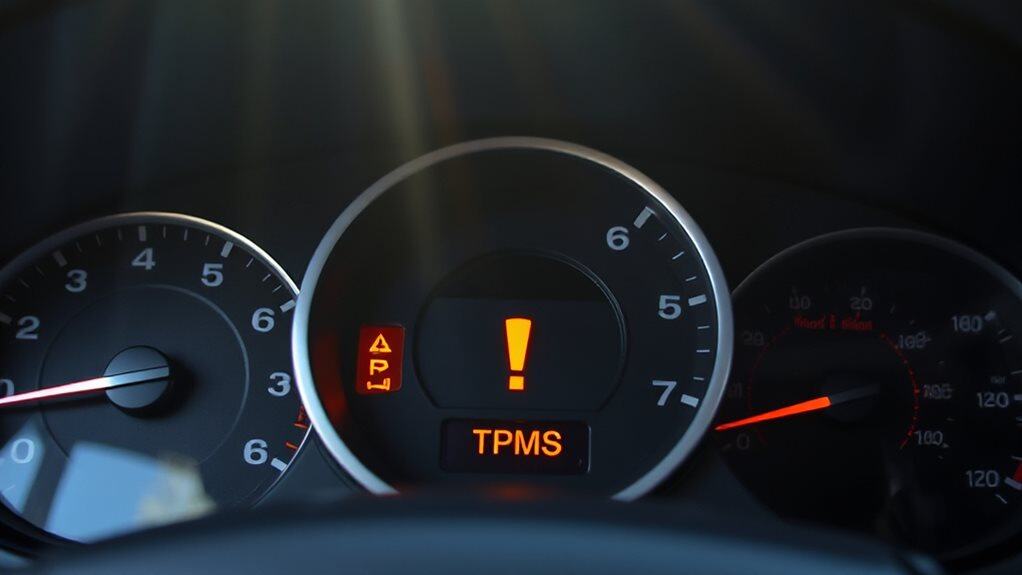
While driving your 2012 Toyota Camry, you might notice the TPMS (Tire Pressure Monitoring System) warning light illuminate on the dashboard, and understanding why it turns on can help you respond correctly.
Low tire pressure, often from leaks or temperature drops, triggers the alert.
Cold weather temporarily reduces PSI, while faulty sensors or system errors may cause false warnings. Inspect tires visually for cuts, bulges, embedded objects, and uneven wear to rule out physical problems.
After inflating tires, drive over 50 mph for 10 minutes or reset manually to clear the light.
A TPMS sensor replacement may be necessary if the warning light persists despite properly inflated tires.
What 35 PSI Means for Your Camry’s Tire Pressure
The 2012 Toyota Camry performs best when your tires are inflated to the manufacturer’s specified 35 PSI when cold, a pressure value clearly listed on the driver’s side door jamb sticker and confirmed in the owner’s manual.
This pressure optimizes fuel efficiency, handling, and tread life while reducing blowout risk.
Maintaining 35 PSI guarantees TPMS stays calibrated, preventing false warnings.
Though some find it slightly firm, especially in city driving, it’s engineered for safety and performance.
Check pressure cold with a reliable gauge, adjusting only when tires are cool for accuracy.
Also remember to recheck wheel lug torque after driving 50–100 miles to ensure proper clamping force and safety with wheel fasteners.
How Tire Positions Appear on the TPMS Display
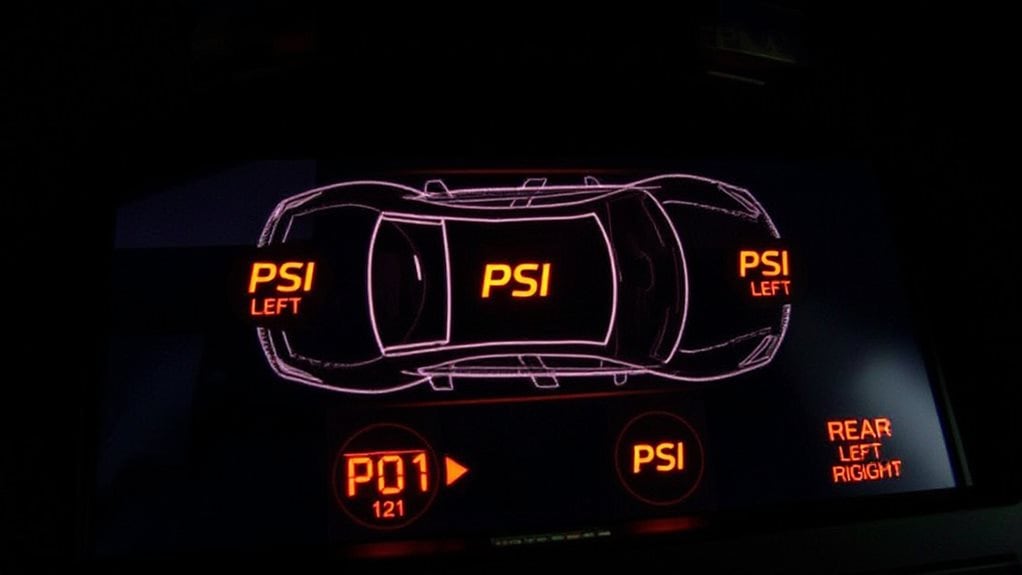
Pull up the tire pressure menu on your 2012 Toyota Camry, and you’ll see four icons showing the air levels in each tire—though they won’t be labeled with words like “front left” or “rear right.”
Instead, the system uses a fixed clockwise sequence: the first icon stands for the driver’s side front tire, the second for the passenger’s side front, the third for the passenger’s side rear, and the fourth for the driver’s side rear.
If a tire icon shows an unusual or rapidly changing reading, check for possible sensor or wiring issues that may require further inspection.
When to Relearn TPMS After Tire Service
You’ll need to relearn the TPMS whenever you rotate your tires, especially if front and rear pressure settings differ.
After replacing any tire pressure sensor, a relearn is required so the ECU recognizes the new sensor’s ID.
Any major tire service—like changing sizes or adjusting pressures post-maintenance—also triggers the need to reset the system.
If a CV axle is improperly seated it can cause abnormal vibrations and should be inspected promptly for driveability issues.
Tire Rotation And Sensors
When rotating your tires, keep in mind that moving wheels from one position to another throws off the TPMS sensor-to-vehicle pairing originally set at the factory.
You’ll need to relearn the system so sensors match new positions. Use the TPMS reset button, drive to recalibrate, or use a professional OBDII tool.
Don’t skip this—accurate readings depend on it.
After Sensor Replacement
After replacing a tire pressure sensor or swapping tires, you’ll need to reprogram the system so your 2012 Toyota Camry recognizes the updated setup.
Press and hold the SET button for about 5 seconds to initiate relearn.
Make sure all tires are inflated to 34 PSI before starting.
Skipping this step may cause incorrect readings or system errors.
Use professional tools if the ECU locks.
Following Tire Service Work
Following routine tire service—such as rotation, balancing, or inflation adjustments—your 2012 Toyota Camry’s TPMS may require a relearn procedure to accurately reflect current tire pressure readings.
First, inflate all tires to the placard pressure and verify with a gauge.
Then, drive a few miles so the system recalibrates automatically.
If the light persists, use the reset button or a TPMS tool for full relearn.
How to Relearn TPMS on a 2012 Camry
First, make sure your tires are inflated to the placard pressure and the ignition is on before starting the TPMS relearn process.
If your 2012 Camry has a reset button—usually in the glove compartment—press and hold it until the TPMS light blinks three times, signaling the system is ready to relearn.
For full verification, use a TPMS tool to sync each sensor’s ID to the ECU and confirm that the display shows accurate pressures by tire position.
Ensure the vehicle is on level ground and at operating temperature before final verification to get an accurate reading of the tire pressure.
Tpms Relearn Process
Kick off the TPMS relearn process by making sure your 2012 Camry is ready for the procedure—this means inflating all four tires to the recommended 34 PSI and confirming the pressures with a reliable gauge.
Park on a level surface, turn the key to “on,” then press and hold the SET button below the glove box for 5 seconds. The TPMS light will blink, signaling system initialization.
It’ll listen for sensor signals up to 3 minutes. For best results, use a TPMS tool to manually send sensor IDs, especially if sensors are blocked by brake components. This guarantees accurate relearning without issues.
Relearn Verification Steps
Once the TPMS relearn process is underway, you’ll need to verify that each sensor is properly recognized by the vehicle’s system using the correct tools and steps.
Reactivate each sensor while the vehicle stays in the ON position, then read them again to confirm communication.
Check that the TPMS light turns off and pressure displays correctly for each wheel location, ensuring all IDs are registered and functioning as intended.
Best TPMS Sensors for 2012 Camry

When replacing TPMS sensors on your 2012 Toyota Camry, choosing the right model guarantees accurate pressure readings and full system compatibility.
Opt for 315MHz sensors like OEM part numbers 42607-06020 or 28103-CA000.
Confirm if your system is high-line or low-line to avoid 0 PSI readings.
Use Pacific OEM sensors or cross-compatible options like 550-0105 for reliable, SAE2657-compliant performance.
A blown transmission fuse can cause gear and shift problems and may require immediate attention to prevent further drivetrain issues.
Why TPMS Readings Are Wrong After Rotation (And How to Fix It)
After rotating your tires, you might notice the TPMS dashboard display showing incorrect pressure readings or triggering a warning light—even if all tires are properly inflated.
That’s because the system still links each sensor to its old position. To fix it, reset the TPMS: use the reset button until the light blinks, then drive over 30 mph for 10–15 minutes to relearn positions.
Why Cold Tire Pressure Matters for Accurate TPMS Readings
You just rotated your tires and reset the TPMS, but now the warning light pops on again overnight—no leak, no damage, just cold weather.
Cold air makes air molecules contract, dropping pressure about 1 PSI per 10°F. Since TPMS relies on cold tire pressure baselines, even a 30°F drop can trigger alerts.
Always check pressure when tires are cold for accurate readings.
Wrapping Up
Your 2012 Camry’s TPMS helps monitor tire pressure for safety and efficiency. When the light comes on, check pressure immediately—35 PSI is ideal. After rotations or sensor changes, you’ll need to relearn the system so positions display correctly. Always reset TPMS after service, using the correct procedure. Cold tires give the most accurate readings. Proper maintenance guarantees reliable alerts and extends tire life.