T-rated tires are built for a maximum sustained speed of 118 mph (190 km/h) and use softer sidewalls and a lower-modulus rubber compound, which gives a plush ride, lower rolling resistance, and longer tread life—often exceeding 140,000 km. H-rated tires handle up to 130 mph (210 km/h) by adding a nylon cap ply, extra steel belts, and stiffer construction; this enhances cornering precision, high-speed stability, and braking performance but generates more heat, leading to faster wear and higher cost. If you keep going, you’ll uncover how these differences affect fuel economy, vehicle suitability, and long-term value.
Quick Tips
- T‑rated tires are rated up to 118 mph (190 km/h), while H‑rated tires handle up to 130 mph (210 km/h).
- H‑rated tires use a nylon cap ply and extra steel belts for a stiffer carcass, giving sharper cornering and shorter braking distances.
- T‑rated tires have softer sidewalls and compound, providing a quieter, more comfortable ride and typically longer tread life.
- The stiffer construction of H‑rated tires generates more heat, leading to faster wear and shorter warranties compared to T‑rated tires.
- T‑rated tires are cheaper upfront, last about 24 % longer, and suit family or budget vehicles; H‑rated tires cost more and are best for high‑performance or sport‑oriented cars.
Understanding Tire Speed Ratings: T vs H Explained
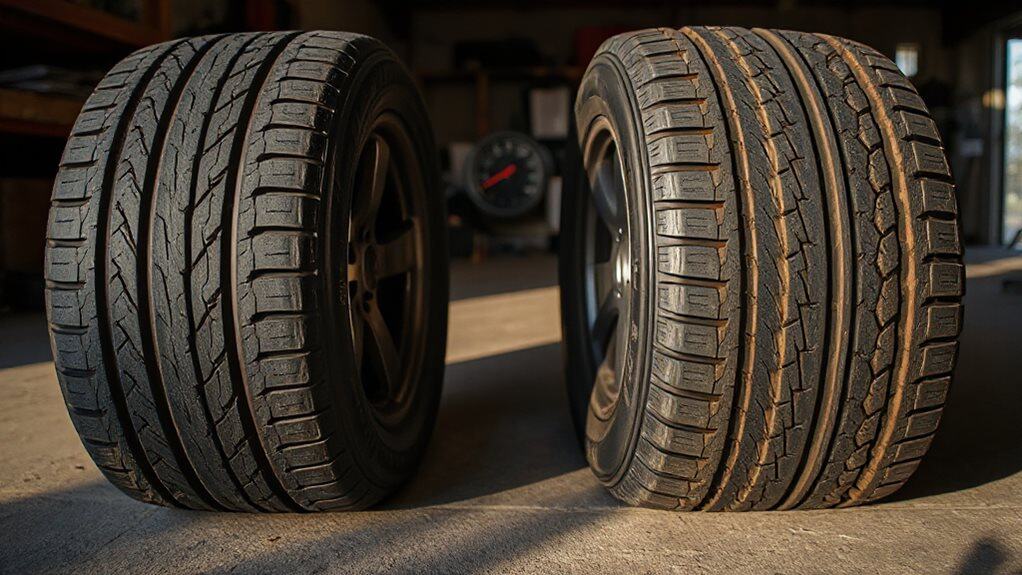
What exactly does a tire’s speed rating tell you? It indicates the maximum sustained speed the tire can handle under load before performance degrades.
A “T” rating tops out at 118 mph (190 km/h), suited for family sedans and winter tires, while “H” reaches 130 mph (210 km/h), offering better heat dissipation and handling for sportier vehicles. Higher letters mean stronger cornering and braking at speed. Speed rating is indicated on the tire’s sidewall as the last letter after the load index. Electrical issues like a blown fuse or low battery can leave vehicle systems malfunctioning, so always verify power and related components when diagnosing trunk-related warnings or indicator lights; see fuse 58 for a common example.
How Speed Ratings Translate to Real‑World Maximum Speeds
You’ll notice that the T rating’s 118 mph limit often exceeds the legal speed caps on most highways, so the practical ceiling is usually set by law rather than tire capability.
In contrast, the H rating’s 130 mph ceiling can be reached on high‑performance roads, yet real‑world factors like tire wear, inflation pressure, and road conditions typically keep you well below that figure.
Understanding these distinctions helps you match the tire’s rated speed to both statutory limits and everyday driving conditions. A common source of vehicle warnings is a faulty door ajar sensor, which can create misleading alerts unrelated to tire performance.
Maximum Legal Speed
How do speed ratings translate into the maximum speeds you can legally and safely maintain on the road? T‑rated tires permit up to 118 mph (190 km/h) under controlled conditions, while H‑rated tires allow 130 mph (210 km/h). You must respect the lowest rating on your car, match the tire’s rating to the vehicle’s specifications, and stay within posted speed limits to ensure safety and legality.
Practical Speed Limits
A T‑rated tire can sustain a continuous speed of 118 mph (190 km/h), which already exceeds the posted limits on most highways, while an H‑rated tire is rated for 130 mph (210 km/h) and therefore adds a modest safety buffer for high‑performance driving. In practice, you’ll stay well below 118 mph with a T tire on family cars, whereas an H tire lets sport sedans safely approach 130 mph, though everyday traffic rarely reaches these extremes.
Inside H‑Rated Tire Construction: Nylon Cap Plies & Extra Belts
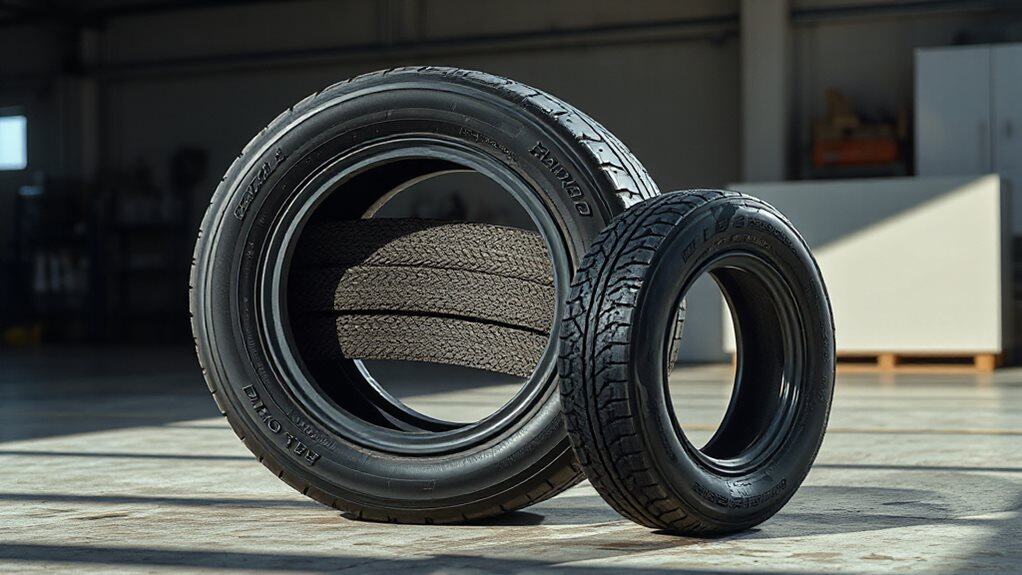
Most H‑rated tires rely on a nylon cap ply and extra belt layers to keep the tread package stable at speeds up to 130 mph.
The cap ply, made of nylon 6 or 6,6, encircles the belt package like a hoop, preventing belt shift under centrifugal force.
Extra steel belts add stiffness, while edge strips may be used where stress peaks.
Together they maintain uniform belt positioning, balance, and smooth operation.
Regular inspection and maintenance, such as checking for wear and debris that can affect performance, help ensure safe, consistent airflow and cooling around the tire assembly.
Heat Resistance Explained: Why H‑Rated Tires Stay Stable at Higher RPMs
The nylon cap ply and extra belt layers that keep an H‑rated tire’s tread package stable also play a key role in heat resistance, because they limit belt movement and maintain uniform pressure across the rubber. This structure curbs hysteresis, spreads friction‑generated heat, and lets the compound stay within its suitable 140‑170°F window.
Consequently, the tire dissipates thermal energy efficiently, preserving grip and preventing premature wear at higher RPMs. Regular maintenance and monitoring can help prevent issues caused by excess heat in tire components.
How Cornering Precision and Steering Response Differ Between T‑ and H‑Rated Tires
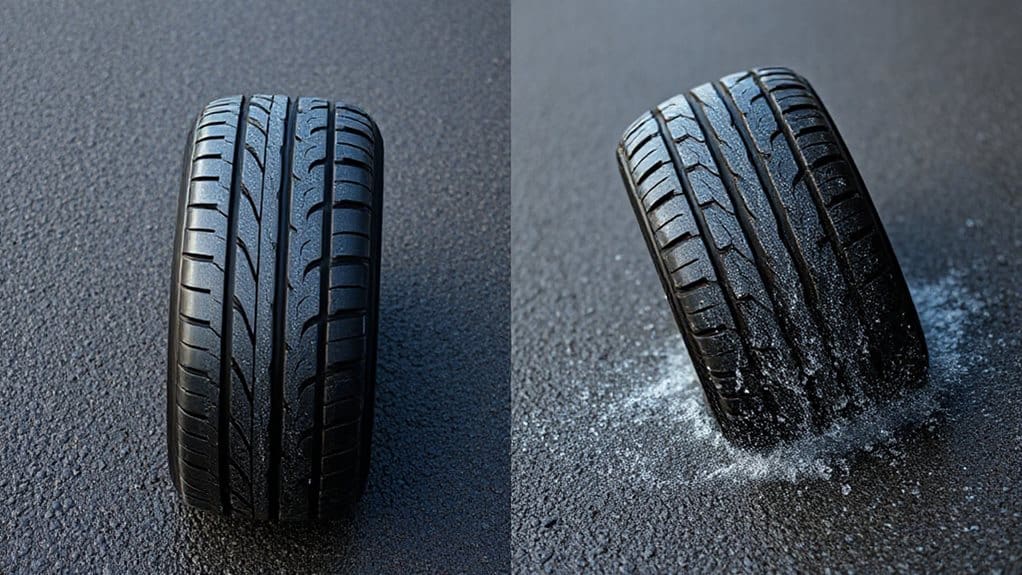
Why does a corner feel tighter in an H‑rated tire than in a T‑rated one? H‑rated tires use a stiffer carcass and sidewalls, which limit flex under lateral forces, keeping the tread shape intact. This rigidity gives sharper turn‑in response and more precise steering feedback.
T‑rated tires, with softer sidewalls, absorb more energy, producing a mushier feel and reduced cornering precision, especially at higher speeds. Inspect related suspension and driveline components for worn splines or U‑joints to rule out vibration sources and ensure precise steering driveshaft wear.
Braking Distance Comparison: T‑Rated vs H‑Rated Tires
When you compare T‑rated and H‑rated tires, you’ll notice a clear stopping‑distance variance: H‑rated models typically shave several meters off the braking roll because their stiffer casings and extra belts resist heat build‑up better during hard stops.
This thermal advantage means that, even under load, H‑rated tires maintain grip longer, while T‑rated tires, designed for a softer ride, lose traction sooner as temperature rises.
Consequently, the interaction between load rating and heat management directly influences how quickly each tire can bring a vehicle to a halt.
Regular maintenance, including checks for heat-related damage and monitoring components that can overheat, helps preserve braking performance and prevent issues similar to those that cause AC compressors to smoke.
Stopping Distance Variance
How much farther will a car travel before it stops if you’re using a T‑rated tire instead of an H‑rated one? You’ll add roughly four meters (about thirteen feet) to the stopping distance.
H‑rated tires have stiffer casings and stronger construction, which improve grip and stability under hard braking.
T‑rated tires, designed for lower sustained speeds, lack those enhancements, so they lag in emergency stops.
Heat Build‑Up Influence
The extra four‑meter stopping‑distance increase you saw with T‑rated tires isn’t just a matter of grip; it also stems from how each tire handles heat during hard braking.
H‑rated tires use full‑width nylon cap plies that dissipate heat, keeping the rubber stable and preserving traction.
T‑rated tires lack this heat‑resistant structure, so temperature rise softens the tread, lengthening brake response and stopping distance.
Load Rating Interaction
Why does load rating matter when you compare braking distances between T‑rated and H‑rated tires? Load rating determines how much weight the tire can support without deforming, which directly affects grip and deceleration.
H‑rated tires, built with stronger sidewalls and reinforced belts, maintain shape under heavier loads, shortening stopping distances.
T‑rated tires, softer in construction, may compress more, increasing braking distance under comparable loads.
Ride‑Comfort Trade‑offs: Plushness, Firmness, and Road Noise Levels
What you notice first when comparing T‑rated and H‑rated tires is how each rating shapes the ride‑comfort experience through plushness, firmness, and road‑noise levels. T‑rated tires use softer sidewalls and fewer belts, giving a plush, quieter ride with lower firmness, ideal for daily driving.
H‑rated tires add cap plies and extra belts, increasing firmness and road feel, which can raise noise and reduce plushness, especially on rough surfaces.
Why Do T‑Rated Tires Outlast H‑Rated Ones? What That Means for You
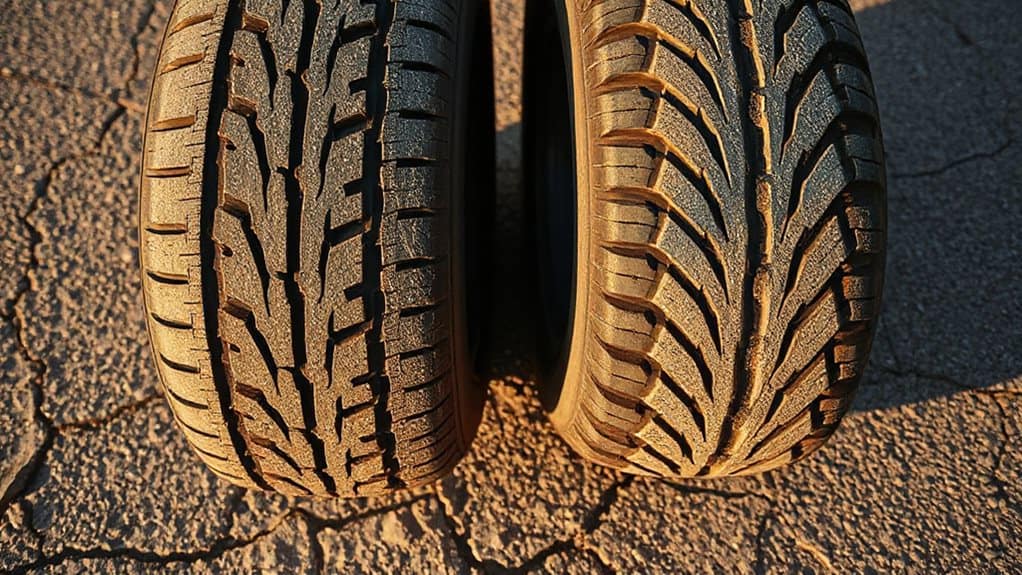
You’ll notice that T‑rated tires use a softer compound composition, which means they generate less heat under normal driving conditions and thus experience slower tread degradation.
Because their construction is less stiff, the internal stresses that cause cracks in H‑rated tires are reduced, extending the tire’s useful life.
This combination of lower heat buildup and reduced structural stiffness translates into higher mileage before you need a replacement.
Softer Compound Composition
Ever wondered why T‑rated tires tend to outlast their H‑rated counterparts? They use a softer rubber compound, which means lower modulus and more flexibility.
This softer mix reduces rolling resistance and spreads wear evenly, extending tread life by about 24 %.
H‑rated tires, built for speed stability, employ a higher‑modulus compound that resists deformation but wears faster under normal driving conditions.
Lower Heat Build‑Up
The softer rubber compound that gives T‑rated tires their longer tread life also keeps their temperature down during normal driving.
Because they generate less rolling resistance, they waste less energy as heat, staying cooler at everyday speeds under 118 mph.
Lower heat slows rubber degradation, extending treadwear to roughly 61 th miles versus 49 k for H‑rated.
This cooler operation improves fuel efficiency and reduces wear.
Reduced Structural Stiffness
Why do T‑rated tires last longer than H‑rated ones? Their softer sidewalls mean reduced structural stiffness, so the carcass flexes instead of cracking under normal loads. This flexibility spreads stress, slowing tread wear.
In contrast, H‑rated tires use stiffer materials for high‑speed stability, which concentrate forces and accelerate degradation. Consequently, T‑rated tires often exceed 140,000 km, while H‑rated models average about 70,000 km.
Cost vs. Value: Up‑Front Price, Fuel Savings, and Long‑Term ROI for T‑Rated vs H‑Rated Tires
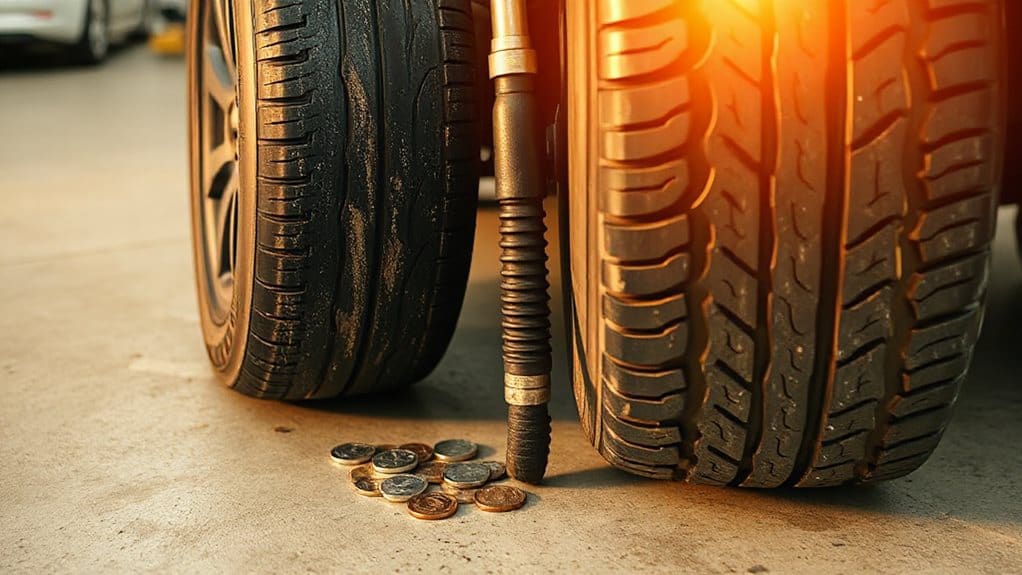
How much does a tire’s upfront cost really matter when you factor in fuel savings and long‑term return on investment? T‑rated tires start near $76 and last 24 % longer, giving you lower cost‑per‑mile and better fuel economy. H‑rated options cost more, wear faster, and offer shorter warranties. Over thousands of miles, T‑rated models deliver superior ROI through reduced replacement cycles and rolling‑resistance savings.
Ideal Vehicle Matches for T‑Rated vs H‑Rated Tires
Which vehicle type benefits most from a T‑rated versus an H‑rated tire? Family sedans, minivans, and budget‑conscious cars pair well with T‑rated tires because their softer sidewalls give a smoother ride, lower road noise, and longer tread life—about 61,000 miles.
Sport sedans, performance SUVs, and high‑performance vehicles suit H‑rated tires, which provide stronger construction, sharper cornering, shorter braking distances, and better wet‑condition grip.
Choosing the Right Tire: Decision Framework for Speed Rating, Use Case, and Budget
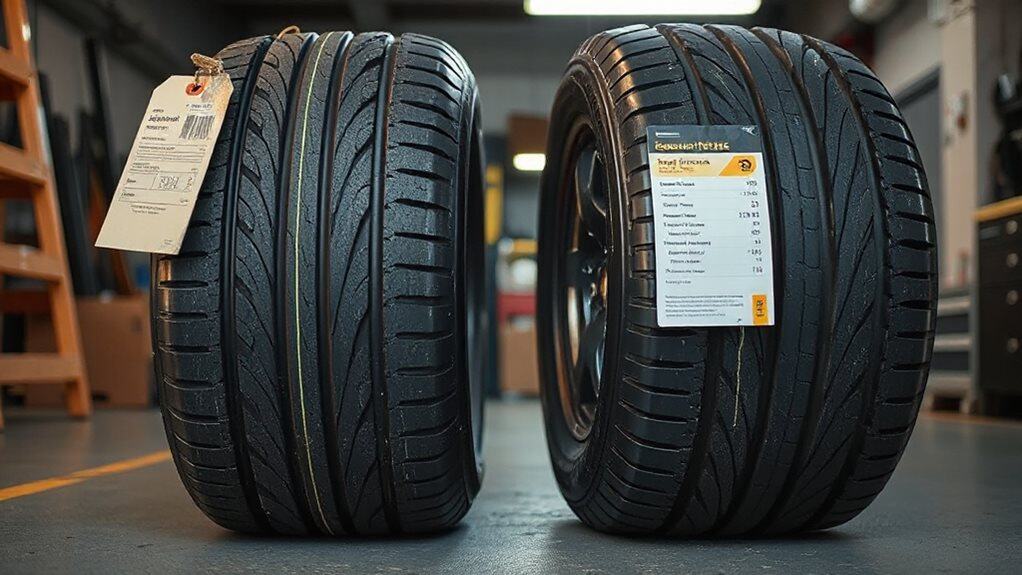
What you need most when selecting a tire is a clear structure that aligns speed rating, intended use, and budget.
First, match the rating to your vehicle’s top sustained speed; T‑rated suits family cars under 118 mph, while H‑rated fits sportier models up to 130 mph.
Next, weigh handling versus comfort—H offers stiffer sidewalls and sharper grip, T provides smoother rides and longer tread life.
Finally, compare prices and load indexes; higher ratings cost more but may not add value if you rarely exceed their limits.
Use manufacturer charts to verify compatibility and avoid over‑specifying.
Wrapping Up
Pick the right rating that matches your vehicle’s performance needs and driving habits. T‑rated tires offer longer tread life and lower cost, making them suitable for daily commuting and moderate speeds. H‑rated tires provide higher heat resistance, better cornering stability, and support higher RPMs, ideal for sportier driving or heavier loads. Evaluate speed limits, climate, and budget to ensure the tire’s speed rating aligns with your expectations and safety requirements.