
That blue-green crust on your car battery is usually copper sulfate or lead sulfate formed when sulfuric acid vapors or leaking electrolyte react with copper terminals or lead posts, creating a nonconductive, powdery deposit that raises resistance and can cause starting or charging issues; if deposits are wet, smelly, or reappear quickly you likely have an active leak, otherwise dry flaky buildup is older corrosion; clean and neutralize safely with baking soda solution and protective gear, and keep reading for cleanup, prevention, and replacement signs.
Quick Tips
- Blue/green crust on terminals is usually hydrated copper sulfate formed when battery acid reacts with copper connectors.
- The deposits are non-conductive, increase resistance, and can cause poor starting or charging issues.
- Wetness, bubbling, or a strong sulfuric smell indicate an active leak requiring immediate attention.
- Clean dry deposits with a baking soda solution, rinse with distilled water, dry, and coat terminals with dielectric grease.
- Replace the battery if there’s active leakage, casing damage, cranking voltage under 10 V, or persistent electrical faults after cleaning.
What the Blue/Green Residue on a Car Battery Is
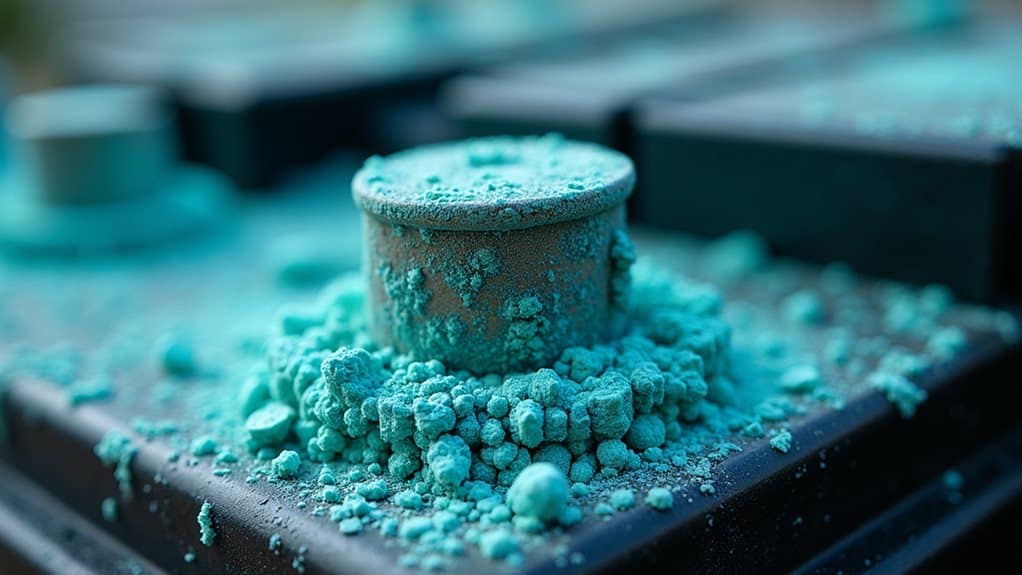
Although it might look like paint or dust, the blue-green crust on a car battery is usually hydrated copper sulfate, a powdery compound that forms when battery acid contacts copper in the terminals or connectors.
You’ll also see white or gray lead sulfate on lead posts; both are acid-reaction byproducts.
These powders are non-conductive, indicate terminal degradation, and raise electrical resistance, often linked to leakage, charging faults, or poor maintenance.
Regular inspection for symptoms like dimming headlights or dashboard charging warnings can help catch related charging system problems early and avoid being stranded, especially if a charging fuse is blown.
The site may sometimes show a security block when access triggers a protection service, displaying identifiers like a Cloudflare Ray ID.
Is It Dangerous : How to Tell Active Leaks From Old Corrosion?
When you see blue or green crust on a battery terminal, it’s important to know whether that material comes from an old, inactive corrosion or from an active electrolyte leak, because the risks and the fixes differ; active leaks can emit corrosive acid, lower electrolyte levels, and cause electrical faults, while old corrosion is usually a dry, inert salt deposit that primarily increases resistance at the connection.
Check for wetness, bubbling, a strong sulfuric smell, recent rapid buildup, or voltage drops—these indicate active leaks needing immediate attention; dry, flaky deposits that don’t reappear quickly after cleaning are likely inactive corrosion.
When cleaning, always turn off the ignition and avoid touching both battery posts simultaneously, and consider simple on-car cleaning methods like spraying hot water or using a baking soda paste to remove deposits without disconnecting if the corrosion is inactive.
How Battery Leaks and Corrosion Form Blue/Green Deposits
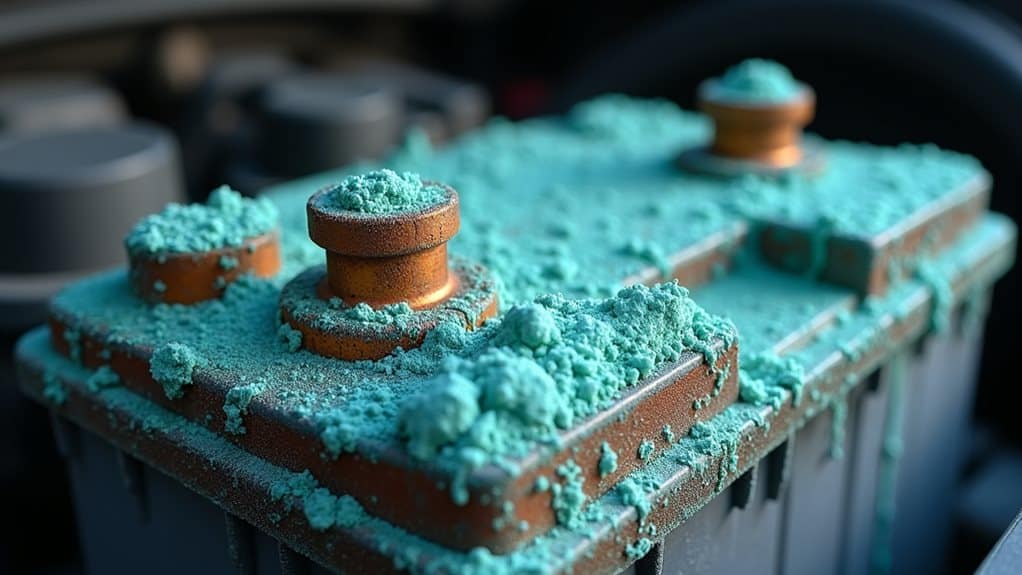
Now that you know how to tell active leaks from old corrosion, it helps to understand the chemistry and conditions that actually produce blue and green crust on battery terminals.
Sulfuric acid vapors and hydrogen sulfide react with copper to form blue copper sulfate; with lead they form white lead sulfate that can oxidize to pale blue-green.
Heat, moisture, salt, overcharging, and leakage accelerate these reactions. Faults in nearby systems like low battery voltage or damaged wiring can increase leakage and corrosion risk.
Quick, Safe Steps to Clean and Neutralize Battery Corrosion
You should start by preparing a safe neutralizing solution—mix one tablespoon of baking soda with one cup of warm water or use a commercial battery terminal cleaner—so that the alkaline mix will neutralize acidic corrosion without harming the battery.
With heavy-duty gloves and goggles on, apply the paste or solution to the corroded terminals, let it sit for several minutes, then use a battery terminal brush or stiff wire brush to scrub away deposits, taking care to reach inside cable clamps and avoid dumping excess liquid onto the battery top.
Rinse thoroughly with a small amount of distilled water, dry completely with a clean cloth, coat the posts with dielectric grease or petroleum jelly, and reconnect the positive cable first, then the negative, tightening securely.
A loose gas cap can allow fuel vapors to escape and trigger EVAP system faults, so always inspect for a properly sealing gas cap as part of routine vehicle maintenance.
Safe Neutralizing Solutions
Because acid and alkaline battery corrosion react differently, you’ll want to pick the right neutralizing agent and follow precise steps to avoid damage or injury.
Use baking soda paste for acidic leaks; apply with a brush, scrub gently, rinse with distilled water, then dry.
For alkaline leaks, wipe with white vinegar or lemon juice, rinse, dry, and optionally finish with isopropyl alcohol before protection.
Protective Cleanup Steps
Before you touch the battery, put on chemical-resistant gloves, safety goggles, and a mask or respirator, then make sure the ignition is off and the car is secured in park or neutral so nothing can move while you work.
Disconnect negative first, then positive; keep cables off metal.
Apply baking soda paste, let fizz 5–10 minutes, scrub gently, rinse sparingly, dry, grease, reconnect positive then negative.
Preventing Blue Battery Corrosion: Materials and Routine Fixes
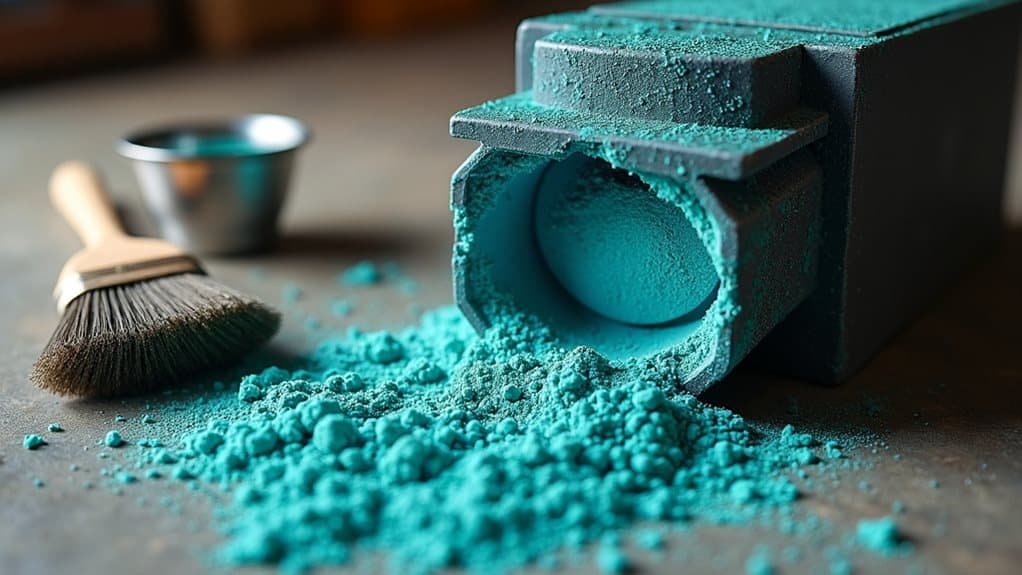
When blue-green corrosion appears on your car battery terminals, you’ll want to tackle it systematically to prevent performance loss and electrical issues; start by neutralizing any acidic buildup with a measured baking soda solution, then mechanically remove the loosened deposits and apply a protective coating to inhibit recurrence.
Clean biannually, use a brass brush and terminal cleaner, rinse with distilled water, then coat with petroleum jelly or dielectric grease.
Hydrogen sulfide odors can signal internal battery issues, so ventilate the area and monitor for rotten-egg smell.
When to Replace the Battery or Call a Pro
If you see active leakage—wet, crystalline blue fluid or bubbling around the case—you should stop using the vehicle and consider replacement, because electrolyte leakage corrodes terminals and can expose internal plates.
Severe terminal damage, such as eaten-away posts or cracked plastic that prevents a clean clamp, often means the battery is compromised and a technician should assess whether the case and connections can be repaired or if a full replacement is safer.
For persistent electrical issues like repeated low resting voltage, large voltage drops during cranking, or CCA well below spec, have a pro run a load and CCA test to confirm internal resistance and capacity before you decide to replace the unit.
Also inspect nearby components and fasteners for corrosion and proper clamping torque—improperly torqued battery terminals or hold-downs can worsen issues, so check proper torque when securing connections.
Signs Of Active Leakage
Because active leakage can quickly damage your vehicle and pose safety risks, you should be able to recognize clear, objective signs that a battery is failing and needs immediate attention or replacement.
Look for white, blue-green, or crystal corrosion on terminals, swelling, cracks or heat-distorted casing, a strong sulfur smell, wet or pooled fluid, rapid performance loss, and uneven or falling cell fluid levels.
Severe Terminal Damage
Inspect the terminals closely and act decisively if you see severe damage, because certain signs mean the battery can’t be safely serviced at home and needs professional replacement.
If corrosion penetrates half the post, housing is cracked or melted, clamps won’t tighten, or posts are eroded or bent, stop.
Disconnect negative first, avoid sparks, and call a technician for replacement and system inspection.
Persistent Electrical Issues
When persistent electrical problems keep occurring after you’ve cleaned the terminals and charged the battery, you need to evaluate objective signs rather than hope the issue will resolve itself; repeated low resting voltage (below about 12.4 V), rapid reformation of blue-green corrosion within days, or the battery failing to hold a charge after 24 hours are clear indicators that the battery or the charging system requires professional attention.
If voltage stays under 12.4 V, alternator output won’t exceed 13.5 V, warning lights persist, or starting repeatedly fails, have a technician perform load and impedance tests, inspect for sulfation, case cracks, CCA loss, and charging-system faults; replace the battery immediately if cranking voltage drops below 10 V or leakage and casing damage are evident.
Wrapping Up
You can usually ignore blue/green residue if it’s dry and localized, but don’t assume it’s harmless; it’s typically copper sulfate or lead salts from corrosion or leaked electrolyte. Wear gloves and eye protection, neutralize acid with baking soda solution, clean terminals with a wire brush, rinse and dry, then apply dielectric grease or terminal protectors. If residue keeps returning, terminals are pitted or you see active leaking, replace the battery or get professional testing.


