
You’ll find that a flex fan flattens its blades at 6,000–8,000 RPM and runs at full water‑pump speed, giving constant high‑rpm airflow but adding 15–26 HP of parasitic load, whereas a clutch fan keeps fixed blades, engages only when engine temperature triggers the clutch, and slips at high RPM to reduce drag, costing about 2–10 HP at idle and up to 19 HP when fully engaged. Flex fans generally provide better cooling at low speeds but are louder, while clutch fans are quieter, lighter, and more fuel‑efficient at cruise. The choice hinges on your engine’s use—stock, modified, or drag racing—so if you keep exploring, you’ll see which system fits your goals best.
Quick Tips
- Flex fans flatten blades at 6,000‑8,000 RPM, delivering higher airflow at high engine speeds but increasing drag and noise.
- Clutch fans use temperature‑triggered clutches, disengaging at high RPM to reduce parasitic loss, though airflow drops when the clutch slips.
- At idle or low‑speed stop‑and‑go, flex fans provide more constant airflow, while clutch fans may lose cooling if the clutch disengages.
- Flex fans continuously consume 15‑26 HP, whereas clutch fans cost roughly 2 HP when disengaged and 8‑19 HP when engaged, offering better fuel efficiency in cruising.
- Flex fans are louder and transmit more vibration to the engine, while clutch fans are quieter, especially when disengaged, and generally cheaper and easier to install.
Flex vs Clutch Fan: Core Difference Explained?
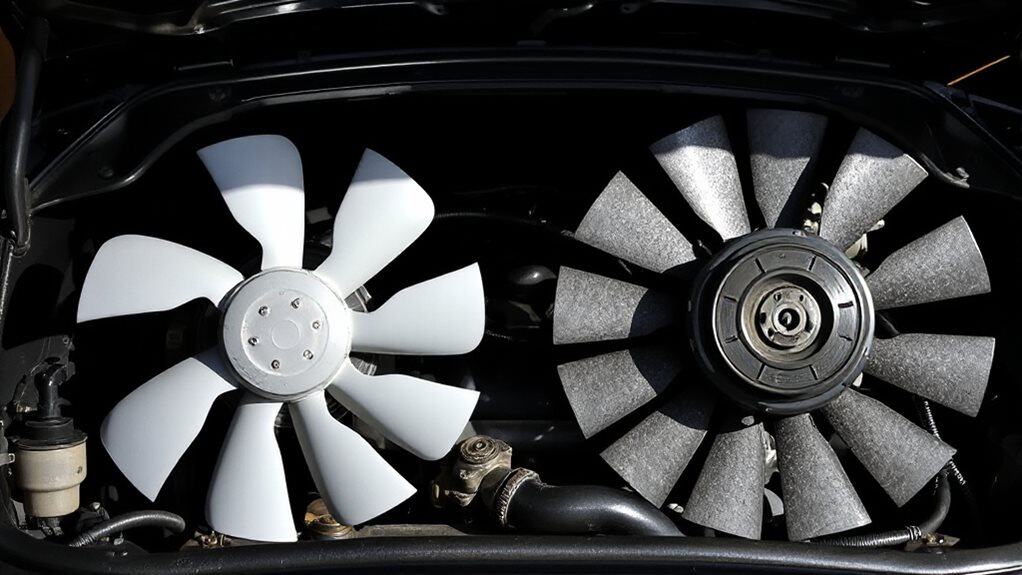
How exactly do flex fans differ from clutch fans? You’ll see that flex fans flatten their blades at high RPM, disengaging by speed rather than temperature, and they run at 100 % of water‑pump speed without a clutch coupler. In contrast, clutch fans keep fixed blades, engage based on engine heat, slip at high RPM, and require a temperature‑responsive clutch to modulate drag. Ensure the cooling system is properly bled and free of trapped air to optimal performance. Using lubricants like WD-40 on brakes can be a dangerous maintenance mistake and is unrelated to proper cooling system care.
How Much Horsepower Is Lost at Idle and Cruise for Each Fan?
When the engine idles, a clutch fan typically costs you only a couple of horsepower—about 2 HP when disengaged and up to 9 HP when engaged—while a flex fan constantly draws far more, ranging from 14 HP to 26 HP depending on material and design.
At cruising speeds the clutch fan’s loss stays under 9 HP, often around 7–8 HP, whereas the flex fan still robs roughly 14–20 HP, with a peak gain of 10 HP if you remove it entirely.
These differences in idle power consumption and cruise power impact show how fan type variability directly affects overall engine performance.
If gasoline is spilled on vehicle surfaces during maintenance, promptly blot and clean the area to avoid odors and possible paint or interior damage, as detailed in safety precautions above.
Idle Power Consumption
Ever wondered how much horsepower your engine loses just to keep the radiator cool at idle?
Flex fans hold blades at a fixed pitch, so they draw a constant power and can cost up to 10 HP more than an ideal clutch fan at low speeds.
Clutch fans slip minimally, saving roughly 10 HP at idle while still providing sufficient airflow.
Both systems consume power, but the clutch’s controlled engagement reduces the idle penalty.
Cruise Power Impact
What actually happens to your engine’s horsepower when you move from idle to cruising speed? A disengaged clutch fan steals roughly 2 HP, staying under 9 HP total loss even at peak RPM, while an engaged clutch can cost 8‑19 HP, sometimes up to 14 HP.
Flex fans, however, constantly rob power: 19 HP for a plastic 15″ fan and 26 HP for a metal version, with only a slight reduction at very high RPM.
Fan Type Variability
If you compare the three fan families at idle and cruise, the horsepower penalty becomes clear: a disengaged clutch fan typically saps about 2 HP at idle, while a flex fan continuously draws roughly 19 HP (plastic 15″) to 26 HP (metal) regardless of engine speed, and an electric fan adds only about 1 HP even at peak RPM.
The clutch’s slippage limits loss, flex fans stay active, and electric fans use minimal power, letting you gauge real‑world efficiency.
Which Fan Cools Better at Low RPM and Stop‑and‑Go Traffic?
You’ll notice that a flex fan moves far more air at idle because its blades stay rigid even at low RPM, giving you higher airflow capacity in stop‑and‑go traffic.
In contrast, a clutch fan relies on temperature‑triggered engagement, and its clutch can slip when the engine is slow, reducing the effective airflow.
Consequently, the flex fan generally provides better cooling at low speeds, while the clutch fan’s performance depends on how quickly it locks up.
Choosing the wrong exhaust component could cost you serious horsepower and money, so consider how flow characteristics affect overall engine performance.
Idle Airflow Capacity
Why does idle airflow matter when you’re stuck in stop‑and‑go traffic? At idle, a clutch fan’s fixed‑pitch blades move more cubic feet per minute (CFM) than a flex fan’s shallow pitch, so it pulls more air through the radiator. The clutch engages when temperature rises, keeping cooling consistent despite low RPM. Flex fans flatten at low speeds, limiting airflow, which can raise engine temperature in traffic.
Clutch Slip At Low RPM
Idle airflow drops dramatically when a clutch fan slips at low engine speeds, so the fan’s ability to move air at, and300‑and‑go traffic becomes a key factor in cooling performance. You’ll notice that a flex fan spins constantly, delivering steady airflow even at idle, while a clutch fan disengages, reducing airflow and risking heat buildup.
In stop‑and‑go, the flex fan keeps temperatures stable; the clutch fan’s slip can cause temperature spikes.
High‑Engine‑Speed Performance: Flex vs Clutch Fans
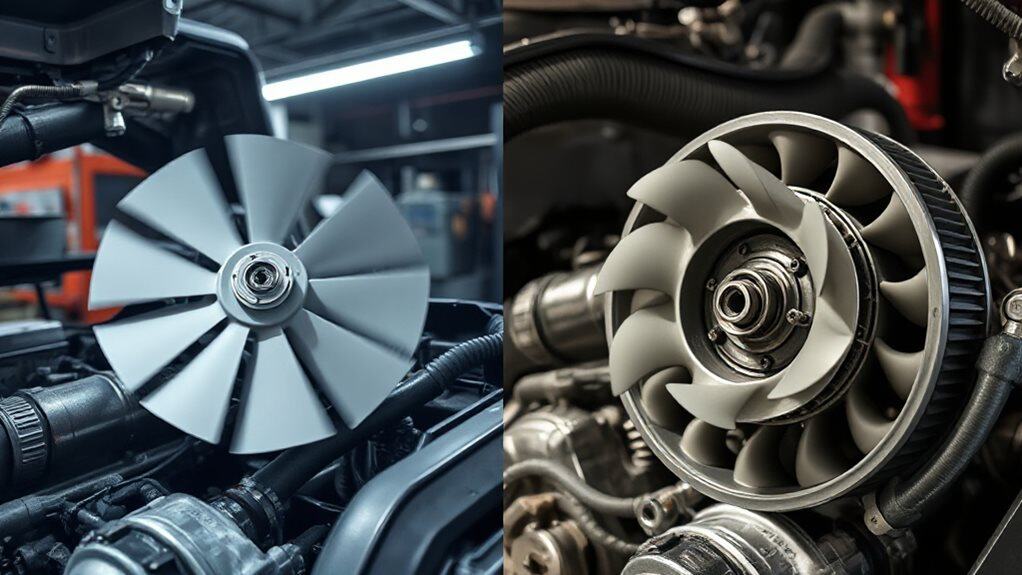
When the engine reaches high RPM, a flex fan and a clutch fan behave quite differently, and those differences directly affect cooling and power delivery.
Flex blades flatten, cutting drag and moving more air in the 6,000‑8,000 RPM range, which frees horsepower.
A clutch fan slips, lowering drag but still consuming power when engaged, and its airflow drops as RPM rises, limiting high‑speed cooling efficiency.
Removing auxiliary components like a secondary air pump can simplify the engine bay and reduce weight, potentially improving horsepower and torque.
How Do Flex and Clutch Fans Influence Fuel Economy (MPG)?
Flex and clutch fans affect fuel economy in distinct ways because they draw power from the engine differently under various driving conditions. At idle, a flex fan spins continuously, demanding torque and burning more fuel, while a clutch disengages, saving fuel.
On the highway, the clutch can fully slip, eliminating parasitic drag, whereas the flex fan still spins, reducing MPG. Consequently, clutch fans usually yield better overall fuel efficiency. Trickle chargers can help preserve battery health during long storage periods by preventing discharge and the need for premature replacement, which in turn helps maintain reliable fan operation and overall vehicle efficiency by avoiding battery failures.
Weight & Drag: How Flex and Clutch Fans Differ
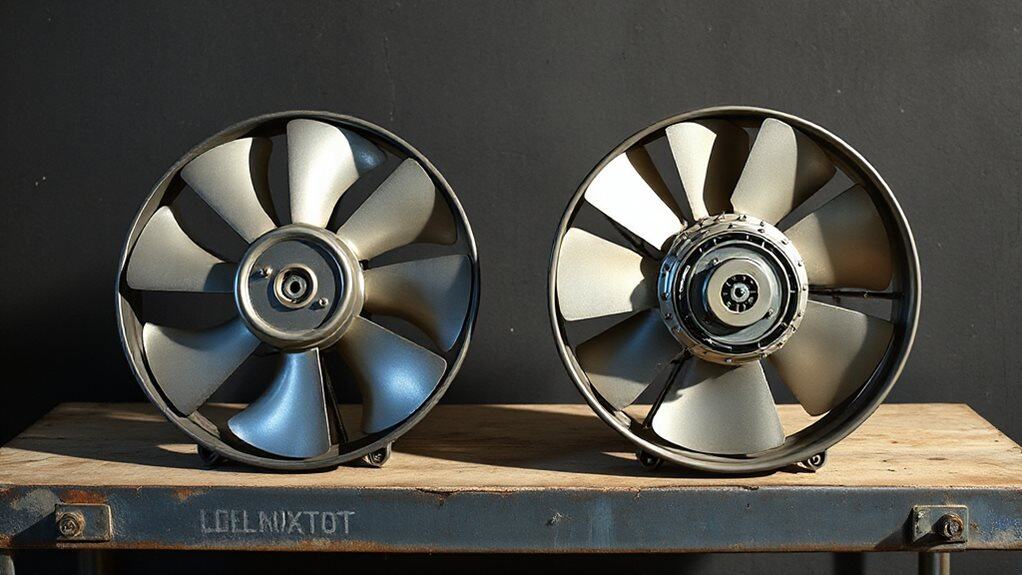
How much does the fan’s weight and drag affect your engine’s efficiency? A clutch fan adds 5‑10 lb and spins at ~30 % minimum speed, creating continuous parasitic load on the water pump shaft.
A flex fan weighs about 1 lb, imposes far less drag, and accelerates more quickly, reducing rotational inertia and improving acceleration, especially in performance or track applications.
Condensation and occasional water dripping from the exhaust are normal but unrelated to fan choice.
When and Why a Clutch Fan Engages (and Slips) at High RPM?
Because the clutch fan’s engagement is driven by temperature‑sensitive components, it begins to bite as soon as the engine’s coolant and surrounding air reach roughly 90 °C. The bi‑metallic spring deflects, opening silicone fluid ports; fluid viscosity then couples the fan to engine RPM.
As speed climbs past 2,000‑3,000 RPM, thrust pulls the blades away, limiting fan RPM and causing slip, while cooling airflow from vehicle speed reduces the need for full fan engagement.
How Do Noise and Vibration Differ Between Flex and Clutch Fans?
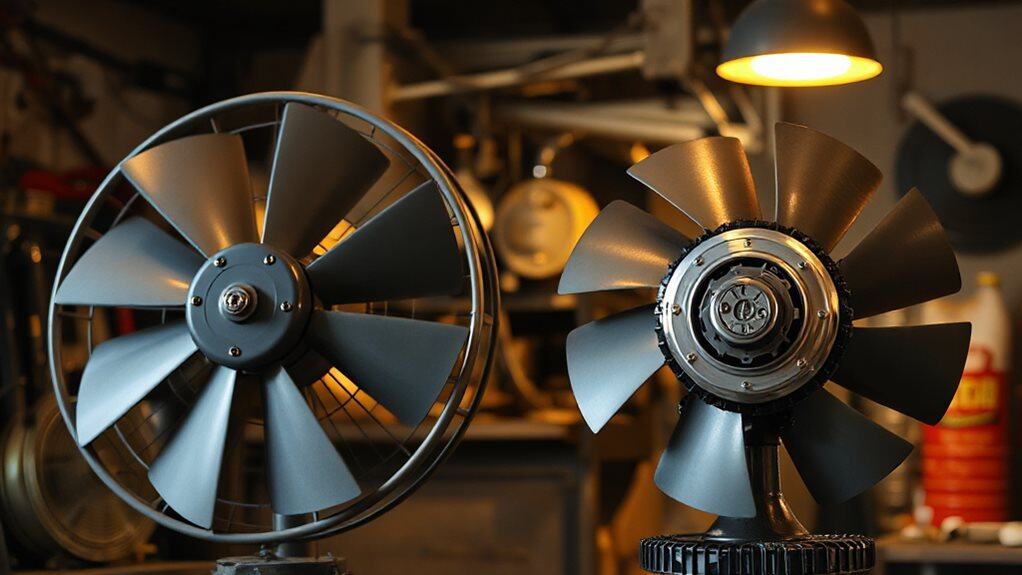
You’ll notice that flex fans tend to be louder than clutch fans, especially when the engine revs high, because their blades flex and generate a higher sound pressure level.
At the same time, the lighter, flexible design of a flex fan transmits less vibration to the engine block and cabin, whereas a clutch fan’s constant spinning and heavier components cause more vibration that can be felt through the steering wheel and seats.
Consequently, the overall cabin quietness improves with a flex fan, while a clutch fan may feel steadier but adds a persistent hum and greater vibration.
Sound Level Comparison
Usually, a flex fan will be noticeably louder than a clutch fan because it spins at full speed all the time. You’ll hear a constant roar that feels intrusive in town, while a clutch fan hums only when engaged and quiets down when disengaged.
The flex fan’s uninterrupted high‑RPM operation raises overall decibel levels, whereas the clutch fan’s intermittent action reduces noise during highway cruising.
Vibration Transmission to Engine
How does vibration travel from the fan to the engine, and why does the type of fan matter? Flex blades are directly bolted, so when they flatten at high RPM they send more torque‑induced vibration straight into the crankcase.
Clutch fans disengage and free‑wheel, isolating the engine and cutting transmission. At low RPM flex fans may cause slight hum, while clutch units stay quieter due to slip. Both need secure 19‑inch mounting for stability.
Impact on Cabin Quietness
What makes a cabin feel quieter isn’t just the engine’s roar; it’s also how the cooling fan transmits noise and vibration into the passenger space. A clutch fan emits a steady hum, so the cabin hears a constant background tone.
A flex fan’s noise spikes with engine speed, producing variable, higher‑frequency sounds and vibrations that can feel more intrusive, especially at high RPMs.
How Do Cost and Installation Complexity Compare Between Flex and Clutch Fans?
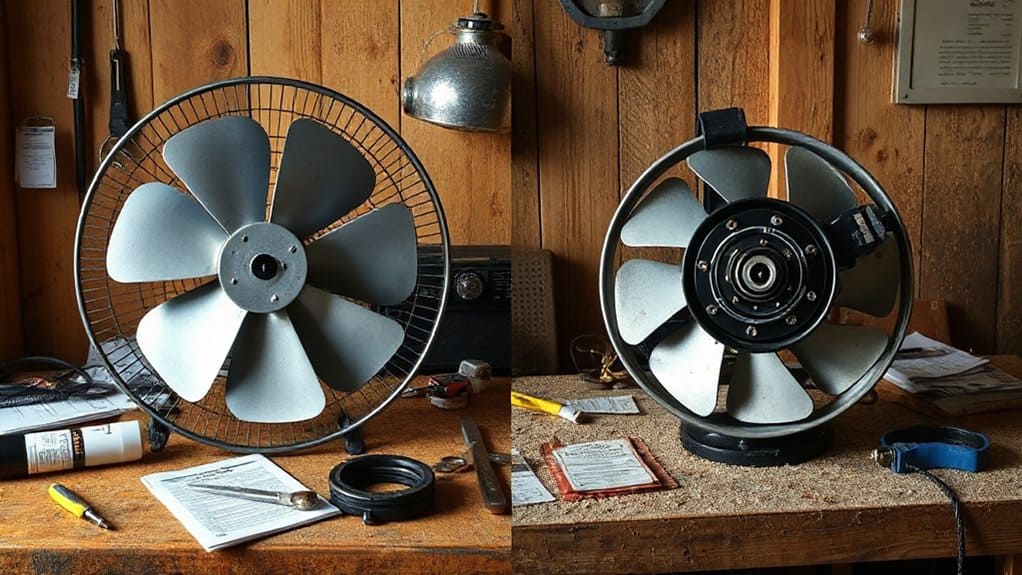
Generally, the upfront cost of a clutch fan is far lower than that of a flex fan, with clutch units starting around $20 and flex models costing roughly twice as much, plus the extra expense of a required fan spacer. Installation is straightforward for a clutch fan—bolt it to the water pump and connect the belt. Flex fans need a spacer, adding a small part cost and requiring precise alignment, but both avoid wiring changes.
Best Fan Choice for Stock Engines, Modified Builds, and Drag Racing
When you move from cost and installation considerations to actual performance, the choice among clutch and flex fans depends on how you’ll use the engine. For stock engines, a clutch fan gives you low‑rpm efficiency, minimal power loss, and quieter operation.
Modified builds benefit from a flex fan’s constant high‑rpm airflow and reduced drag.
In drag racing, flex fans provide reliable high‑rpm cooling, blade flattening, and customizable CFM, while clutch fans may slip and lose airflow.
Wrapping Up
In short, a flex fan runs continuously, giving steady cooling but sacrificing fuel economy and generating more noise at low speeds. A clutch fan disengages when cooling demand is low, improving MPG and reducing vibration, yet it can slip or stall under high‑load conditions. Choose a flex fan for high‑performance or drag applications where maximum airflow is critical, and a clutch fan for daily drivers or modified street engines that benefit from efficiency and quieter operation.


